
Join 250,000+
professionals today
Add Insights to your inbox - get the latest
professional news for free.
Join our 250K+ subscribers
Subscribe21 MAY 2026 / BUSINESS
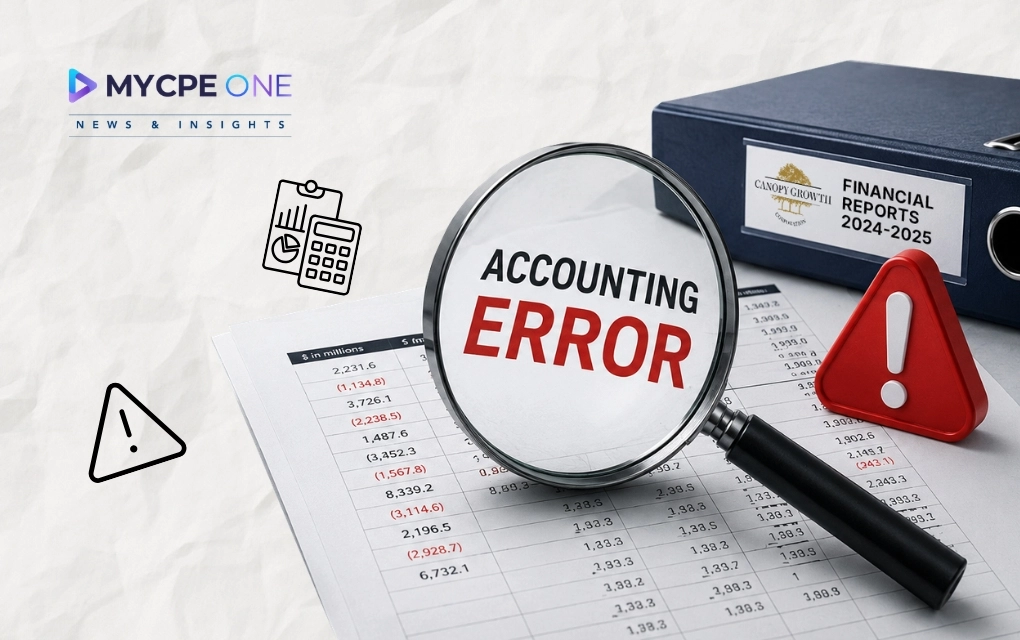
The cannabis company Canopy Growth experienced a serious dip in stock prices following the revelation of a two-year accounting error tied to foreign-currency-denominated warrants. The firm's financial results for fiscal 2024 and 2025 will need to be restated and the case underlines the significant impact of technical accounting errors on investor confidence and credibility, although the company insists the issue won't affect core operations.
When a cannabis company finds a two-year accounting mistake inside its own year-end audit process, Wall Street doesn’t exactly shrug and move on. It reacts first and asks questions later. That’s exactly what happened when Canopy Growth dropped a late-Friday disclosure saying it would restate financial results for fiscal 2024 and 2025 after uncovering a financial reporting error tied to foreign-currency-denominated warrants. By Tuesday, investors had already hit the panic button. Shares slid nearly 6%, extending a brutal stretch that has already seen the stock fall 14% year-to-date and roughly 41% over the last 12 months. And while Canopy insists the issue is “non-cash” and doesn’t affect core operations, the episode shines a bright spotlight on something finance professionals know all too well: technical accounting errors can still create very real credibility problems.
At the center of the issue is a classic accounting classification mistake involving share-settled warrants. Canopy Growth, whose functional currency is the Canadian dollar, issued warrants with exercise prices denominated in U.S. dollars during fiscal 2024. Under IFRS accounting standards, specifically IAS 32 and IFRS 9, that matters a lot more than it sounds. Because the exercise price was tied to a foreign currency, the warrants failed the “fixed-for-fixed” equity classification test. Instead of being treated as equity instruments, they should have been classified as financial liabilities and remeasured at fair value during every reporting period, with gains or losses flowing through earnings.
Instead, Canopy classified them as equity for two straight fiscal years. That means the company’s balance sheet presentation was wrong, and fair value adjustments that should have hit the income statement never showed up properly. The company says the corrections are entirely non-cash and won’t affect revenue, gross margins, EBITDA, liquidity, or cash flow. Operationally, the business remains the same. But accounting professionals know this isn’t just bookkeeping trivia. Classification errors tied to complex financial instruments are exactly the kind of issues regulators, auditors, and investors obsess over because they raise questions about internal review controls and technical accounting oversight.
Canopy announced the issue after markets closed, a timing choice that definitely raised eyebrows across the finance world. The company simultaneously disclosed that it would:
That last point matters more than many headlines acknowledged. An MCTO temporarily prevents directors and officers from trading company securities while the market operates with incomplete information. In other words, regulators want to ensure insiders don’t trade while corrected financial statements are still pending.
That’s not corporate theater. That’s governance in action. And investors clearly took the disclosure seriously. Markets may intellectually understand the phrase “non-cash adjustment,” but emotionally? A two-year restatement still feels like a flashing warning sign. On Bay Street and Wall Street alike, the phrase “restated financials” tends to spook people before they even reach page two of the filing.
The accounting guidance itself isn’t particularly obscure. IFRS rules around foreign-currency-denominated warrants have existed for years and are relatively well established. Still, these issues happen more often than many people realize, especially in industries with fast-moving capital structures like cannabis, biotech, and early-stage tech. A few factors likely contributed:
Cannabis companies spent years raising capital aggressively through warrants, convertibles, and hybrid securities during the sector’s expansion boom. The sheer volume of financing activity created layers of accounting complexity that many finance teams struggled to manage in real time. When companies issue multiple instruments across currencies, jurisdictions, and reporting periods, classification risks multiply fast.
Cross-border financing structures often look simple at issuance but become technically messy under IFRS and GAAP analysis. Teams sometimes focus heavily on valuation mechanics while underestimating how currency denomination changes classification treatment. That’s where the “fixed-for-fixed” test becomes critical.
This might be the biggest lesson of all. Once an accounting treatment gets approved in Year One, it often rolls forward automatically unless somebody actively re-challenges the conclusion. Teams assume the previous review was correct. Auditors may focus on new risks instead of reopening old determinations. Then suddenly, during a later review cycle, someone asks the uncomfortable question nobody asked earlier. And boom, here comes a restatement.
The broader cannabis industry has spent years trying to rebuild financial credibility after an era filled with impairments, restructuring charges, inflated growth projections, and aggressive expansion bets that aged like spoiled milk. Canopy’s error doesn’t involve fraud. There’s no indication of operational manipulation or missing cash. That distinction matters. But perception matters too. Institutional investors already approach cannabis reporting with skepticism because many companies in the sector have historically struggled with profitability, consistent controls, and stable reporting frameworks. A two-year accounting restatement at one of the industry’s most recognizable names becomes another reputational pothole for the sector. And the timing adds extra pressure.
On June 15, investors will effectively be reviewing:
That’s a lot for analysts to digest in one sitting. You can bet the farm analysts will be combing through every line item looking for broader control weaknesses or disclosure revisions.
Canopy’s accounting error shows that even non-cash mistakes can shake investor confidence fast. The case highlights why finance teams must carefully review complex instruments, regularly reassess prior accounting treatments, and maintain strong internal controls before small technical issues turn into public restatements.
Until next time…
Don’t forget to share this story on LinkedIn, X and Facebook
Subscribe now for $199 and get unlimited access to MYCPE ONE, from CPE credits to insights Magazine
📢MYCPE ONE Insights has a newsletter on LinkedIn as well! If you want the sharpest analysis of all accounting and finance news without the jargon, Insights is the place to be! Click Here to Join
You’ve reached the 3 free-content piece limit. Unlock unlimited access to all News & CPE resources.
Subscribe Today.
Already have an account?
Sign In