MYCPE ONE
MYCPE ONE LOGO

Join 250,000+
professionals today

Add Insights to your inbox - get the latest
professional news for free.

MYCPE ONE insights

Oregon’s Clean Audit Came With a $2.5B Accounting Error

Join our 250K+ subscribers

Join our 250K+ subscribers

Subscribe

09 JUN 2026 / BUSINESS

Oregon’s Clean Audit Came With a $2.5B Accounting Error

Oregon’s Clean Audit Came With a $2.5B Accounting Error

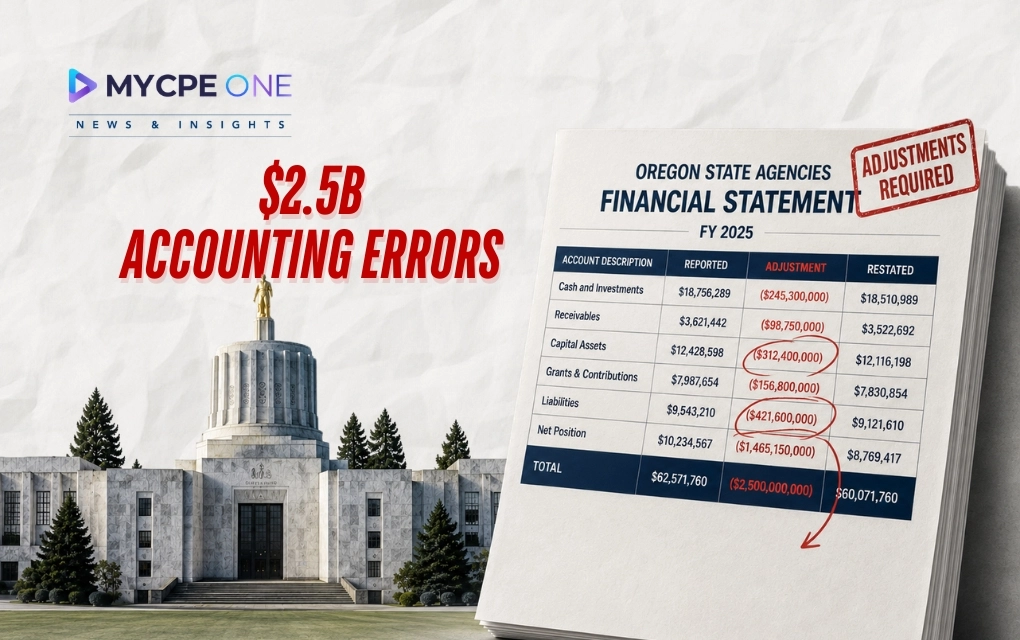
Ever reconcile an account and discover the numbers eventually balance, but only after three hours, four spreadsheets, and a strong cup of coffee? Oregon’s latest audit feels a bit like that. The state received a clean audit opinion for fiscal year 2025, meaning its financial statements were ultimately presented fairly. Yet auditors also identified roughly $2.5 billion in accounting errors, up from $1.8 billion in 2024. The good news? The money was not stolen, lost, or improperly spent. The concern is that so many accounting adjustments were needed before the books could be considered accurate. For accountants, auditors, and finance leaders, the report offers a useful reminder that clean financial statements and strong financial controls are not always the same thing.

Billions in Errors, But Not Missing Money

The headline number naturally grabs attention. Auditors proposed 138 accounting adjustments totaling approximately $2.5 billion across 11 state agencies. Before anyone imagines bags of cash disappearing into the Pacific Northwest fog, auditors stressed that these were unintentional accounting errors, not cases of misspent funds. Most adjustments involved correcting classifications, moving transactions between accounts, and fixing estimates that differed significantly from actual results. In other words, the final destination for the money was generally correct, but the accounting trail often was not.

After the corrections were made, auditors issued an unmodified opinion, commonly called a clean opinion. That means Oregon's financial statements ultimately passed audit scrutiny. Still, the volume of corrections raises an important question: Why were so many adjustments needed in the first place?

When Estimates Go Sideways

According to audit findings, ODOT overstated federal cash balances by approximately $1.1 billion. The issue stemmed from a forecasting tool that did not properly account for how federal transportation funding is reimbursed after expenses are incurred. This is a classic accounting challenge. Estimates and forecasts are necessary, especially in large organizations managing billions of dollars. Problems arise when models fail to reflect actual funding mechanics or when assumptions are not regularly tested against reality. As the old saying goes, "Trust, but verify."

Many finance professionals have seen smaller versions of this problem. A spreadsheet built years ago keeps getting reused. The funding process has changed. A reimbursement schedule shifts. Suddenly, an estimate that once worked starts producing numbers that drift farther from reality. Scale that up to a state government, and the resulting adjustment can reach the billion-dollar range.

Internal Controls Still Need Work

The audit identified 14 findings, including 12 significant deficiencies and two material weaknesses in internal financial controls. For auditors, a material weakness is not a minor paperwork issue. It signals a control problem serious enough that a material misstatement could occur and potentially go undetected. The encouraging news is that Oregon has made progress. Of the 20 financial audit findings reported during the previous three years, 14 have been corrected, while the remaining six are still being addressed.

Auditors also noted that a Medicaid provider eligibility issue dating back to 2012 was finally resolved after agencies implemented additional training, updated procedures, and improved documentation requirements. That shows audit recommendations can work when organizations commit to fixing root causes instead of simply patching symptoms.

Federal Dollars Bring Extra Scrutiny

During fiscal year 2025, Oregon spent more than $21.1 billion in federal grant funding, representing more than one-third of total state spending. Auditors reviewed major federal programs covering nearly 69% of all federal expenditures. Their review identified approximately $15.6 million in questioned federal costs. The largest issue involved the Basic Health Program, also known as Oregon Health Plan Bridge. Auditors found roughly $15 million in known and likely questioned costs tied to eligibility determination errors. Some individuals were enrolled despite earning below program thresholds, while others were enrolled despite earning above allowable limits.

Because auditors considered the compliance failures both material and widespread, they issued an adverse opinion on the program. The Oregon Health Authority told auditors it completed system updates in December 2025 designed to prevent both types of eligibility errors moving forward. For compliance professionals, this serves as a reminder that grant management is often less about accounting entries and more about operational controls. If eligibility systems fail, accounting consequences usually follow.

Takeaways for Professionals

  • First, estimates require ongoing validation. Forecasting models should be regularly compared against actual outcomes, particularly when federal funding, reimbursement structures, or economic assumptions change.
  • Second, reconciliations need to happen throughout the year. Waiting until annual audit fieldwork to identify classification errors is like discovering a roof leak during a thunderstorm.
  • Third, compliance systems should include automated controls wherever possible. The Oregon Health Authority's eligibility system updates are an example of using technology to prevent errors before they occur.
  • Fourth, data must be audit-ready. Auditors issued a disclaimer of opinion on ODOT's Highway Planning and Construction Program because expenditure information could not be provided in a format that allowed required testing.

The Bigger Takeaway

Oregon’s audit is not about missing money but about weaknesses in accounting processes and controls. While the state ultimately received a clean audit opinion, the need for $2.5 billion in adjustments and the presence of material weaknesses show there is still work to do. For finance professionals, the lesson is simple: strong controls, timely reconciliations, and reliable data help prevent problems long before auditors arrive.

Until next time…

Don’t forget to share this story on LinkedIn, X and Facebook

Subscribe now for $199 and get unlimited access to MYCPE ONE, from CPE credits to insights Magazine

📢MYCPE ONE Insights has a newsletter on LinkedIn as well! If you want the sharpest analysis of all accounting and finance news without the jargon, Insights is the place to be! Click Here to Join

Unlock Annual Access to News & CPE Subscription

You’ve reached the 3 free-content piece limit. Unlock unlimited access to all News & CPE resources.
Subscribe Today.

News & Insights

  • Exclusive News & Insights
  • Latest Regulatory Updates
  • Accounting Industry Trends
  • Expert Insights
  • AI-Driven Audio & Summaries
  • Infographics & Videos
  • CPE-Approved Articles
  • Digital Magazine
  • Benchmarking Insights

Unlimited CPE Access for 1 Year

  • 15,000+ Hours of Content
  • 500+ Subject Areas
  • Mandatory Ethics Courses
  • 250+ Compliance Packages
  • 50+ Virtual Conferences and Events Access
  • Format: Live, Audio, Video, E-Books
  • Audio Based Courses & Podcasts
  • Add External Certificates with AI
  • AI Compliance Tracking and Report
  • Instant Certification and Fast Reporting
  • Mobile App Access (iOS and Android)
  • Dedicated Support System
  • Practical Training Programs
  • AI Academy Access
  • Tax Academy Access
  • Audit Academy Access
  • Leadership Academy Access