
Join 250,000+
professionals today
Add Insights to your inbox - get the latest
professional news for free.
Join our 250K+ subscribers
Subscribe04 JUN 2026 / BUSINESS
U.S. Global Investors announced a restatement of its earnings per share (EPS) figures due to a spreadsheet error that saw share counts understated, leading to inflated EPS results. Though the miscalculation didn't affect core financial metrics, it underscored the importance of rigorous checks even on relatively routine calculations.
Accounting mistakes often hide in spreadsheets rather than appearing as obvious problems. That was the case for U.S. Global Investors, Inc. (NASDAQ: GROW), which announced a restatement of its earnings per share (EPS) figures for the three- and nine-month periods ended March 31, 2026. The company said the error did not affect net income, revenue, operating income, cash, assets under management, or any other core financial statement line item. The issue was limited to the EPS calculation, where an omitted share-count component in a supporting spreadsheet led to overstated per-share results. While the company still reported $2.7 million in net income and average assets under management of $1.6 billion, the spreadsheet error was significant enough to require a public correction.
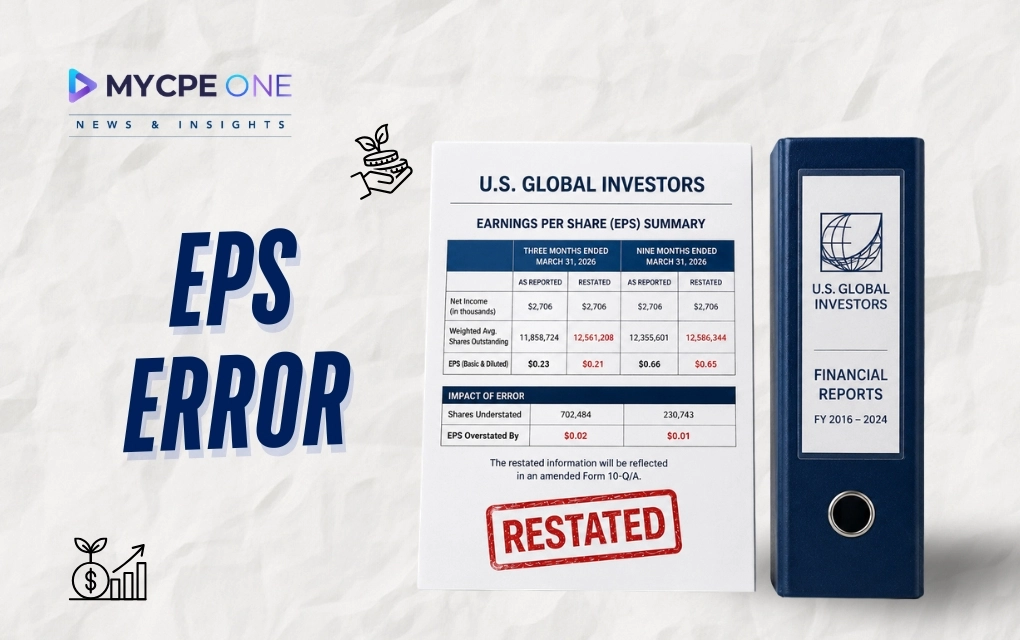
The accounting error centered on weighted average shares outstanding, the denominator used to calculate basic and diluted earnings per share. EPS is simple in theory: net income divided by weighted average shares outstanding. Yet the real-world calculation can get messy when a company’s share count changes throughout the reporting period. U.S. Global Investors identified that a component of shares had been inadvertently omitted from a supporting spreadsheet. That omission understated the company’s weighted average shares outstanding. When the denominator is too low, EPS comes out too high.
Source: Yahoo Finance
For the three months ended March 31, 2026, weighted average shares were understated by 702,484 shares. That caused basic and diluted EPS to be overstated by $0.02. The company’s previously reported EPS of $0.23 was corrected to $0.21, with restated weighted average shares outstanding of 12,561,208 basic shares and 12,585,586 diluted shares. For the nine-month period ended March 31, 2026, weighted average shares were understated by 230,743 shares, causing EPS to be overstated by $0.01. The company said the corrected figures would be reflected in an amended Form 10-Q/A. The key point is this: the earnings were not wrong. The way those earnings were allocated across shares was wrong. In accounting terms, the numerator stayed the same. The denominator needed fixing.
The issue appears tied to the company’s active share repurchase program. U.S. Global Investors has repurchased about 2.7 million shares over the past five years, reducing its share count by more than 20%. While buybacks can boost EPS by reducing shares outstanding, they also make weighted average share calculations more complex. Because the share count changes throughout the period, even a small omission can affect EPS. CEO Frank Holmes said the error was a clerical omission in a supporting schedule, not a reflection of the company’s underlying performance. The case highlights an important lesson for finance teams: when share counts change frequently, strong review controls are essential.
The key lesson is that this EPS correction stemmed from a simple spreadsheet omission, not from fraud, revenue issues, hidden liabilities, or changes to net income. For finance teams, that is a familiar risk. Many critical reporting processes still rely on spreadsheets, where a missing input, broken formula, or overlooked reference can lead to reporting errors. In this case, the mistake was significant enough that U.S. Global Investors said certain previously issued reports and investor communications related to the affected periods should no longer be relied upon. The takeaway: even small spreadsheet errors can have outsized disclosure consequences.
Before the EPS correction, U.S. Global Investors had reported a strong third quarter for fiscal 2026. Total operating revenues were $2.8 million, up 10% from the previous quarter and 31% from the same quarter in 2025. Net income was $2.7 million, compared with a net loss in the prior-year quarter. Operating income improved to $88,000 from an operating loss of $893,000 in the same period a year earlier. The company’s average assets under management reached $1.6 billion, supported by strength in gold and natural resources strategies. Its Gold and Precious Metals Fund, World Precious Minerals Fund, and U.S. Global GO GOLD and Precious Metal Miners ETF all saw stronger average assets from the prior quarter.
Source: Business Insider
The company also highlighted momentum in its U.S. Global Technology and Aerospace & Defense ETF, known as WAR. The fund’s AUM nearly doubled from the end of the December quarter to the end of the March quarter, reaching approximately $20 million. Management connected that growth to rising interest in AI-enabled defense, autonomous systems, cybersecurity, and global defense modernization. The company cited world military spending of $2.9 trillion in 2025 as part of the broader structural trend. The broader message: the business performance story remained positive, but the EPS presentation needed correction.
EPS Risk: Treat EPS schedules as high-risk reporting areas when share counts change frequently.
Share Activity: Carefully review buybacks, equity grants, conversions, treasury stock movements, and diluted-share calculations.
Spreadsheet Controls: Use locked formulas, version control, input validation, change logs, and protected worksheets.
Review Process: Require independent review of share-count inputs, formulas, and calculation logic.
Reconciliation: Match weighted average shares to repurchase records, equity rollforwards, transfer agent data, and prior filings.
Automation: Implement automated controls and system-generated reports for recurring share-count calculations.
Governance: Avoid relying on unmanaged spreadsheets for SEC-reporting schedules.
The U.S. Global Investors EPS restatement is not a story about falling profits. It is a story about precision. A two-cent EPS overstatement may look small, but it still required public disclosure, amended reporting, and a warning that prior communications should no longer be relied upon for the affected figures. That is a big reminder for financial professionals: material reporting risk does not always begin with billion-dollar estimates or complex acquisitions. Sometimes, it begins with one omitted component in a spreadsheet. For accountants, auditors, CFOs, and controllers, the message is clear. Review the supporting schedules. Test the formulas. Reconcile the share counts. Challenge the assumptions. Do not let routine calculations become invisible. Because in financial reporting, the quietest cell in the workbook can still make the loudest noise.
Until next time…
Don’t forget to share this story on LinkedIn, X and Facebook
Subscribe now for $199 and get unlimited access to MYCPE ONE, from CPE credits to insights Magazine
📢MYCPE ONE Insights has a newsletter on LinkedIn as well! If you want the sharpest analysis of all accounting and finance news without the jargon, Insights is the place to be! Click Here to Join
You’ve reached the 3 free-content piece limit. Unlock unlimited access to all News & CPE resources.
Subscribe Today.
Already have an account?
Sign In