MYCPE ONE
MYCPE ONE LOGO

Join 250,000+
professionals today

Add Insights to your inbox - get the latest
professional news for free.

MYCPE ONE insights

What Is “Office Air”? And Why You Look Different by Midday

Join our 250K+ subscribers

Join our 250K+ subscribers

Subscribe

20 APR 2026 / BUSINESS

What Is “Office Air”? And Why You Look Different by Midday

What Is “Office Air”? And Why You Look Different by Midday

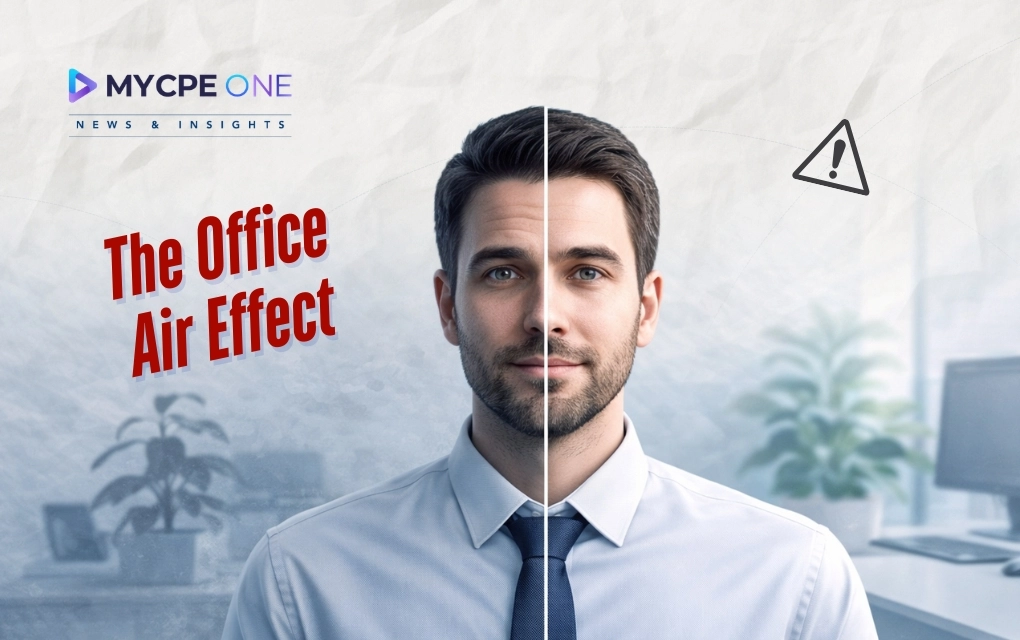
There is a particular kind of disappointment that lives in office bathrooms. Not tragedy, not vanity exactly, just that mildly insulting moment when fluorescent light tells a story you did not authorize. You leave home in the morning looking reasonably intact, maybe even a little sharp, and then by early afternoon the mirror offers a harsher cut of the film. Hair flatter. Skin duller. Eyes like they sat through three committee meetings and a hostage negotiation.

It reminds me, weirdly, of those scenes in old workplace movies where the set itself seems to have a mood. Think The Apartment, or even the quieter office shots in Mad Men, where a room can make a person look both polished and worn out at the same time. Joan Didion once wrote, “I tell myself stories in order to live.” Offices do something similar, except sometimes the story they tell on your face by 1 p.m. is not the one you had in mind. That, I think, is why this “office air” idea landed. Not because it is a formal scientific doctrine. It is not. It landed because it named a tiny daily estrangement that a lot of people already recognized in their bones.

Is “office air” really about air, or something else?

The viral version of the theory is simple enough: people show up to work looking normal, then a few hours later they look oddly depleted. On TikTok, creator Noa Donlan became one of the most visible faces of the phenomenon, describing a progression from clean hair and clear skin in the morning to oilier hair, darker under-eyes, and a puffier face by midday. The phrase spread because it captured something plenty of office workers had noticed but never quite labeled. The question, though, is more interesting than the meme. Is office air actually doing something to people, or is this just the modern office giving visible form to stress, stale routines, bad lighting, dehydration, and the ordinary drag of the workday? That is the version worth sitting with.

Because once you strip away the social media gloss, the topic is not really beauty. It is perception. It is the strange way built environments can shape how people feel in their own skin. And for professionals in accounting, tax, and finance, who spend long stretches in climate-controlled rooms under artificial light staring at screens, that starts to sound less like internet fluff and more like an oddly revealing workplace question.

What if the real issue is friction, not vanity?

The lens that seems most useful here is friction. Not in the grand strategic sense. Just basic human friction: the tiny, repeated resistance a system imposes on a person until the cost becomes visible. Charlie Munger liked the idea that incentives and structure often explain behavior better than intention. I think the same logic works for environments. People do not wake up at 7 a.m. and choose to look tired by lunch. Systems get there for them. Dry air, recirculated ventilation, overhead lighting, long screen exposure, too little movement, too little daylight, too much coffee, not enough water, a low-level stress hum in the background. None of these on their own sounds dramatic. Together, they create drag.

That is what makes the “office air” conversation interesting. It is not really about proving one villain. It is about noticing that small inputs compound. A room can sand down your edges without your permission. A workday can leave residue. And because the effects are subtle, people often dismiss them until they see them all at once in a bathroom mirror and think, what the heck happened? Friction is sneaky like that. It rarely arrives dressed as catastrophe. More often it shows up as a face that looks just a little less like your own by midafternoon.

Why does office air theory keep sticking around?

The available facts do not fully validate the internet’s dramatic phrasing, but they do give it some bones. Several of the articles you shared circle the same core explanation: “office air theory” is not a recognized medical concept, yet indoor environments can affect skin, hair, eyes, and general appearance through dryness, irritation, fatigue, and the cumulative wear of the day. That part is plausible. Air conditioning and heating systems lower indoor humidity, and experts quoted across these reports point to moisture loss as a major culprit. Dermatologists and beauty specialists describe dry indoor air as a contributor to tight or flaky skin, frizz, dullness, and makeup that starts looking patchy or separated. One explanation cited transepidermal water loss, which is a clinical way of saying the skin barrier can lose moisture more quickly in drying conditions. If that sounds fancy, the lived version is simpler: your face starts acting like it has been left near an airport vent.

Ventilation matters too. Poorly maintained offices can accumulate dust, allergens, particulate matter, carbon dioxide, and volatile organic compounds from furniture or flooring. One article drew a loose connection to sick building syndrome, a term that has been around for years and refers to symptoms like headaches, fatigue, dry eyes, irritation, and trouble concentrating that seem linked to time spent in certain buildings. That does not mean every office is toxic. It does mean the built environment is not neutral. Then there is timing. Skin gets oilier as the day goes on. Stress can deepen puffiness or make under-eye shadows look worse. Screen time strains the eyes. Fluorescent lighting can make almost anybody look a little cooked. By itself, none of this proves a grand theory. Together, it explains why a 9 a.m. face and a 2 p.m. face may feel like distant cousins.

And there is a workplace context here that feels impossible to ignore. As return-to-office expectations rise, with one KPMG study cited in your materials saying 83 percent of CEOs expected a full return within three years, people are spending more time inside these environments again. So the theory sticks because the exposure is real, even if the branding is pure TikTok.

Could the bigger problem be the office itself?

What makes this topic linger is that it brushes up against a more awkward possibility. Maybe people are not just reacting to dry air. Maybe they are reacting to a whole system that asks for alertness, neatness, patience, and professional cheerfulness while quietly draining the conditions that support those things. That is where the friction lens comes back. When a building is too cold, too dry, too dim, too sealed off, or too dependent on recirculated air, the costs do not always appear first in productivity dashboards. They show up in softer places. Energy. Mood. Confidence. The sense of being “off” for reasons you cannot quite name.

And once a workplace starts producing those low-level distortions, what happens next? Do employees adapt, or just normalize feeling a little worse than they should? Do organizations treat comfort and maintenance as cosmetic extras until the hidden costs pile up? At what point does a room stop being a container for work and start becoming an active participant in it? I do not think “office air” is a perfect phrase. It is a little dramatic, a little online, a little extra. But I also think it may be pointing, in its messy way, at something real: the body notices what institutions overlook.

Maybe that is why the idea caught on. Not because everyone believes the office is making them ugly, full stop. That is internet talk. But because many people suspect, with some justification, that the places where we spend our days are doing more to us than we admit. And maybe the oddest part is how quickly we learn to treat that as normal. Like the lighting, like the hum of the vent, like the late-afternoon face in the mirror that looks faintly betrayed but still swipes on lip balm and heads back to the desk. Virginia Woolf wrote, “The eyes of others our prisons; their thoughts our cages.” Some days it feels like the office adds its own bars, more subtle than that, less poetic, and a lot more beige.

Until next time…

Don’t forget to share this story on LinkedIn, X and Facebook

Subscribe now for $199 and get unlimited access to MYCPE ONE, from CPE credits to insights Magazine

📢MYCPE ONE Insights has a newsletter on LinkedIn as well! If you want the sharpest analysis of all accounting and finance news without the jargon, Insights is the place to be! Click Here to Join

Unlock Annual Access to News & CPE Subscription

You’ve reached the 3 free-content piece limit. Unlock unlimited access to all News & CPE resources.
Subscribe Today.

News & Updates

  • Exclusive News & Insights
  • Latest Regulatory Updates
  • Accounting Industry Trends
  • Expert Insights
  • AI-Driven Audio & Summaries
  • Infographics & Videos
  • CPE-Approved Articles
  • Digital Magazine
  • Benchmarking Blogs

Unlimited CPE Access for 1 Year

  • 15,000+ Hours of Content
  • 500+ Subject Areas
  • Mandatory Ethics Courses
  • 250+ Compliance Packages
  • 50+ Virtual Conferences and Events Access
  • Format: Live, Audio, Video, E-Books
  • Audio Based Courses & Podcasts
  • Add External Certificates with AI
  • AI Compliance Tracking and Report
  • Instant Certification and Fast Reporting
  • Mobile App Access (iOS and Android)
  • Dedicated Support System
  • Practical Training Programs
  • AI Academy Access
  • Tax Academy Access
  • Audit Academy Access
  • Leadership Academy Access