Join 250,000+
professionals today
Add Insights to your inbox - get the latest
professional news for free.
Join our 250K+ subscribers
Subscribe07 MAY 2026 / BUSINESS
The town of Sodus, New York, has been found with extensive financial reporting failures by a New York State Comptroller audit, including missing annual filings and errors in payroll calculations over several years. The report serves as a reminder to accounting and finance professionals about the potential ramifications of routine control failures, including diminished transparency, non-compliance issues, and operational gaps.
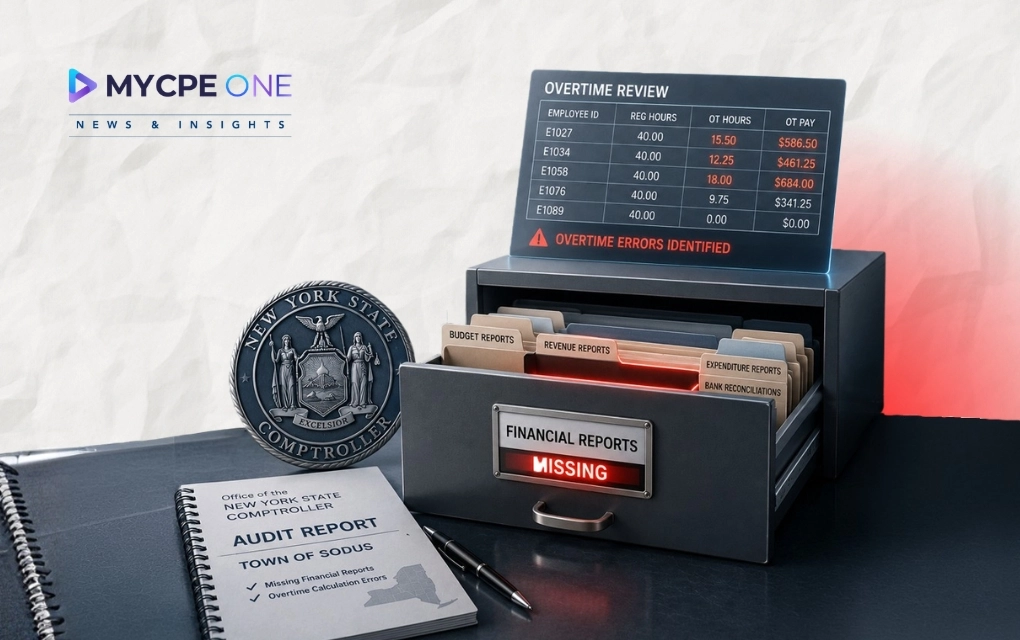
When a small-town government misses one financial filing, it rarely makes headlines. Miss four years in a row, and suddenly, the state comes knocking. That is exactly what happened in the Town of Sodus, New York, where a recent New York State Comptroller audit uncovered a year of financial reporting failures. Missing annual filings, incomplete reconciliations, lost accounting records, and payroll calculation errors exposed deep weaknesses in the town's financial oversight process. For accounting and finance professionals, the audit is a practical reminder of how routine control failures can quietly grow into larger transparency and compliance problems.
The audit reviewed town financial activity from 2020 through November 2025 and identified several years of missed reporting responsibilities. The town failed to file Annual Financial Reports (AFRs) from 2021 through 2024. Auditors also found that the 2020 AFR was submitted more than four years late. The delayed and missing reports created a major visibility gap into the town’s actual financial condition.
Annual Financial Reports are one of the primary tools municipalities use to communicate financial activity to taxpayers, oversight agencies, lenders, and board members. Without them, officials lose access to reliable information needed for budgeting, cash monitoring, and financial planning. The audit also found that the Town Board did not perform the required annual audit of the supervisor’s financial records for 2024. That missing oversight layer increased the risk that reporting errors and incomplete records would remain unresolved for longer periods.
The audit identified several weaknesses involving financial monitoring and accounting procedures. According to auditors, the town supervisor did not consistently provide:
Without reconciliations and timely reporting, management could not reliably monitor available fund balances or financial activity. Reconciliations serve as one of the most important internal accounting controls because they verify whether recorded balances match actual financial activity. When those reviews are delayed or skipped, errors become harder to identify and correct.
The audit also noted that a 2024 server failure contributed to the loss of accounting data and incomplete records. Still, the Comptroller’s Office emphasized that technical issues do not eliminate management’s responsibility to maintain reliable backup systems and accurate accounting records.
That point carries broader relevance for finance teams everywhere. Cybersecurity incidents, server outages, and system failures continue increasing across organizations of all sizes. Strong disaster recovery planning, backup validation, and cloud-based redundancy are now essential parts of financial governance, not simply IT concerns.
The audit also uncovered payroll issues involving overtime calculations for seven highway department employees. Auditors found the employees were overpaid a combined $1,781 because overtime was not calculated correctly. Small payroll errors often point to larger weaknesses inside approval, review, or payroll processing procedures. While the dollar amount itself was relatively modest, payroll findings remain important because compensation systems involve multiple control points, including:
When payroll controls weaken, even small calculation errors can become recurring operational issues over time. Public-sector payroll problems also attract additional scrutiny because compensation spending directly affects taxpayer-funded operations.
The Town of Sodus agreed with the audit findings and stated that corrective actions have already begun. The Comptroller’s Office issued 11 recommendations focused on improving oversight, restoring accurate reporting, and strengthening payroll and accounting controls.
For accounting professionals, the audit reinforces several important operational lessons.
Financial reporting failures rarely begin with one major event. In most cases, they develop gradually through delayed reconciliations, incomplete records, weak oversight, or inconsistent review procedures. The Sodus audit shows how quickly operational gaps can compound when routine accounting controls stop functioning consistently. For municipalities, CPA firms, and finance departments alike, the lesson remains the same: strong financial governance depends on disciplined execution of basic accounting controls every single month, not only when an audit arrives.
Until next time…
Don’t forget to share this story on LinkedIn, X and Facebook
Subscribe now for $199 and get unlimited access to MYCPE ONE, from CPE credits to insights Magazine
📢MYCPE ONE Insights has a newsletter on LinkedIn as well! If you want the sharpest analysis of all accounting and finance news without the jargon, Insights is the place to be! Click Here to Join
You’ve reached the 3 free-content piece limit. Unlock unlimited access to all News & CPE resources.
Subscribe Today.
Already have an account?
Sign In