Join 250,000+
professionals today
Add Insights to your inbox - get the latest
professional news for free.
Join our 250K+ subscribers
Subscribe08 MAY 2026 / BUSINESS
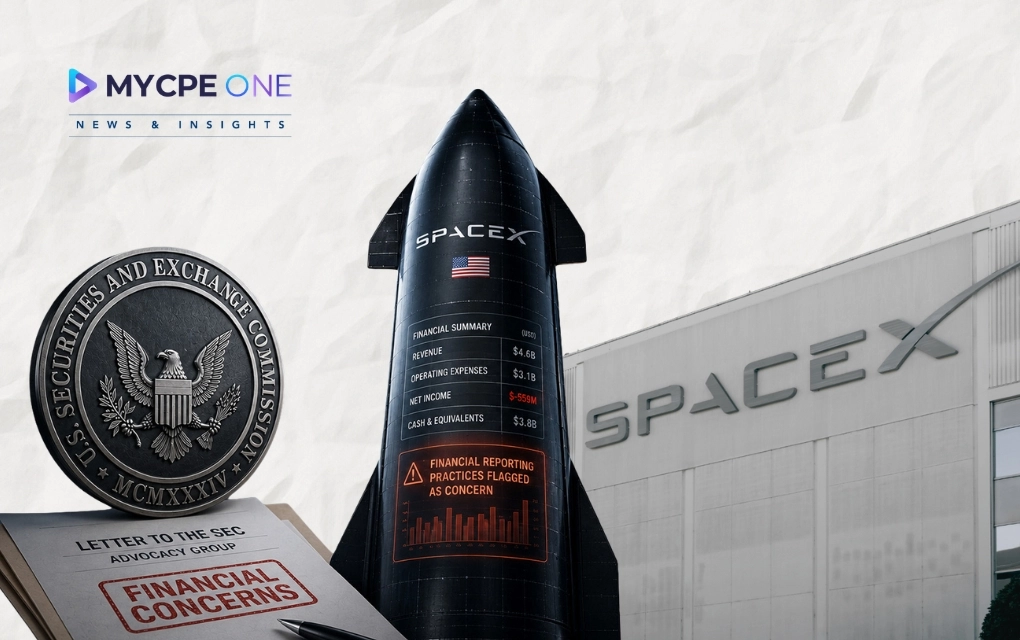
Investor groups and regulators are scrutinizing the potential $1.75-2 trillion valuation of SpaceX as the company prepares for a possible IPO. SOC Investment Group has called on the SEC to review the company’s accounting practices, auditor independence, and transactions with firms controlled by Elon Musk, such as Tesla and xAI, before public investors and pension funds gain exposure, as well as warnings of potential losses if the valuation decreases post-IPO.
A few years ago, Wall Street bankers joked that Elon Musk could probably raise billions with a Mars slide deck and pure hype. Now, as SpaceX prepares for what could become the biggest IPO in U.S. history, investor groups and regulators are asking a much tougher question: do the company’s financial disclosures actually support its reported $1.75 trillion to $2 trillion valuation? SOC Investment Group has urged the SEC to closely examine SpaceX’s accounting practices, auditor independence, and transactions involving other Musk-controlled companies before public investors and pension funds gain exposure. For CPAs, auditors, and finance leaders, this is becoming far more than another Musk headline. It is a litmus test of how public markets handle transparency, governance, and valuation risk at trillion-dollar scale.
SOC’s central argument is straightforward: before ordinary investors and pension funds gain exposure to SpaceX, regulators should make sure the company’s numbers can stand up to independent review. In its May 6 letter to the SEC, SOC asked regulators to review SpaceX’s financial disclosures for accuracy and reliability, confirm the independence of the company’s auditor, and examine transactions involving other Musk-controlled companies, including Tesla and xAI. SOC warned that investors could face losses if SpaceX’s valuation declines after public disclosures receive full market scrutiny.
That concern matters because SpaceX has operated as a private company for years. Private firms can raise large amounts of capital without the same level of public reporting that SEC-registered companies must provide. Once a company enters public markets, investors expect audited financial statements, detailed risk factors, related-party disclosures, revenue recognition clarity, and management discussion that explains how the business actually makes money. SOC sees a gap between SpaceX’s reported valuation and the limited public visibility into its financials. That does not prove accounting problems. It does mean regulators may need to ask sharper questions before the IPO gets cleared.
The biggest accounting issue centers on related-party transactions. SpaceX’s business connections with other Musk-linked companies have attracted attention because those relationships may affect revenue, assets, expenses, and valuation assumptions. Reports say Tesla has sold Cybertrucks to SpaceX and xAI and Megapack battery systems to xAI. SpaceX has also drawn attention because of its reported ties to xAI and the broader Musk company network.
Related-party transactions are not automatically improper. Large companies often transact with affiliates, subsidiaries, founders, executives, or entities under common influence. The accounting question is whether those transactions reflect fair pricing, proper approval, complete disclosure, and clean economic substance. For public companies, ASC 850 requires disclosure of material related-party relationships and transactions. The SEC often pays close attention to these areas because related-party deals can distort financial results if companies fail to explain them clearly.
SOC’s concern is that SpaceX’s reported growth story could look different once investors see how much activity involves affiliated Musk entities. If intercompany sales, shared personnel, joint projects, or asset transfers play a meaningful role in the numbers, the registration statement must explain those relationships without leaving investors guessing. That is where the accounting rubber meets the road.
SOC has used this playbook before. In 2022, JPMorgan Chase agreed to a third-party audit of its $30 billion racial equity commitment after pressure from SOC and other accountability advocates. The bank said it would hire an independent third party and publish a report on the results. This matters because SOC’s approach is consistent. It pushes large institutions to back major claims with independent verification. In JPMorgan’s case, the issue involved whether the bank’s public commitment matched measurable action. With SpaceX, the issue involves whether a potentially record-breaking IPO valuation matches financial disclosures that investors can verify. The comparison is not perfect. JPMorgan was already public, while SpaceX is preparing for a possible IPO. But the professional lesson is similar: when large numbers meet limited transparency, outside groups often demand independent review.
The SEC has several tools available if regulators decide SpaceX’s IPO disclosures require deeper scrutiny before public investors and pension funds gain exposure.
In simple terms, regulators can slow the IPO, demand stronger disclosures, or escalate toward enforcement if concerns deepen.
The real test now is SpaceX’s public registration statement. That filing will show how the company explains its revenue streams, related-party transactions, governance structure, liquidity position, and audit oversight before entering public markets. For accounting professionals, the disclosures may matter far more than the trillion-dollar valuation headlines.
If regulators eventually determine that SpaceX’s disclosures, valuation assumptions, or related-party accounting practices were materially flawed, the fallout could extend far beyond one IPO and reshape how mega-cap private companies approach public-market transparency.
In many ways, the SpaceX IPO is becoming more than a market event, it is turning into a stress test for modern financial disclosure standards. Investors may still believe in the company’s long-term vision, but trillion-dollar valuations eventually demand trillion-dollar levels of transparency. For regulators, auditors, and finance professionals, the real issue is not whether SpaceX can build rockets. It is whether public investors will receive a clear, independently verified picture of how the business operates before retirement funds, index investors, and institutional capital flow into the stock at historic scale.
Until next time…
Don’t forget to share this story on LinkedIn, X and Facebook
Subscribe now for $199 and get unlimited access to MYCPE ONE, from CPE credits to insights Magazine
📢MYCPE ONE Insights has a newsletter on LinkedIn as well! If you want the sharpest analysis of all accounting and finance news without the jargon, Insights is the place to be! Click Here to Join
You’ve reached the 3 free-content piece limit. Unlock unlimited access to all News & CPE resources.
Subscribe Today.
Already have an account?
Sign In