MYCPE ONE
MYCPE ONE LOGO

Join 250,000+
professionals today

Add Insights to your inbox - get the latest
professional news for free.

MYCPE ONE insights

Can Sustainability Survive the Finance Test?

Join our 250K+ subscribers

Join our 250K+ subscribers

Subscribe

23 JUN 2026 / FINANCE

Can Sustainability Survive the Finance Test?

Can Sustainability Survive the Finance Test?

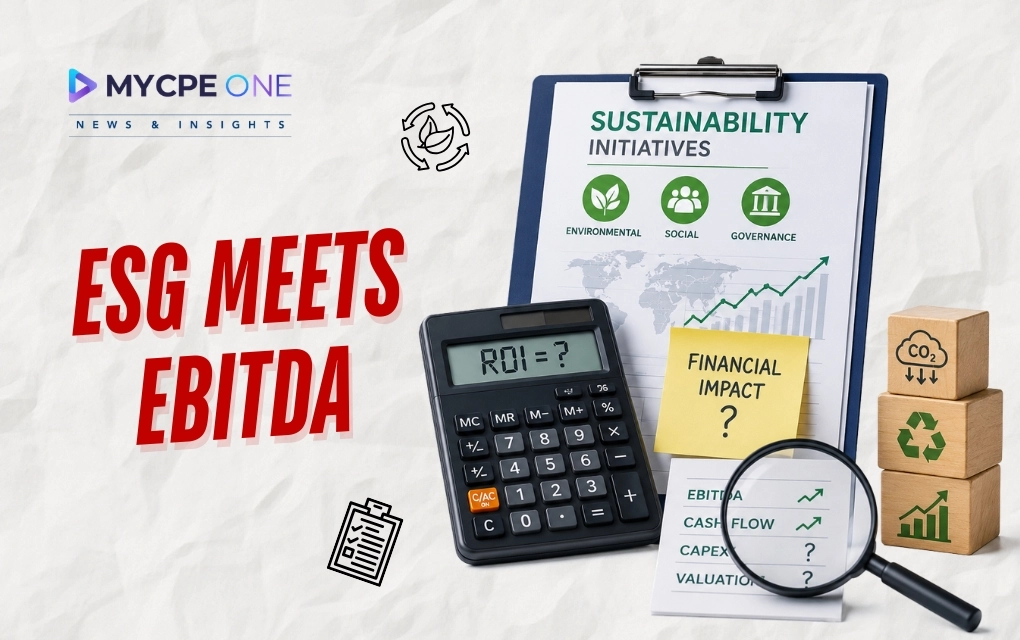
Sustainability has made it into the boardroom. The harder question is whether it has made it into the model. KPMG’s new global study, Closing the Sustainability Valuation Gap, points to a disconnect that finance teams should not ignore. 72% of executives say they understand their organization’s sustainability strategy, metrics, and performance. Only 19% use robust quantification approaches to measure how sustainability affects financial outcomes, operational gains, and innovation. That is a big spread, and not the good kind. KPMG surveyed more than 2,000 executives across 19 countries and territories. The headline is simple: companies understand sustainability better than they can price it.

Can anyone tie this to EBITDA?

That is the question CFOs, controllers, boards, lenders, and investors keep circling back to. A company may have climate targets, supplier goals, energy projects, and public ESG commitments. Fine. But can management connect those efforts to EBITDA, cash flow, CapEx, margins, asset values, insurance costs, cost of capital, or enterprise value? For many companies, the answer is still “not really.” KPMG’s findings show that 60% of organizations consider sustainability risks and opportunities in financial planning. Yet far fewer can translate those risks and opportunities into financial metrics that actually drive capital allocation. That creates a practical problem. If finance cannot quantify the upside or downside, sustainability spending becomes harder to defend when budgets get tight. In other words, the slide deck may look buttoned up, but the spreadsheet still needs work.

Is this still just a compliance exercise?

In the U.S., the timing is interesting. On May 29, 2026, the SEC proposed rescinding the 2024 climate related disclosure rules, saying the rules imposed high costs and moved beyond the agency’s legal authority. Some companies may treat that as a reason to ease off. That would miss the bigger finance issue. Regulation may shift, but risk does not disappear because a rule changes direction. Banks still ask about exposure. Investors still care about resilience. Insurers still price risk. Customers still push supply chain requirements. Private equity buyers still pressure test assumptions during diligence. So, the real question is not only, “What must we disclose?” It is, “What does this do to the business?” That distinction matters. Disclosure tells stakeholders what happened or what management plans to do. Valuation shows whether the decision makes financial sense.

Who is ahead on the math?

KPMG found that some sectors use advanced valuation methods more often than others. Banking and capital markets lead at 33%, followed by energy and natural resources at 31%, and automotive at 27%. That makes sense. These sectors feel sustainability-related risks closer to the cash register. Banks need to assess credit risk. Energy companies deal with transition risk, regulation, and capital heavy assets. Automotive companies face supply chain pressure, technology shifts, and changing consumer demand. The common thread is financial materiality. When sustainability risk hits financing, asset values, operating costs, or customer demand, companies have less room for fuzzy thinking.

A practical example: a food and beverage company may view packaging changes, water reduction, energy upgrades, and waste controls as sustainability projects. Finance may initially see only costs. But if the team models lower input costs, reduced waste, better customer retention, and lower operational risk, the business case can look very different. KPMG’s material notes a U.K. food and beverage portfolio company case where structured valuation work identified sustainability initiatives that could lift EBITDA by as much as 35%. That kind of number gets attention in any budget meeting.

What should CPAs watch?

For CPAs and finance teams, the next phase is measurement quality.

Auditors should consider whether sustainability-related risks affect estimates, impairments, useful lives, contingencies, inventory assumptions, or going concern analysis. Controllers should care about data ownership and internal controls. Tax teams should watch credits, incentives, transfer pricing, and capital investment decisions. CFOs should care because weak measurement leads to weak capital allocation. CPA firms also have a real advisory opportunity here, especially with private and mid-market clients. Many companies do not need a massive ESG department. They need help turning operational facts into financial assumptions. That can mean asking basic but valuable questions:

What costs changed because of energy, water, materials, insurance, or logistics? Which customers now require sustainability data? Which facilities carry higher physical or transition risk? Which projects could reduce waste, downtime, or compliance exposure? Which assumptions would a lender, investor, buyer, or auditor challenge? That is not politics. That is finance doing its job. Warren Buffett’s line fits neatly here: “Price is what you pay. Value is what you get.” Sustainability programs often show the price clearly. New systems, reporting work, consultants, controls, and capital projects all show up fast. The harder task is proving the value with enough discipline to support decisions.

The takeaway

KPMG’s report does not prove that sustainability always creates value. It proves that many companies still cannot measure the value well enough. That is the real issue for finance professionals. Sustainability has moved beyond awareness, but it has not fully entered the machinery of forecasting, valuation, budgeting, controls, and audit evidence. For U.S. companies, the SEC’s softer climate disclosure direction may reduce one form of pressure. It does not remove the business need to price risk and defend investment decisions. The next question for boards is not, “Do we have a sustainability strategy?” It is sharper and more useful: “Can finance support the numbers behind it?” Right now, for too many companies, that answer still needs a lot more work.

Until next time…

Don’t forget to share this story on LinkedIn, X and Facebook

Subscribe now for $199 and get unlimited access to MYCPE ONE, from CPE credits to insights Magazine

📢MYCPE ONE Insights has a newsletter on LinkedIn as well! If you want the sharpest analysis of all accounting and finance news without the jargon, Insights is the place to be! Click Here to Join

Unlock Annual Access to News & CPE Subscription

You’ve reached the 3 free-content piece limit. Unlock unlimited access to all News & CPE resources.
Subscribe Today.

News & Insights

  • Exclusive News & Insights
  • Latest Regulatory Updates
  • Accounting Industry Trends
  • Expert Insights
  • AI-Driven Audio & Summaries
  • Infographics & Videos
  • CPE-Approved Articles
  • Digital Magazine
  • Benchmarking Insights

Unlimited CPE Access for 1 Year

  • 15,000+ Hours of Content
  • 500+ Subject Areas
  • Mandatory Ethics Courses
  • 250+ Compliance Packages
  • 50+ Virtual Conferences and Events Access
  • Format: Live, Audio, Video, E-Books
  • Audio Based Courses & Podcasts
  • Add External Certificates with AI
  • AI Compliance Tracking and Report
  • Instant Certification and Fast Reporting
  • Mobile App Access (iOS and Android)
  • Dedicated Support System
  • Practical Training Programs
  • AI Academy Access
  • Tax Academy Access
  • Audit Academy Access
  • Leadership Academy Access