MYCPE ONE
MYCPE ONE LOGO

Join 250,000+
professionals today

Add Insights to your inbox - get the latest
professional news for free.

MYCPE ONE insights

How JPMorgan Plans to Rebuild America with a $1.5 Trillion Investment

Join our 250K+ subscribers

Join our 250K+ subscribers

Subscribe

15 OCT 2025 / FINANCE

CPE Approved

How JPMorgan Plans to Rebuild America with a $1.5 Trillion Investment

How JPMorgan Plans to Rebuild America with a $1.5 Trillion Investment

When Wall Street starts talking about patriotism, you know something big’s cooking.

Goldman Sachs just snapped up Industry Ventures, a $7 billion venture capital firm, for $665 million in cash and equity, plus a potential $300 million bonus if things go well through 2030. The move expands Goldman’s $540 billion alternatives platform, a fancy way of saying it’s chasing the next generation of fast-growing startups. Not to be outdone, JPMorgan Chase went bigger, way bigger, with a $1.5 trillion plan to supercharge America’s critical industries over the next decade. If this were poker, Jamie Dimon just pushed his entire stack across the table, betting that America’s resilience is still the best investment around.

The $1.5 Trillion Power Play

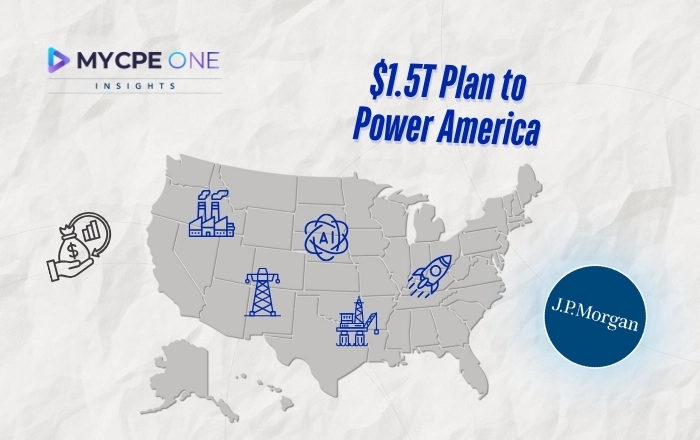
On paper, JPMorgan’s new “Security and Resiliency Initiative” sounds like a bureaucratic mouthful. In reality, it’s one of the most ambitious long-term investment programs ever attempted by a private bank. The 10-year plan will channel $1.5 trillion into financing, facilitating, and investing across four powerhouse sectors: defense and aerospace, energy independence, supply chain and advanced manufacturing, and frontier technologies like AI and quantum computing. Within that massive umbrella sits a more focused play, $10 billion in direct equity and venture capital investments, aimed squarely at companies driving innovation and national security. Think drones, nuclear power, nanomaterials, and the kind of robotics that make sci-fi engineers jealous.

Jamie Dimon, JPMorgan’s CEO and resident straight-talker, summed it up neatly: “It has become painfully clear that the United States has allowed itself to become too reliant on unreliable sources of critical minerals, products, and manufacturing.” Translation: we’ve been outsourcing too much, and it’s time to fix it.

America Needs Speed, Not Paperwork

Dimon didn’t mince words when unveiling the plan. He called for cutting “excessive regulations,” slashing “bureaucratic delay,” and ending “partisan gridlock.” His argument? The U.S. can’t afford to sit in neutral while rivals like China keep building, mining, and innovating at breakneck speed. He’s not wrong. Recent supply chain shocks, from rare earth minerals to semiconductors, exposed just how fragile America’s industrial backbone has become. The initiative’s timing also lines up neatly with the Trump administration’s focus on reshoring manufacturing and tightening control over defense-related technologies. But Dimon was quick to point out this isn’t a political handshake. “This is a JPMorgan initiative,” he told reporters. “It’s 100% commercial.” In Wall Street-speak, that means it’s expected to make real money, not just headlines.

A Bank Built for the Long Haul

JPMorgan isn’t exactly new to big moves. With $4.6 trillion in assets and $357 billion in shareholder equity as of June 30, 2025, it’s the biggest U.S. bank by a country mile. It already counts 34,000 mid-sized companies and 90% of the Fortune 500 among its clients. Now, it’s wrapping those relationships in a national security bow. The initiative will also include an external advisory council packed with private- and public-sector heavyweights, plus a beefed-up team of bankers, researchers, and investment pros. The firm’s Center for Geopolitics, launched recently, will feed data and strategy on supply chains, rare earths, and frontier tech. And if you think this sounds like a patriotic marketing stunt, consider this: JPMorgan was already planning to pour $1 trillion into these sectors. Dimon just hiked that figure by 50%. That’s not just talk; that’s a commitment with a balance sheet to match.

Strong Earnings, Strong Message

Timing is everything, and Dimon’s announcement couldn’t have landed at a better moment. JPMorgan’s latest earnings report blew past Wall Street expectations, with third-quarter of 2025 net income hitting $14.4 billion and earnings per share clocking in at $5.07, up 16% year over year. In Dimon’s words, “Each line of business performed well. While there have been some signs of a softening, particularly in job growth, the U.S. economy generally remained resilient.” He credited the bank’s “fortress balance sheet” for its ability to weather uncertainty, from tariffs and trade wars to sticky inflation and geopolitics. That same fortress now forms the foundation for JPMorgan’s national security play. If the initiative pays off, it won’t just strengthen America’s industrial core; it’ll cement JPMorgan’s place as the financial backbone of that rebuild.

Tricolor Trouble

Even the best drivers hit a few potholes. JPMorgan took a $170 million hit from the collapse of Tricolor Holdings, a subprime auto lender for First Brands that folded in September after racking up roughly $1 billion in revolving credit from five banks. Dimon called it a reminder that credit markets have been partying for too long. “We’ve had a credit bull market for the best part of 14 years, and these are early signs there may be some excess out there because of it,” he told analysts. Still, for a megabank that earned $14 billion in a single quarter, the loss is a speed bump, not a blowout. The bigger story remains its shift toward long-term, real-economy investment, one designed to make the U.S. more resilient when the next financial storm rolls in.

When Patriotism Meets Profit

Wall Street’s initial response was a mix of intrigue and applause. JPMorgan shares climbed more than 2% on announcement day, signaling confidence that Dimon’s “patriotic capitalism” could generate real returns. Analysts called it both strategic and symbolic, “a way to align the bank’s commercial muscle with the country’s economic priorities.” Of course, skeptics exist. Some worry that funneling money into government-favored sectors might overheat certain markets or crowd out private players. Others say it’s a bold bet that assumes long-term political stability, a rare commodity these days. Still, investors like Michael Ashley Schulman of Running Point Capital called the move “a big patriotic umbrella that grabs cameras.” And he’s not wrong. The blend of self-interest and national interest might just make Dimon’s plan the corporate equivalent of eating your cake and having it too.

What’s Next

The initiative’s impact won’t be felt overnight. Building new shipyards, battery plants, or semiconductor facilities takes time, capital, and a workforce capable of welding, coding, and troubleshooting. Dimon himself flagged the skills gap as a looming challenge, hinting that JPMorgan might fund vocational programs to fill it. Meanwhile, Goldman’s acquisition of Industry Ventures underscores a parallel truth: the future of finance is deeply tied to innovation. Whether it’s JPMorgan bankrolling quantum startups or Goldman chasing venture returns, Wall Street is clearly betting that America’s next growth story will be written in code, copper, and clean energy.

So, what’s the bottom line? JPMorgan just rebranded capitalism with a side of patriotism. Dimon’s betting that by doubling down on America’s industrial backbone, he’s also doubling down on profit. As he put it: “Hopefully, once again, as America has in the past, we will all come together to address these immense challenges. We need to act now.” And when Jamie Dimon says “act now,” the markets tend to listen.

Get your CPE Credit from here

Until next time…

Don’t forget to share this story on LinkedIn, X and Facebook

Subscribe now for $199 and get unlimited access to MYCPE ONE, from CPE credits to insights Magazine

📢MYCPE ONE Insights has a newsletter on LinkedIn as well! If you want the sharpest analysis of all accounting and finance news without the jargon, Insights is the place to be! Click Here to Join

Earn CPE Credits by Simply Reading Articles – Starting at Just $199/Year!

50 of the Top 200 Accounting Firms trust MYCPE ONE for their team’s learning—why not you? With 15,000+ approved content hours, 500+ emerging subject areas, and automated compliance tracking, staying ahead has never been easier.

We don’t just create boring tax, accounting, and audit content—our platform offers engaging, insightful, and trending material that your team will actually enjoy while earning CPE credits.

Sign up today, go through the comprehensive list of features and unlock unlimited learning!

Schedule a call!

Unlock Annual Access to News & CPE Subscription

You’ve reached the 3 free-content piece limit. Unlock unlimited access to all News & CPE resources.
Subscribe Today.

News & Updates

  • Exclusive News & Insights
  • Latest Regulatory Updates
  • Accounting Industry Trends
  • Expert Insights
  • AI-Driven Audio & Summaries
  • Infographics & Videos
  • CPE-Approved Articles
  • Digital Magazine
  • Benchmarking Blogs

Unlimited CPE Access for 1 Year

  • 15,000+ Hours of Content
  • 500+ Subject Areas
  • Mandatory Ethics Courses
  • 250+ Compliance Packages
  • 50+ Virtual Conferences and Events Access
  • Format: Live, Audio, Video, E-Books
  • Audio Based Courses & Podcasts
  • Add External Certificates with AI
  • AI Compliance Tracking and Report
  • Instant Certification and Fast Reporting
  • Mobile App Access (iOS and Android)
  • Dedicated Support System
  • Practical Training Programs
  • AI Academy Access
  • Tax Academy Access
  • Audit Academy Access
  • Leadership Academy Access