Join 250,000+
professionals today
Add Insights to your inbox - get the latest
professional news for free.
Join our 250K+ subscribers
Subscribe10 OCT 2025 / BUSINESS
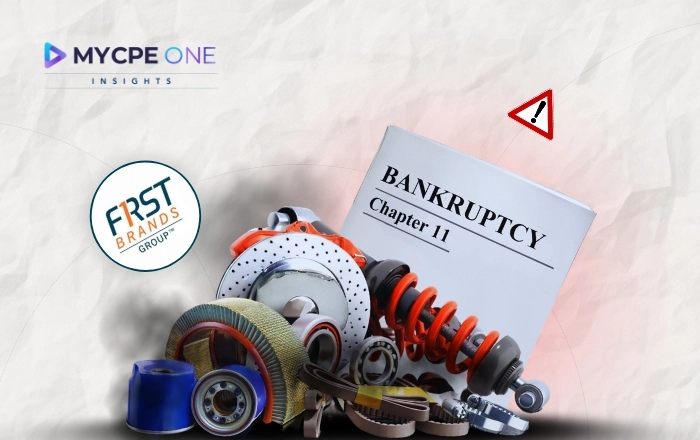
First Brands Group, the auto parts manufacturer behind brands like Raybestos, TRICO, and FRAM, has filed for Chapter 11 bankruptcy, revealing liabilities between $10 and $50 billion garnering attention from debt investors and creditors. The collapse shows the dangers of aggressive, debt-fueled growth, with creditors possibly facing billions in losses, the U.S. Department of Justice launching an investigation into potential misconduct, and Wall Street taking note, particularly in the wake of another auto-related bankruptcy.
When it comes to auto parts, breakdowns are supposed to happen on the highway, not in the boardroom. Yet that’s exactly the crash scene we’re watching. First Brands Group, the privately held auto parts maker behind names like Raybestos, TRICO, and FRAM, has slammed headfirst into Chapter 11 bankruptcy. The filing revealed a staggering $10 to $50 billion in liabilities, a wipeout so big it’s rattled debt investors and sent creditors scrambling for airbags. Much like the Staples bankruptcy, this collapse underscores how quickly leverage-fueled growth can turn from horsepower to hazard.
Patrick James First Brands Group wasn’t always a cautionary tale. Based in Ohio, the company built an empire by gobbling up rivals. The strategy? Growth on steroids, fueled by billions in debt-financed acquisitions. The firm didn’t just lean on traditional loans. It loaded up on exotic financing, invoice factoring, supply chain finance, and inventory-backed deals. By late 2024, filings revealed $2.3 billion in factored invoices, more than 70% of its annual sales and $682 million of supply-chain finance, parked off the balance sheet. It looked like horsepower, but in reality, the engine was running on borrowed fuel.
This wasn’t James’ first dance with controversial financing. Back in the 2000s, he and linked companies were sued by lenders who alleged misrepresentations tied to receivables and inventory. Those cases were settled and dismissed, but they cast a long shadow. This time, the stakes weren’t millions; they were tens of billions. As one restructuring adviser put it bluntly: “This wasn’t growth powered by oil, it was growth powered by leverage.”
By late September 2025, the wheels were literally off. The bankruptcy petition listed assets of just $1–10 billion against liabilities up to $50 billion, a Ferrari frame strapped to a lawnmower engine. Even worse, investigators are probing whether invoices were pledged multiple times, so-called double pledging. Court documents suggest collateral may have even been commingled between lenders, raising questions of potential misconduct. As Charles Moore, First Brands’ Chief Restructuring Officer, disclosed: “Receivables may have been factored more than once.”
The liquidity picture was even uglier: First Brands had just $14 million in cash left in the bank before filing. To make matters worse, SouthState Bank seized $27 million in working capital funds days before bankruptcy, yanking what restructuring advisers called “the last remaining liquidity” of its U.S. subsidiaries. Credit markets reacted fast: First Brands’ top-rated loans sank to 33–50 cents on the dollar, and Fitch downgraded the credit rating, warning that options had narrowed to “off-market solutions.” To keep the lights on, lenders stepped in with $1.1 billion in debtor-in-possession (DIP) financing, a fancy way of saying life support until the wreckage is sorted.
In the wake of the bankruptcy, the U.S. Department of Justice (DOJ) has launched an inquiry into the collapse, as federal prosecutors look to untangle the situation. The probe, led by the U.S. Attorney’s office for the Southern District of New York, is still in its early stages. Prosecutors are focusing on the potential irregularities in the company’s financing arrangements, with creditors and investors left facing billions in losses. The investigation is described as a fact-finding mission, but the fact that the DOJ is involved underscores the seriousness of the potential misconduct.
Raistone, one of First Brands’ largest creditors, has alleged that up to $2.3 billion has "simply vanished" during the company’s rapid fall into bankruptcy. This allegation comes amid claims that some of First Brands’ off-balance-sheet financing was more opaque than initially realized. Raistone has called for an independent examination to ensure proper recovery for creditors. They argue that the debtors should not appoint the investigators, as they might have a vested interest in downplaying their own potential misconduct.
The collapse left a tangle of losers in its wake. Court filings show $866 million in supply chain finance claims spread across fintechs and asset managers. Big names on the list:
Even Jefferies and Millennium, Wall Street heavyweights, are exposed. Jefferies, in particular, looks bruised. The bank had been trying to float a $6 billion refinancing just weeks before the collapse, only to pull the plug when lenders demanded clarity on the murky books. As the FT put it, Jefferies’ reputation in credit markets just took another black eye. This collapse is déjà vu for Jefferies, which already took heat last year for leading a Saks Global junk bond deal that soured within months. First Brands may have just dented its reputation further.
Jefferies revealed in its latest filings that its credit unit had exposure of around $715 million to First Brands through its Point Bonita Capital fund. The bank has also acknowledged losses in its Apex Credit Partners joint venture, which holds $48 million in First Brands’ debt across 12 collateralized loan obligations (CLOs). Jefferies is facing significant scrutiny, especially given its relationship with First Brands, which involved complex, opaque financing strategies that weren’t fully disclosed until now.
Not everyone lost. Some players cashed in on First Brands’ downfall. Apollo Global Management and Diameter Capital Partners had quietly shorted the company’s debt earlier in the year. When the bankruptcy dropped, they closed positions with profits. Diameter then doubled down, scooping up senior debt at below 40 cents on the dollar, betting it can flip value during restructuring. Proof that in distressed debt, the vultures don’t just circle, they feast.
The losers?
As one distressed trader told Bloomberg, the fallout was “the largest risk transfer in a single day since Credit Suisse’s rescue.” Goldman Sachs put a number on it: nearly $1 billion in First Brands loans traded hands in 24 hours.
For automakers like Ford or GM? Not really. First Brands is an aftermarket supplier, not a frontline OEM. But for retailers, distributors, and the brake community, this is no small fry. Brands like Raybestos and Centric are staples, and a messy restructuring could disrupt supply lines. More broadly, Wall Street is spooked. First Brands collapsed just weeks after subprime auto lender Tricolor Holdings went under. Two auto-adjacent bankruptcies in quick succession has investors whispering: systemic stress? Rising interest rates, opaque financing structures, and aggressive debt-fueled growth might just be a recipe for more wrecks down the road.
First Brands BDO now faces a long Chapter 11 slog. Expect asset sales, brand carve-outs, and debt haircuts. Hedge funds hunting distressed debt may scoop up pieces at a discount. Rumours already suggest that some debt was traded at below 40 cents on the dollar. Meanwhile, auditors are under the microscope. BDO signed off with a clean opinion in March, but questions mounted, leading First Brands to bring in Deloitte for a “quality of earnings” review. Bankruptcy hit before Deloitte finished, underscoring how fast this engine seized up. At its core, First Brands’ bankruptcy isn’t just about one company. It’s a cautionary tale of over-leverage, hidden financing, and hubris. The collapse shows how easy it is for private firms to balloon on credit and just how devastating the bust can be when the music stops. The lesson? In finance, just like in driving, speed without control doesn’t get you ahead; it just gets you into a crash faster.
Until next time…
Don’t forget to share this story on LinkedIn, X and Facebook
Subscribe now for $199 and get unlimited access to MYCPE ONE, from CPE credits to insights Magazine
📢MYCPE ONE Insights has a newsletter on LinkedIn as well! If you want the sharpest analysis of all accounting and finance news without the jargon, Insights is the place to be! Click Here to Join
Unlimited CPE for Just $199/Year!
Get CPE credits by reading or listening to approved content. Enjoy unlimited CPE for CPA (US), EA, CMA, CIA, CFE, SHRM, HRCI, and 100+ other designations—all for just $199 per year! (Learn More)
Team Subscriptions Available – Starting at Just $199/Year!
Schedule a no-obligation callYou’ve reached the 3 free-content piece limit. Unlock unlimited access to all News & CPE resources.
Subscribe Today.
Already have an account?
Sign In