

MYCPE ONE
MYCPE ONE LOGO

Join 250,000+
professionals today

Add Insights to your inbox - get the latest
professional news for free.

MYCPE ONE insights

Wall Street’s Buyback Bonanza Isn’t Just Confidence, It’s Strategy

Join our 250K+ subscribers

Join our 250K+ subscribers

Subscribe

17 APR 2026 / FINANCE

Wall Street’s Buyback Bonanza Isn’t Just Confidence, It’s Strategy

Wall Street’s Buyback Bonanza Isn’t Just Confidence, It’s Strategy

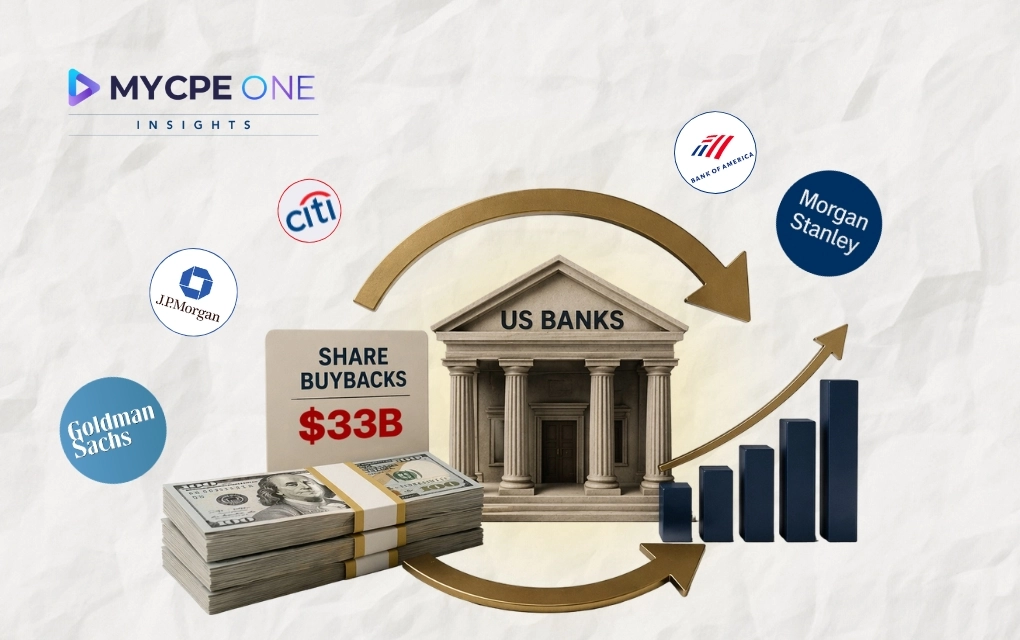
When America’s biggest banks start writing cheques to themselves, it’s rarely impulsive, it’s calculated capital choreography. In Q1 2026, giants like JPMorgan Chase, Citigroup, and Goldman Sachs didn’t just beat earnings expectations they rewrote the playbook, collectively spending a record $33 billion on share buybacks. 

And they had the firepower to do it.

  • JPMorgan reported ~$50.5 billion in revenue, up ~10% year-on-year  
  • Citigroup posted $24.6 billion in revenue, its best in a decade  

Across the “big six,” profits neared $50 billion for the quarter. This isn’t just a good quarter. It’s a liquidity statement. 

From Safety Nets to Shareholder Returns 

Let’s rewind. After the 2008 financial crisis, regulators forced banks into a defensive stance, higher capital buffers, tighter lending, and less risk-taking. Fast forward to 2026, and the script has flipped. Banks are no longer hoarding capital, they’re deploying it. Why? Because the system today is: 

  • Better capitalized 
  • More profitable 
  • And, crucially, less restricted than it was a decade ago 

Buybacks, in that sense, are not just payouts. They’re a signal that banks have more capital than they need.   

Why Now? Follow the Money and the Volatility 

If buybacks are the outcome, then earnings are the fuel. 

1. Trading Desks Are Printing Money Again 

Geopolitical instability, from Middle East tensions to energy shocks has injected volatility into global markets. And volatility, for banks, is revenue. JPMorgan’s markets division alone generated $11.6 billion. Equity and fixed income trading surged across firms. Investment banking fees rebounded with stronger deal activity. In simple terms: chaos outside = commissions inside. 

2. Consumers Didn’t Crack 

Despite inflation and global uncertainty, consumer spending held up, from strong credit card usage to stable employment and healthy deposit levels, which supported steady net interest income, a backbone for large lenders.

3. Capital Was Sitting Idle 

Banks found themselves in a rare position, enjoying high earnings, strong balance sheets, and a limited immediate need for reinvestment. As a result, the question was no longer “Can we return capital?” Instead, it became, “Why aren’t we returning more?” 

Deregulation as a Dividend Catalyst 

Now to the real accelerant policy. Under Donald Trump’s administration, banking regulation has taken a noticeably lighter turn. Key shifts include: 

  • Proposed cuts of ~5% in capital requirements for large banks 
  • A broader rollback of post-crisis regulatory intensity 
  • Encouragement for banks to lend more and hold less idle capital

The implication? Less capital locked in reserves = more capital available for buybacks. Banks aren’t just reacting to profits, they’re responding to policy permission.

A Subtle Trade-Off: Buybacks vs Balance Sheet Strength 

Here’s where it gets interesting. As buybacks surged, capital ratios—measuring equity versus risk-weighted assets—declined, with some banks, like Goldman Sachs, seeing ratios dip to multi-year lows. While this doesn’t signal immediate danger, it does raise a quiet question: Are banks optimizing returns, or stretching their buffers? For now, markets seem comfortable with the trade-off.

The Strategy Shift 

Buybacks weren’t the only destination for capital. Banks also expanded lending portfolios and reinvested in trading operations (once out of favour in the 2010s). The result? A more balanced revenue mix: 

  • Interest income (steady) 
  • Trading (cyclical, but booming) 
  • Investment banking (recovering) 

It’s less about one engine, and more about a multi-engine growth model. 

Looking Ahead

The future of bank buybacks hinges on three key variables: regulation, market volatility, and economic resilience. If deregulation continues, buybacks could remain elevated, whereas a reversal could shift capital back to buffers. Trading-driven profits are cyclical, so less market volatility would reduce the fuel for buybacks. Likewise, strong consumer spending supports strong banks, but any cracks could quickly shift priorities. The $33 billion moment isn’t just about rewarding shareholders, it reflects confidence in balance sheets, a favorable regulatory climate, and a strategic bet that current conditions will hold, or at least hold long enough. In banking, capital doesn’t just move; it signals. And right now, it’s signaling: “We’re comfortable, but not complacent.

Until next time…

Don’t forget to share this story on LinkedIn, X and Facebook

Subscribe now for $199 and get unlimited access to MYCPE ONE, from CPE credits to insights Magazine

📢MYCPE ONE Insights has a newsletter on LinkedIn as well! If you want the sharpest analysis of all accounting and finance news without the jargon, Insights is the place to be! Click Here to Join

Unlock Annual Access to News & CPE Subscription

You’ve reached the 3 free-content piece limit. Unlock unlimited access to all News & CPE resources.
Subscribe Today.

News & Updates

  • Exclusive News & Insights
  • Latest Regulatory Updates
  • Accounting Industry Trends
  • Expert Insights
  • AI-Driven Audio & Summaries
  • Infographics & Videos
  • CPE-Approved Articles
  • Digital Magazine
  • Benchmarking Blogs

Unlimited CPE Access for 1 Year

  • 15,000+ Hours of Content
  • 500+ Subject Areas
  • Mandatory Ethics Courses
  • 250+ Compliance Packages
  • 50+ Virtual Conferences and Events Access
  • Format: Live, Audio, Video, E-Books
  • Audio Based Courses & Podcasts
  • Add External Certificates with AI
  • AI Compliance Tracking and Report
  • Instant Certification and Fast Reporting
  • Mobile App Access (iOS and Android)
  • Dedicated Support System
  • Practical Training Programs
  • AI Academy Access
  • Tax Academy Access
  • Audit Academy Access
  • Leadership Academy Access