
Join 250,000+
professionals today
Add Insights to your inbox - get the latest
professional news for free.
Join our 250K+ subscribers
Subscribe03 SEP 2025 / FINANCE
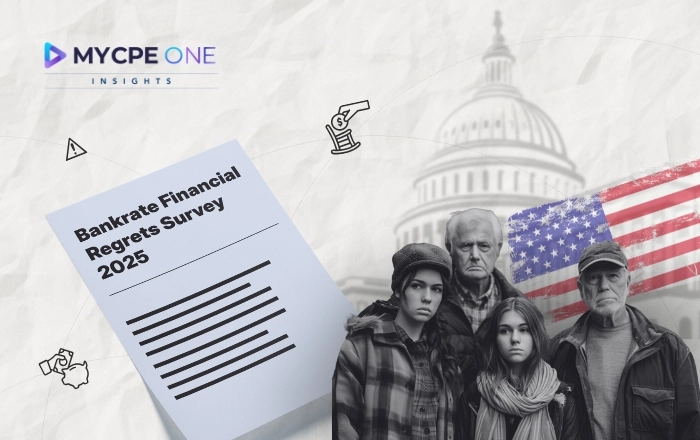
According to a survey by Bankrate, 74% of Americans admitted having at least one financial regret in 2025, largely driven by inflation, stagnant wages, increasing living costs, and tariff-heavy policies. While the top regret was inadequate savings (38%), followed by debt (20%), 43% of regretful respondents made no attempts to rectify their financial mistakes from the past year, suggesting an ongoing struggle with cost of living outpacing income growth.
That’s not just a quip; it’s a reality backed by the numbers. A new Bankrate survey reveals that 74% of Americans admit to at least one financial regret in 2025. For many, it’s failing to save enough. For others, it’s drowning in credit card debt. These regrets aren’t happening in a vacuum; they’re fueled by inflation, flat wages, and climbing costs for essentials like gas and groceries. As we broke down in our earlier piece on Why U.S. Credit Card Defaults Are at a 14-Year High, this financial storm has been building for years. Layer on Trump 2.0’s tariff-heavy policies, and consumer wallets are stretched thinner than ever. Legendary investor Ray Dalio isn’t mincing words; he warns America is heading toward a “debt-induced heart attack” within three years if the current path continues. For everyday Americans, the chest pains are already starting.
Let’s not sugarcoat it. Essentials are up, earnings are flat, and optimism is running on fumes. Bankrate found that 30% of Americans say cheaper basics like gas or groceries would most improve their financial lives. Better job opportunities ranked a distant second. But even with that clarity, progress feels stuck. Nearly 43% of people with regrets say they haven’t fixed them at all in the past year, up from 40% in 2024. That stalled momentum reflects a system where the cost of living outpaces income growth, leaving households with little room to maneuver.
Debt.com’s own survey backs this up: credit card debt is now the #1 money mistake for Americans for the second straight year, with 24% citing overspending on plastic. Many carry balances of $15,000 or more, compounding into financial paralysis. As Howard Dvorkin, chairman of Debt.com, put it, “When everyday essentials cost more, people rely on credit cards to close the gap. The problem is those balances grow fast, and so does regret.”
Source: FT
The biggest regret? Not saving enough. From retirement to emergency funds, 38% of respondents said lack of savings was their number-one miss, nearly double the 20% who pointed to debt.
This aligns with Fidelity’s data showing the average 401(k) balance at just $131,700, far short of the 10x salary benchmark financial planners recommend by retirement.
If there’s a silver lining, regrets ticked down slightly from 77% in 2024 to 74% in 2025. But here’s the catch: fewer people are taking action to fix them. As Bankrate’s Stephen Kates put it, “Our data show that while fewer Americans report having financial regrets, those who do are making less progress in addressing them.” The past decade has layered pressure: credit card interest rates above 20%, emergency funds drained by inflation, and stimulus checks fading into memory. Defaults surged to $46 billion in write-offs in 2024 alone, the highest since the Great Recession. For millions, the game has shifted from wealth-building to pure financial survival.
So, how do you turn regret into resilience? Experts like Jake Martin and Ashton Lawrence stress three moves:
Small, consistent moves beat flashy overhauls every time.
Financial regret isn’t about personal failure; it’s about structural strain. Tariffs that hike prices, debt cycles that hinder progress, and wage growth that cannot keep pace all contribute to the problem. As Dalio warns, America’s debt pile risks a systemic “heart attack” if left unchecked. But at the household level, the lesson is clear: regret is the warning light, not the engine failure. The real danger is doing nothing. Whether you’re 25 or 65, there’s still room to rewrite your money story. Start now, start small, and don’t let regret be the last word in your financial journey. Want more breakdowns like this? Subscribe to our newsletter and stay ahead of the financial curve.
Until next time…
Don’t forget to share this story on LinkedIn, X and Facebook
Subscribe now for $199 and get unlimited access to MYCPE ONE, from CPE credits to insights Magazine
📢MYCPE ONE Insights has a newsletter on LinkedIn as well! If you want the sharpest analysis of all accounting and finance news without the jargon, Insights is the place to be! Click Here to Join
Transforming Finance & Accounting Operations for Enterprises!
We help 100+ clients streamline F&A operations with our full-suite outsourcing services-eliminating the need for in-house teams. Partner with us for Top-tier finance & accounting talent, Cutting-edge technology, and World-class infrastructure.
Our Full-Suite F&A Services Include:
We collaborate with CPA and accounting firms to drive real business value.
Schedule a no-obligation discovery callYou’ve reached the 3 free-content piece limit. Unlock unlimited access to all News & CPE resources.
Subscribe Today.
Already have an account?
Sign In