
Join 250,000+
professionals today
Add Insights to your inbox - get the latest
professional news for free.
Join our 250K+ subscribers
Subscribe14 APR 2026 / CPA STATE BOARD UPDATES
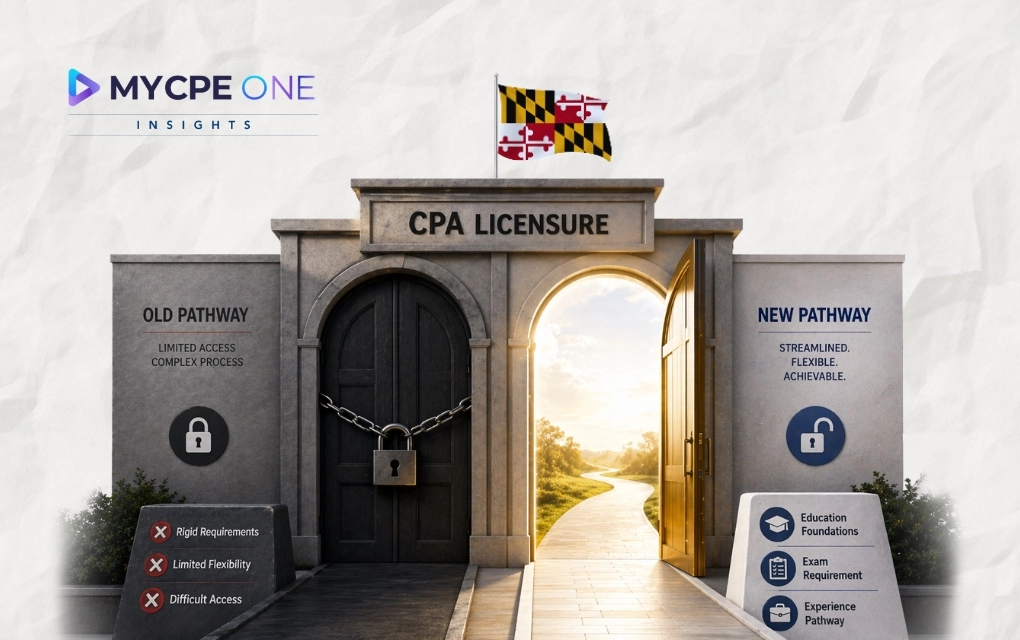
Maryland House Bill 643, which allows real-world experience to count towards becoming a Certified Public Accountant (CPA), was passed unanimously by both chambers, offering an alternative to the traditional additional credit hour requirement. This reform, set to take effect from October 1, 2026, is aimed at tackling talent shortages and excessive costs associated with earning extra course credits, and aligns with similar measures implemented in 39 other states and Puerto Rico.
For years, becoming a CPA felt like running a marathon where the last mile was… more college credits. Now, Maryland just hit pause on that grind and said, “What if real-world experience actually counts?” With House Bill 643 sailing through both chambers unanimously, the state isn’t just tweaking rules, it’s rewriting the playbook. And if you’re a CPA, aspiring CPA, or firm leader in Maryland, this isn’t background noise. This is the kind of shift that can seriously move the needle on careers, hiring, and the future of the profession.
Rewind to early 2026. MACPA members packed Annapolis halls, pushing lawmakers to rethink the rigid 150-hour requirement. What started as Senate Bill 34 quickly evolved into House Bill 643, and let’s just say, it didn’t crawl across the finish line… it cruised. The bill passed unanimously in both the House and Senate, no pushback, no drama. That alone tells you something: this wasn’t controversial, it was overdue.
MACPA CEO Rebekah Olson summed it up cleanly: “This is a tremendous victory for Maryland’s CPA profession. It opens doors for more candidates while helping employers address critical talent needs.” And here’s the kicker; Maryland isn’t alone. 39 states and Puerto Rico have already moved in this direction or are actively rewriting their CPA licensure rules. As one academic tracking the trend put it, “We’re chugging right along.” Translation? This isn’t a one-off move. It’s a full-blown national shift.
Let’s break it down without the regulatory jargon. Maryland didn’t scrap the old system. It just added another way in. You now have three paths to CPA licensure:
No shortcuts on the CPA Exam. No watered-down standards. Just a simple idea: If you’ve been doing the work, that experience should count. This goes into effect October 1, 2026, assuming Gov. Wes Moore signs off, which historically tends to happen.
Let’s not sugarcoat it: firms across the U.S. have been scrambling to find licensed CPAs. The 150-hour rule? It’s been a bottleneck. More time, more tuition, more debt. And for many candidates, that’s where the journey stops. Maryland basically said: Enough is enough. Here’s what’s driving this shift:
This new pathway doesn’t lower the bar. It just removes unnecessary friction. Or put another way, Maryland is finally betting on skills over seat time.
This is where things get interesting.
You’ve been doing audit, tax, or compliance work for years. You know your stuff. But you never checked that “150-hour” box. Now? That barrier just disappeared. Instead of going back to school, you can lean on your actual experience, pass the exam, and finally get licensed. That’s not just helpful. That’s a career unlock.
This is where firms can really cash in.
In short, this isn’t just a policy change. It’s a talent strategy upgrade.
You’ve got options now, and that’s huge. Want the traditional academic route? Still there. Prefer to earn while you learn? That’s now legit too. It’s a “choose your path” setup, and every road leads to the same CPA credential. Not bad, right?
Here’s where the story gets bigger than one state. Across the country, regulators are rethinking how CPAs are trained and licensed. Maryland just joined states like Colorado and New Hampshire in pushing forward similar reforms. But Maryland’s approach hits a sweet spot:
That balance matters. A lot. Because let’s be honest, nobody wants a watered-down CPA credential. But nobody wants a broken pipeline either.
Maryland didn’t lower the bar. It just made the path to the bar more realistic.
And if this trend keeps rolling, don’t be surprised if more states jump on the bandwagon soon. So, the real question is: Are you ready to take advantage of it, or are you still playing by the old rules?
Until next time…
Don’t forget to share this story on LinkedIn, X and Facebook
Subscribe now for $199 and get unlimited access to MYCPE ONE, from CPE credits to insights Magazine
📢MYCPE ONE Insights has a newsletter on LinkedIn as well! If you want the sharpest analysis of all accounting and finance news without the jargon, Insights is the place to be! Click Here to Join
You’ve reached the 3 free-content piece limit. Unlock unlimited access to all News & CPE resources.
Subscribe Today.
Already have an account?
Sign In