MYCPE ONE
MYCPE ONE LOGO

Join 250,000+
professionals today

Add Insights to your inbox - get the latest
professional news for free.

MYCPE ONE insights

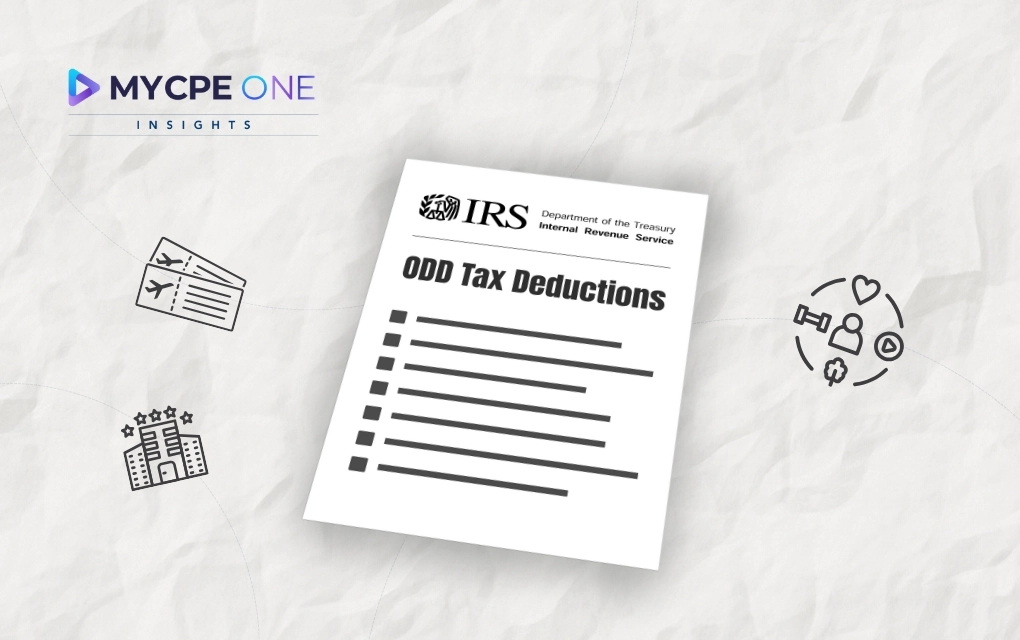
Bizarre Tax Deductions the IRS Said Yes To

Join our 250K+ subscribers

Join our 250K+ subscribers

Subscribe

08 JAN 2026 / IRS UPDATES

Bizarre Tax Deductions the IRS Said Yes To

Bizarre Tax Deductions the IRS Said Yes To

I once watched a neighbor repaint his front door three times in one weekend. Same color, technically. Each coat is just a little different. He stood back after every attempt, squinting, as if the door might confess something if stared at long enough. It was never about the paint. It was about the line between “good enough” and “right,” a line that kept moving the moment he thought he’d found it. That kind of quiet tinkering shows up everywhere. In how people load a dishwasher. How long do they wait before replying to a message? In how they explain themselves when they’re almost sure they’re allowed to do something, but not fully sure.

Rules exist, but most of life happens near their edges. Not in open defiance, more in gentle testing. A pause. A glance around. A decision made without announcing itself. What’s interesting is how often this behavior isn’t rebellious at all. It’s curious. People aren’t trying to blow things up. They’re trying to see where the wall actually is. That instinct, the urge to stand close to the line and lean forward just a bit, tends to get written off as cleverness or cynicism. But most of the time, it’s neither. It’s just human. And it shows up even in places we pretend are purely mechanical.

Why does “allowed” feel negotiable?

Eventually, this instinct collides with tax law. Not in sweeping policy debates, but in small, oddly specific moments. A swimming pool. A dog. A musical instrument. Body oil. A plane that probably did not need leather seats. The tax code speaks in confident terms. Ordinary. Necessary. Medical. Business. These words read cleanly until you try to fit them over real lives. Then they start to stretch. So, the central question I keep circling is this: why do certain claims that sound ridiculous at first glance end up surviving scrutiny, while others get laughed out of the room?

This isn’t about fraud. Most of the stories that stick are not criminal, just strange. They aren’t about hiding income or fabricating receipts. They’re about classification. About whether something counts. And maybe more importantly, about who decides. The code draws lines, but enforcement lives in interpretation. Somewhere between intent and paperwork, between plausibility and proof, a judgment gets made. Sometimes quietly. Sometimes, with a memo that later becomes folklore. The question isn’t why people try. That part feels obvious. The question is why the system sometimes nods and says okay.

What lens Explains Odd Deductions?

The mental model that helps me make sense of this is boundary testing. Not cheating. Boundary testing. Cheating ignores the rules. Boundary testing takes them seriously enough to ask where they end. It happens when rules are principle-based instead of mechanical. When language like ordinary and necessary replaces hard lists. Boundary testing is not loud. It doesn’t announce itself. It shows up as a story that almost fits. A fact pattern that feels plausible if you don’t rush it. This kind of system invites interpretation. Interpretation invites judgment. Judgment invites inconsistency.

And yet, it also invites adaptability. A rigid checklist would collapse under the weight of real life. Principles bend. That’s their job. Boundary testing reveals what a system tolerates, not what it promises. It shows how much discretion exists once the spreadsheet ends and the human review begins. This lens matters because it shifts attention away from the strangest examples and toward the pattern beneath them. The question stops being “How did that get approved?” and becomes “What standard did this quietly satisfy?”

We’ll need that lens once we step into the weeds.

How does the Tax Code Bend?

On the surface, stories about unusual deductions read like bar trivia for accountants.

A junkyard deducts cat food because the cats control rats. A performer deducts body oil because it is part of a professional image. A swimming pool becomes partially deductible because a doctor prescribes aquatic therapy. Clarinet lessons qualify because an orthodontist says they help correct an overbite. It sounds nuts until you slow down. What’s easy to miss is that these deductions did not survive because they were clever. They survived because they aligned, narrowly, with the purpose behind the rule. The cats were not pets. They were pest control. The body oil was not grooming. It was stage preparation. The pool was not leisure. It was treatment, and even then, only to the extent it did not increase property value. The spreadsheet says expense. Behavior suggests something more constrained.

Now look at what fails. Pets claimed as dependents. Weddings are labeled as business entertainment. Tattoos framed as medical care. Fallout shelters were pitched as a preventive treatment. These don’t collapse because they are strange. They collapse because the story breaks under pressure. Boundary testing succeeds when the narrative fits the intent of the rule, not just its wording. The IRS and courts seem far less bothered by odd facts than by thin explanations. They tolerate weirdness better than they tolerate reach. That distinction gets lost when these stories are told as loopholes. They’re not loopholes. They’re stress tests.

Where does Fragility Creep in?

Systems built on judgment carry a quiet risk. Flexibility cuts both ways. The same discretion that allows reasonable edge cases also creates uneven outcomes. Two similar claims can land differently depending on timing, documentation, or who happens to review them. That unpredictability rarely makes headlines, but it shapes behavior. There’s also imitation risk. Once a boundary holds in one case, others lean on it harder. What was once a narrow exception starts to look like a template. The system responds not by rewriting rules, but by tightening scrutiny. More documentation. More skepticism. More time spent explaining yourself.

That’s where fatigue creeps in. Not panic. Just weariness. At what point does a principle-based system start to feel arbitrary? How much discretion is too much before trust erodes? When enforcement relies heavily on judgment, who bears the cost of inconsistency? There are no clean answers here. Just tradeoffs. The kind that feel manageable until they aren’t, and invisible until you’re standing right at the edge.

What do boundaries say about us?

I keep thinking about that front door. The neighbor eventually stopped repainting. Not because he found the perfect shade, but because he got tired. The door was fine. It always had been. Rules are like that. They don’t exist to be perfected, just applied well enough to keep things standing. The strange deductions aren’t the punchline. They’re reminders that law is lived before it is enforced. That interpretation is unavoidable. That human systems carry human fingerprints. There’s a line somewhere, but it rarely announces itself in advance. It appears only after someone approaches it, tells a story, and waits to see whether the system nods back. And maybe that’s the point. Not that the line is blurry, but that we only learn where it is by walking up to it, pausing, and deciding whether to lean forward or step back.

Until next time…

Don’t forget to share this story on LinkedIn, X and Facebook

Subscribe now for $199 and get unlimited access to MYCPE ONE, from CPE credits to insights Magazine

📢MYCPE ONE Insights has a newsletter on LinkedIn as well! If you want the sharpest analysis of all accounting and finance news without the jargon, Insights is the place to be! Click Here to Join

Unlock Annual Access to News & CPE Subscription

You’ve reached the 3 free-content piece limit. Unlock unlimited access to all News & CPE resources.
Subscribe Today.

News & Updates

  • Exclusive News & Insights
  • Latest Regulatory Updates
  • Accounting Industry Trends
  • Expert Insights
  • AI-Driven Audio & Summaries
  • Infographics & Videos
  • CPE-Approved Articles
  • Digital Magazine
  • Benchmarking Blogs

Unlimited CPE Access for 1 Year

  • 15,000+ Hours of Content
  • 500+ Subject Areas
  • Mandatory Ethics Courses
  • 250+ Compliance Packages
  • 50+ Virtual Conferences and Events Access
  • Format: Live, Audio, Video, E-Books
  • Audio Based Courses & Podcasts
  • Add External Certificates with AI
  • AI Compliance Tracking and Report
  • Instant Certification and Fast Reporting
  • Mobile App Access (iOS and Android)
  • Dedicated Support System
  • Practical Training Programs
  • AI Academy Access
  • Tax Academy Access
  • Audit Academy Access
  • Leadership Academy Access