


MYCPE ONE
MYCPE ONE LOGO

Join 250,000+
professionals today

Add Insights to your inbox - get the latest
professional news for free.

MYCPE ONE insights

IRS Extends ERC Clock for Taxpayers

Join our 250K+ subscribers

Join our 250K+ subscribers

Subscribe

28 APR 2026 / IRS UPDATES

IRS Extends ERC Clock for Taxpayers

IRS Extends ERC Clock for Taxpayers

A tax deadline is like a smoke alarm with a weak battery. It may chirp for months, but once it goes silent, the damage may already be done. That is the problem now facing some businesses whose Employee Retention Credit claims were denied while their appeals or responses are still sitting in IRS traffic. The IRS has introduced a new process allowing certain taxpayers to request more time after an ERC claim disallowance, mainly to prevent good faith taxpayers from losing refund rights simply because the administrative process moved more slowly than the statute

Is the ERC Clock Playing Hardball?

When the IRS denies an ERC claim, taxpayers generally receive Letter 105-C for a full disallowance or Letter 106-C for a partial disallowance. From the date of that letter, they usually have two years to resolve the claim administratively or file a refund lawsuit in federal court. The tricky part? Filing a protest with IRS Appeals does not stop that two-year clock. That is where things get dicey. If the two-year period expires, the IRS cannot issue a refund or credit, even if Appeals later agrees the taxpayer was right. In plain English, the taxpayer can win the argument and still lose the money. That is not exactly a warm and fuzzy taxpayer rights moment.

What’s the New IRS Lifeline?

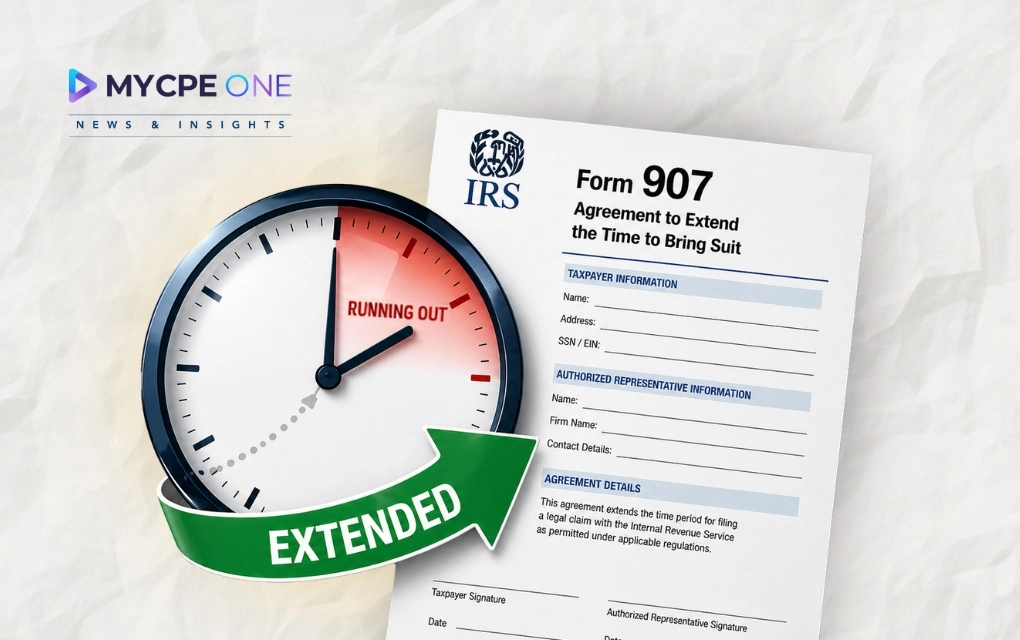
The new route centers on Form 907, Agreement to Extend the Time to Bring Suit. Taxpayers may use the streamlined process if they are waiting for the IRS to review their response to a Letter 105-C or 106-C and have six months or less remaining before the two-year deadline expires. The form can now be submitted through the IRS Document Upload Tool by selecting notice “CP320B.” The IRS will review properly completed forms and respond in writing. The extension is not valid until the IRS signs and returns a countersigned copy, so this is not a “send it and forget it” situation.

That last detail matters. A half-filled Form 907 is not a magic ticket. Missing taxpayer IDs, claim amounts, quarter ending dates, signatures, or power of attorney documentation can slow down or sink the request.

Why Is Everyone Suddenly Watching Form 907?

Because the ERC backlog has been a real headache. National Taxpayer Advocate Erin Collins previously urged the IRS to make Form 907 easier to use for ERC disputes, warning that taxpayers could lose rights while waiting on administrative review. Accounting Today reported that the IRS issued about 28,000 ERC disallowance notices in summer 2024, many based on risk filter analysis rather than a prior examination. That created a procedural traffic jam. Some taxpayers protested, expecting Appeals review. Instead, cases were routed first to IRS Compliance because no exam had occurred earlier. Meanwhile, the two-year clock kept running. Talk about being stuck between red tape and a hard place.

Collins called the IRS move positive but warned taxpayers must act quickly because once the deadline expires, the right to a refund is lost. She also noted the process currently applies only to ERC disallowance protests, not every refund disallowance issue.

What Should Tax Pros Do Before the Door Closes?

  • First, check the date on the original Letter 105-C or 106-C. Not the date the client forwarded it. Not the date someone found it in a PDF folder named “IRS stuff.” The actual notice date drives the two-year deadline.
  • Second, confirm whether the client already responded to the disallowance and is still waiting on the IRS. If yes, and the deadline is within six months, Form 907 should be on the radar fast.
  • Third, review the ERC support package. The IRS expects documentation tied to eligibility, including government orders for suspension claims, gross receipts records for decline claims, recovery startup business support, worksheets, wage calculations, and confirmation that wages were not double-counted with PPP forgiveness or paid to related individuals.

The Bottom Line

This IRS update gives taxpayers breathing room, not victory. It helps preserve the right to keep fighting, but it does not prove ERC eligibility. For advisors, the move is a clear heads-up. Calendar the deadline, review the file, fix weak documentation, and do not assume Appeals will finish before the clock runs out. In tax, “we’re waiting to hear back” is not a strategy. Sometimes it is just the sound of a deadline sneaking up in loafers.

Until next time…

Don’t forget to share this story on LinkedIn, X and Facebook

Subscribe now for $199 and get unlimited access to MYCPE ONE, from CPE credits to insights Magazine

📢MYCPE ONE Insights has a newsletter on LinkedIn as well! If you want the sharpest analysis of all accounting and finance news without the jargon, Insights is the place to be! Click Here to Join

Unlock Annual Access to News & CPE Subscription

You’ve reached the 3 free-content piece limit. Unlock unlimited access to all News & CPE resources.
Subscribe Today.

News & Updates

  • Exclusive News & Insights
  • Latest Regulatory Updates
  • Accounting Industry Trends
  • Expert Insights
  • AI-Driven Audio & Summaries
  • Infographics & Videos
  • CPE-Approved Articles
  • Digital Magazine
  • Benchmarking Blogs

Unlimited CPE Access for 1 Year

  • 15,000+ Hours of Content
  • 500+ Subject Areas
  • Mandatory Ethics Courses
  • 250+ Compliance Packages
  • 50+ Virtual Conferences and Events Access
  • Format: Live, Audio, Video, E-Books
  • Audio Based Courses & Podcasts
  • Add External Certificates with AI
  • AI Compliance Tracking and Report
  • Instant Certification and Fast Reporting
  • Mobile App Access (iOS and Android)
  • Dedicated Support System
  • Practical Training Programs
  • AI Academy Access
  • Tax Academy Access
  • Audit Academy Access
  • Leadership Academy Access