MYCPE ONE
MYCPE ONE LOGO

Join 250,000+
professionals today

Add Insights to your inbox - get the latest
professional news for free.

MYCPE ONE insights

IRS CP53E Refund Scam Sparks Warnings From Accounting Firms

Join our 250K+ subscribers

Join our 250K+ subscribers

Subscribe

06 MAY 2026 / IRS UPDATES

IRS CP53E Refund Scam Sparks Warnings From Accounting Firms

IRS CP53E Refund Scam Sparks Warnings From Accounting Firms

One little IRS letter is suddenly turning tax season into a cybersecurity thriller. Across the U.S., taxpayers are opening mailboxes and seeing IRS Notice CP53E, a notice tied to delayed refunds and missing direct deposit details. Some notices are legitimate. Some may have been issued by mistake. And some are outright scams designed to steal banking information from unsuspecting taxpayers. That combination is creating serious confusion for accounting firms, tax professionals, and taxpayers already exhausted from filing season. The bigger issue is not just the scam itself. It is what the scam represents: the IRS’s aggressive shift toward electronic refunds is colliding headfirst with modern phishing fraud. And firms are now being forced to play translator, cybersecurity coach, and fraud filter all at once.

What Is an IRS CP53E Notice?

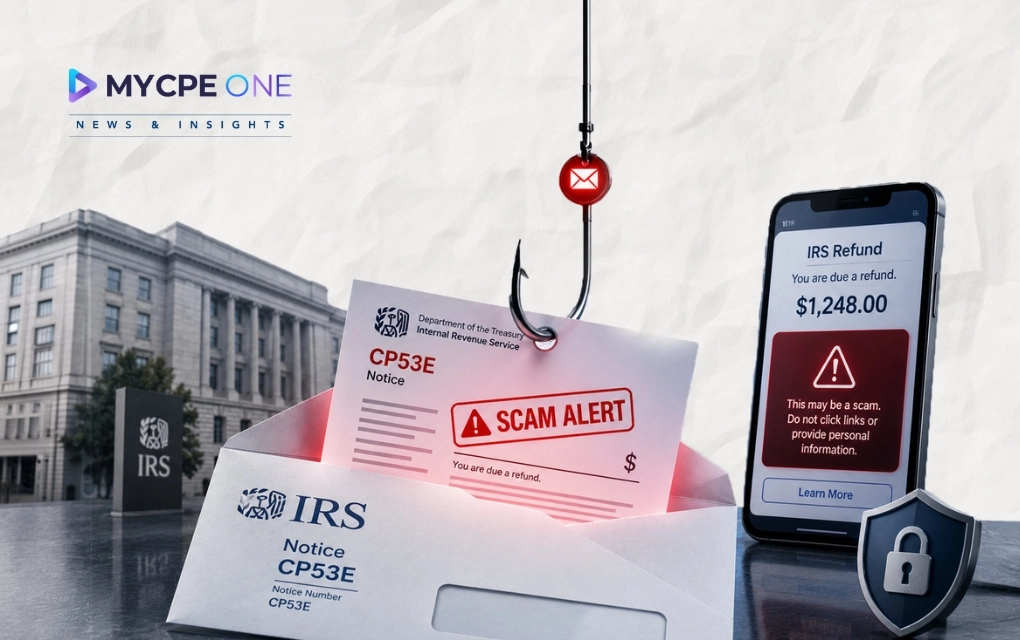
IRS Notice CP53E is not fake by default. It is a legitimate IRS notice sent when the agency cannot process a refund through direct deposit because the taxpayer’s banking information is missing, incorrect, rejected, or cannot be verified. The notice typically instructs taxpayers to update their banking information through their IRS Online Account within 30 days. If no update is made, the IRS may eventually issue a paper refund check instead. Sounds straightforward. But here’s where things got messy fast.

According to lawmakers on the House Ways and Means Committee, more than 1.4 million taxpayers had already received these notices earlier this year, and that number was reportedly growing by nearly 300,000 notices per week. Some taxpayers even received CP53E notices despite not expecting refunds at all. That immediately triggered concern among tax professionals and lawmakers alike. CBIZ warned that several clients received CP53E notices “despite not being due a refund,” while Grassi flagged growing reports of fake notices designed to harvest financial data. Now taxpayers are stuck wondering:

  • Is the notice real?
  • Is my refund delayed?
  • Did the IRS mess up?
  • Or is this a scam?

That uncertainty is exactly what scammers love.

A New Door for Fraudsters

This entire situation traces back to President Trump’s Executive Order 14247, signed in March 2026, which directed federal agencies to accelerate the move away from paper payments and toward electronic disbursements. The Treasury Department later confirmed that paper refund checks would begin phasing out starting Sept. 30, 2025, except for limited situations.

The IRS says the shift is designed to:

  • reduce fraud and lost checks,
  • speed up refund delivery,
  • and lower administrative costs.

And to be fair, the numbers support some of that logic. The IRS noted that paper checks are more than 16 times more likely to be lost, stolen, altered, or delayed compared to electronic payments.

Electronic refunds also generally arrive within 21 days, while mailed paper refunds can take six weeks or longer. But here’s the catch nobody can ignore now: every new digital process creates a shiny new playground for scammers. CP53E became the perfect scam target because it combines three emotionally loaded things:

  • refunds,
  • urgency,
  • and bank account verification.

That’s basically phishing catnip.

With QR Codes and Fake Links

Accounting firms are now aggressively warning clients about how these scams actually work. Fraudulent CP53E notices often look incredibly convincing. Many copy official IRS formatting, reference refund delays, and include urgent instructions demanding immediate action.

Some fake notices include:

  • QR codes directing taxpayers to “verify” refunds,
  • clickable links leading to fake IRS websites,
  • requests for bank information by phone, text, or email,
  • threatening language claiming refunds are frozen,
  • or bizarre requests involving prepaid cards or gift cards.

That last one should immediately set off alarm bells.

The IRS does not release refunds through gift cards. Ever. Grassi’s Brian McCuller and Joseph Carnevale warned taxpayers that scammers are even “forward-dating” notices to increase the “perception of urgency.” That psychological trick matters more than people realize. Panic makes taxpayers click before thinking. And scammers know it.

The safest rule is brutally simple: If a CP53E notice asks taxpayers to update banking information anywhere outside IRS.gov/Account, something is probably off. The IRS has made clear that taxpayers must update bank account information through their secure IRS Online Account. IRS employees cannot change direct deposit information over the phone. That one rule alone can shut down most CP53E scams immediately.

The Front Line of Refund Fraud Prevention

This is where accounting firms suddenly find themselves wearing a completely different hat. Clients are forwarding screenshots, mailing scanned notices, calling offices in panic, and asking whether their refunds are delayed, frozen, or stolen. Tax professionals are no longer just preparing returns. They are now helping clients authenticate government communications in real time. And honestly, firms do not really have the luxury of ignoring this anymore.

One successful phishing scam can turn into:

  • identity theft,
  • fraudulent tax filings,
  • drained bank accounts,
  • compromised client portals,
  • and reputational damage for firms trying to assist clients.

That is why many firms are now building internal CP53E response procedures. Some are creating client alerts explaining:

  • How legitimate notices work,
  • How to verify notices safely,

and what red flags clients should watch for.

Others are training reception teams, admin staff, and junior preparers to identify suspicious notices before clients act impulsively. Because sometimes the first person a nervous client contacts is not the partner or tax director. It is the front desk. And in scams like this, speed matters.

This Ain’t Just a Tax Problem Anymore”

The CP53E situation highlights something much bigger happening across the financial industry. Tax administration is becoming deeply tied to cybersecurity. As the IRS modernizes refund systems and pushes more electronic payments, fraudsters are evolving just as quickly. Every new refund process, portal, verification step, or digital workflow creates another opportunity for impersonation scams. For firms, cybersecurity awareness is no longer just an IT discussion sitting in the corner of the office. It is now a core client service issue.

The firms handling this best are keeping their guidance simple:

  • never click refund links,
  • never trust QR codes,
  • never share banking details through text or email,
  • and always go directly to IRS.gov through a manually typed browser address.

Because with CP53E, the real challenge is not just getting the refund. It is making sure taxpayers do not hand their financial identity to scammers while trying to claim it.

Until next time…

Don’t forget to share this story on LinkedIn, X and Facebook

Subscribe now for $199 and get unlimited access to MYCPE ONE, from CPE credits to insights Magazine

📢MYCPE ONE Insights has a newsletter on LinkedIn as well! If you want the sharpest analysis of all accounting and finance news without the jargon, Insights is the place to be! Click Here to Join

Unlock Annual Access to News & CPE Subscription

You’ve reached the 3 free-content piece limit. Unlock unlimited access to all News & CPE resources.
Subscribe Today.

News & Updates

  • Exclusive News & Insights
  • Latest Regulatory Updates
  • Accounting Industry Trends
  • Expert Insights
  • AI-Driven Audio & Summaries
  • Infographics & Videos
  • CPE-Approved Articles
  • Digital Magazine
  • Benchmarking Blogs

Unlimited CPE Access for 1 Year

  • 15,000+ Hours of Content
  • 500+ Subject Areas
  • Mandatory Ethics Courses
  • 250+ Compliance Packages
  • 50+ Virtual Conferences and Events Access
  • Format: Live, Audio, Video, E-Books
  • Audio Based Courses & Podcasts
  • Add External Certificates with AI
  • AI Compliance Tracking and Report
  • Instant Certification and Fast Reporting
  • Mobile App Access (iOS and Android)
  • Dedicated Support System
  • Practical Training Programs
  • AI Academy Access
  • Tax Academy Access
  • Audit Academy Access
  • Leadership Academy Access