MYCPE ONE
MYCPE ONE LOGO

Join 250,000+
professionals today

Add Insights to your inbox - get the latest
professional news for free.

MYCPE ONE insights

IRS Breaks Down Overtime Deduction Rules Ahead of Tax Season

Join our 250K+ subscribers

Join our 250K+ subscribers

Subscribe

27 JAN 2026 / IRS UPDATES

IRS Breaks Down Overtime Deduction Rules Ahead of Tax Season

IRS Breaks Down Overtime Deduction Rules Ahead of Tax Season

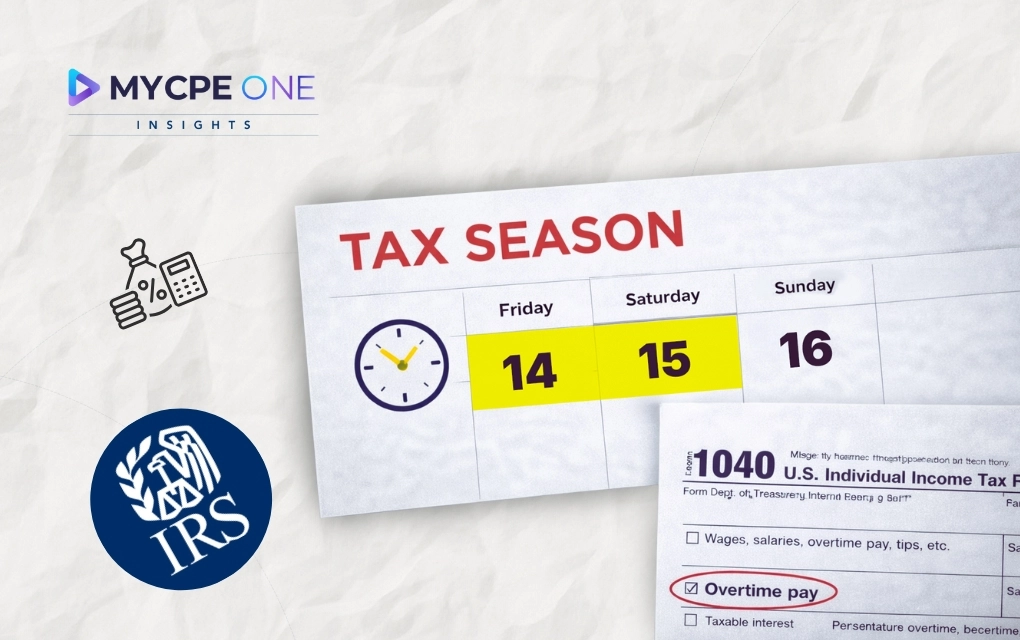
Overtime pay usually feels simple. You work late, you get time and a half, you move on. Then Congress adds a brand-new deduction, the IRS skips updating the W-2, and tax season opens anyway. Suddenly, everyone is staring at pay stubs as if they were evidence in a field audit. That is the situation heading into the 2025 filing season. The One Big Beautiful Bill Act quietly created a temporary overtime deduction, and the IRS responded with last-minute FAQs instead of form changes. Now tax professionals have to turn statutory fine print into something clients can actually file without blowing a gasket. This is not theoretical. This will hit real returns.

What is the overtime deduction?

For tax years 2025 through 2028, individuals may deduct qualified overtime compensation. The keyword is qualified. The deduction applies only to the portion of overtime pay that exceeds an employee’s regular rate, meaning the extra half required when someone earns time and a half under federal law. Not the full overtime payment. Not double time. Not holiday premiums.

If an employee earns $30 per hour and receives $45 for an overtime hour, only $15 qualifies. The rest remains fully taxable. This is a deduction, not an exclusion, so the income still flows through gross income before the benefit shows up below the line. Congress capped the deduction at $12,500 per return, or $25,000 for married couples filing jointly. It begins phasing out at $150,000 of modified adjusted gross income for single filers and $300,000 for joint filers. The target audience is obvious.

Who qualifies for the deduction?

Eligibility lives and dies with the Fair Labor Standards Act.

To qualify, the worker must be covered by the FLSA and not exempt from its overtime rules. That immediately removes a large group of professionals from the conversation. Executives, administrators, professionals, certain computer employees, and outside sales employees are all exempt. Yes, that includes CPAs. Independent contractors do not qualify. Many agricultural and seasonal workers do not qualify. Being paid extra for long hours does not matter if the law does not require it. Most hourly employees remain covered, especially those in retail, warehousing, manufacturing, construction, clerical, and administrative roles. Many federal and state government employees also qualify, which simplifies things slightly.

Why does FLSA status matter?

Because state law and employer generosity do not control this deduction.

California may require overtime after eight hours in a day. Some employers pay double time on weekends. Others count PTO toward weekly hours. None of that expands the deduction unless the overtime is required under federal FLSA rules. Payroll providers have already flagged the issue. Many employers pay overtime in ways that exceed federal requirements, which creates a split calculation. One number for total overtime paid. Another for overtime that qualifies for the deduction. The IRS has been clear. Federal law sets the boundary. Everything else is noise.

How is overtime reported in 2025?

This is where the wheels can wobble.

For tax year 2025, employers are not required to separately report qualified overtime compensation on Forms W-2 or 1099. The IRS chose penalty relief over redesigning forms ahead of tax season. That means taxpayers must reconstruct the deductible amount using pay stubs, payroll portals, or employer-provided documentation. The IRS allows reasonable methods, but that phrase invites scrutiny if numbers drift. The deduction is calculated on a new Schedule 1-A and eventually flows to Form 1040, line 13b. It sits alongside deductions for tips, car loan interest, and the enhanced deduction for seniors. Taxpayers do not need to itemize to claim it. Beginning in 2026, the IRS plans to require separate reporting of qualified overtime on W-2 and 1099 forms. Until then, expect confusion.

What firms should watch this Tax Season?

Expectation management is the real work here.

Clients will hear “overtime deduction” and assume a big payoff. In reality, the benefit is capped, phased out, limited to federal overtime rules, and dependent on documentation that many employers are not providing clearly. The smartest move is triage. Confirm FLSA eligibility first. If the client is exempt, stop there. If not, isolate the federal overtime premium only, not state enhancements or employer bonuses. There is also a withholding gap. Because payroll withholding did not change, some taxpayers may feel disappointed when the deduction does not move the needle the way they expected. That is not a math issue. That is a communication issue.

The IRS issued Fact Sheet 2026-01 just days before tax season for a reason. It also granted penalty relief for taxpayers who rely on the FAQs in good faith. While that guidance lacks precedential weight, it gives preparers a defensible position if they follow it carefully.

The Bottom Line

This deduction is real, narrow, and easy to misuse. The IRS did not bend the rules, expand eligibility, or simplify reporting. It handed professionals a ruler, a calculator, and a short runway. The firms that stay disciplined will do fine. Verify eligibility early. Document calculations. Set expectations before returns go out the door. Tax season already has enough chaos. This is one area where sticking to the federal math keeps everyone out of trouble.

Until next time…

Don’t forget to share this story on LinkedIn, X and Facebook

Subscribe now for $199 and get unlimited access to MYCPE ONE, from CPE credits to insights Magazine

📢MYCPE ONE Insights has a newsletter on LinkedIn as well! If you want the sharpest analysis of all accounting and finance news without the jargon, Insights is the place to be! Click Here to Join

Unlock Annual Access to News & CPE Subscription

You’ve reached the 3 free-content piece limit. Unlock unlimited access to all News & CPE resources.
Subscribe Today.

News & Updates

  • Exclusive News & Insights
  • Latest Regulatory Updates
  • Accounting Industry Trends
  • Expert Insights
  • AI-Driven Audio & Summaries
  • Infographics & Videos
  • CPE-Approved Articles
  • Digital Magazine
  • Benchmarking Blogs

Unlimited CPE Access for 1 Year

  • 15,000+ Hours of Content
  • 500+ Subject Areas
  • Mandatory Ethics Courses
  • 250+ Compliance Packages
  • 50+ Virtual Conferences and Events Access
  • Format: Live, Audio, Video, E-Books
  • Audio Based Courses & Podcasts
  • Add External Certificates with AI
  • AI Compliance Tracking and Report
  • Instant Certification and Fast Reporting
  • Mobile App Access (iOS and Android)
  • Dedicated Support System
  • Practical Training Programs
  • AI Academy Access
  • Tax Academy Access
  • Audit Academy Access
  • Leadership Academy Access