Join 250,000+
professionals today
Add Insights to your inbox - get the latest
professional news for free.
Join our 250K+ subscribers
Subscribe05 JAN 2026 / MONTHLY REGULATORY CAPSULE
The IRS, FASB, GASB, AICPA, and PCAOB have issued several significant regulatory updates and amendments that will shape the financial, auditing, tax, and regulatory landscape in 2026. Key announcements include the IRS's accelerated efforts to track financial crime, including tax fraud tied to digital payments, identity theft, and cyber schemes; changes to how the IRS communicates math error notices; the raising of the slot jackpot reporting threshold; and major shifts from the PCAOB on auditing and quality control systems.
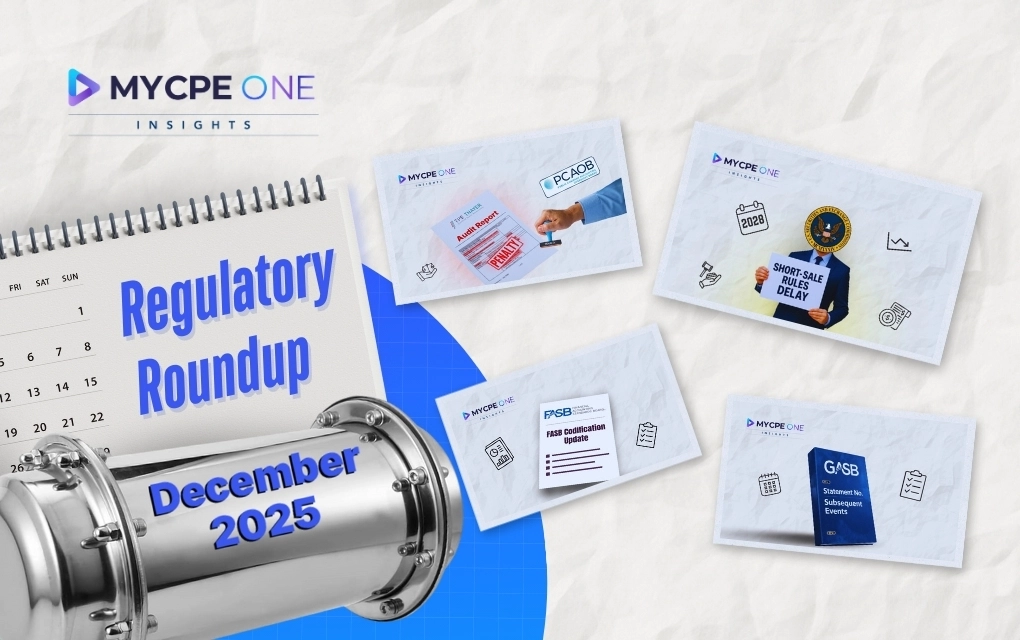
December didn’t just close the calendar year; it set the tone for the year ahead. As firms roll straight from year-end close into tax season, regulators are making it clear this is not a “reset and relax” moment. The IRS is entering filing season with record enforcement momentum, standard setters are cleaning up long-standing gray areas, and audit and market regulators are sharpening their focus on execution, not excuses. From GAAP refinements to audit discipline, investor protection, and tax administration, December’s regulatory activity reads like a checklist of what professionals will be judged on in 2026. This recap pulls together the most important compliance and regulatory developments you need on your radar right now, while there’s still time to adjust, not react.
IRS Criminal Investigation’s FY 2025 report reads less like an annual update and more like a warning shot. Despite staffing constraints, the agency identified $10.59 billion in financial crimes, driven by a sharp rise in complex tax fraud tied to digital payments, identity theft, and cyber-enabled schemes. Massive data seizures and headline-grabbing enforcement actions signal a permanent shift toward tech-driven investigations. For professionals, the message is clear: tax, AML, and cyber risks are now deeply intertwined, and enforcement is accelerating fast.
Trump administration officials are forecasting a record-breaking refund season, driven by tax cuts in the One Big Beautiful Bill Act and unchanged withholding tables. Treasury and IRS leadership say millions of taxpayers could see noticeably larger refunds before withholding adjustments catch up. New deductions for tips, overtime, and certain auto loans add to the mix, while Social Security tax relief looms large. The projections raise important planning questions for advisors as refund expectations collide with longer-term cash flow realities
The newly signed IRS Math and Taxpayer Help Act aims to fix one of the IRS’s most frustrating pain points: opaque math error notices. The law requires clearer explanations of adjustments, explicit calculations, and a firm 60-day window for taxpayers to challenge changes. A certified-mail pilot program adds another layer of accountability. For practitioners, this marks a meaningful shift toward transparency and stronger taxpayer rights, though how smoothly the IRS executes these changes remains to be seen.
After decades of stagnation, the IRS confirmed that the slot jackpot reporting threshold will rise to $2,000 starting in 2026 under the One Big Beautiful Bill Act. The change modernizes a rule untouched since 1977 and is expected to significantly reduce routine reporting on casino floors. While the update won’t apply retroactively, the IRS has signaled more guidance is coming, suggesting this long-awaited fix may still evolve as regulations are finalized.
The AICPA is taking direct aim at the profession’s growing private equity entanglements with a proposed overhaul of its ethics guidance on alternative practice structures. The exposure draft focuses on independence risks, investor influence, and increasingly complex firm alignments, shifting from vague principles to clearer triggers and documentation expectations. With public comments opening soon, the proposal signals that PE-backed firm models are no longer fringe issues but a core ethics priority the profession must now confront head-on.
Facing mounting pressure from passthrough complexity, the AICPA is urging Treasury and the IRS to rethink how partnerships and S corporations are reported. Its recommendations focus on advance notice, longer comment periods, coordination with software providers, and a serious reassessment of reporting burdens under the Paperwork Reduction Act. The message is straightforward: PTE reporting has become too cumbersome, and without structural simplification, compliance strain on practitioners will only keep intensifying.
ASU 2025-12 is FASB’s reminder that not all impactful updates come with headline-grabbing measurement changes. This Codification refresh targets 33 focused fixes, cleaning up definitions, correcting examples, and removing obsolete guidance that has long slowed research and judgment calls. Clarifications around diluted EPS during loss periods and tighter cross-referencing aim to reduce diversity in practice. For CPAs, the update is less about changing numbers and more about making GAAP faster to navigate, easier to defend, and less prone to misinterpretation.
FASB’s December 2025 interim reporting update delivers long-awaited structure to Topic 270 by clearly defining who must apply it and what interim financials should include. All interim GAAP financial statements now fall squarely under the guidance, with required disclosures consolidated into one place. A new principle-based requirement for disclosing material events since the year-end tightens consistency and judgment. The changes promise fewer interpretive debates and smoother reporting cycles, though teams will need to rethink disclosure checklists and materiality assessments.
After decades of silence, FASB has finally issued authoritative guidance on government grants with new Topic 832. The standard defines what qualifies as a grant, how recognition thresholds work, and how asset versus income grants should be accounted for. Longstanding reliance on IAS 20 and analogies is replaced with a clear GAAP framework, paired with expanded disclosure requirements. While effective dates are still a few years out, the shift signals the end of improvisation and the start of consistent, comparable grant reporting.
GASB Statement No. 105 aims to eliminate long-standing confusion around how governments handle events that occur after year-end but before financial statements are issued. Driven by inconsistent application under prior guidance, the update clarifies timing, definitions, and disclosure expectations, especially for debt-related activity. By clearly separating recognized from non-recognized subsequent events, GASB reduces judgment gray areas and improves comparability across state and local governments. With effective dates still ahead, finance teams now have time to tighten policies and align practices before scrutiny increases.
A recent wave of PCAOB enforcement actions shows how seemingly routine audits can unravel fast when discipline slips. Across multiple firms, the Board flagged skipped procedures, weak engagement quality reviews, late file locking, and sloppy Form AP reporting. What stands out is the PCAOB’s sharp focus on quality control systems, not just individual errors. With explicit citations and real penalties, the message is clear: documentation timing, supervision, and transparency are no longer soft spots, and enforcement scrutiny is only getting tighter.
The PCAOB’s sanction of TPS Thayer highlights rising enforcement pressure around cross-border audits, especially involving China-based work. The firm relied heavily on an unregistered foreign audit firm, failed to supervise properly, and omitted required disclosures to regulators and audit committees. The resulting penalties underscore a hard line from the PCAOB: outsourcing work does not outsource responsibility. As inspection access expands overseas, U.S. firms face shrinking tolerance for informal arrangements and heightened expectations around registration, oversight, and transparency.
The SEC’s latest delay of its short-sale and stock-lending disclosure rules has reignited debate over whether transparency reform is being paused or quietly diluted. With compliance now pushed into 2028, court challenges and industry pushback are clearly shaping the timeline. Critics warn repeated extensions risk undermining market visibility, while supporters argue the operational burden was underestimated. As legal review continues, the core tension remains unresolved: how to balance market transparency with implementation complexity in a politically charged rulemaking environment.
The SEC’s enforcement action against multiple fake crypto platforms and investment clubs highlights how social media-driven scams continue to evolve. According to the complaint, fraudsters used AI-themed investment pitches, group chats, and fabricated trading platforms to build trust and siphon millions from retail investors. The case underscores the SEC’s growing focus on digital confidence scams and reinforces a familiar warning for professionals and investors alike: flashy tech narratives and online communities are no substitute for basic verification.
In charging Nathan Gauvin and his affiliated entities, the SEC is once again spotlighting how online communities can be weaponized against retail investors. The complaint alleges false credentials, inflated performance claims, and fake fund valuations used to raise more than $18 million, much of which was misappropriated. Paired with parallel criminal charges, the case sends a clear signal that the SEC is aggressively policing fraud tied to Discord and similar platforms, where credibility can be manufactured quickly, and losses pile up fast.
If December taught us anything, it’s that 2026 is shaping up to be a year of follow-through. Regulators aren’t introducing chaos; they’re closing loopholes, clarifying expectations, and enforcing basics that should already be working. As tax season ramps up, audit plans get finalized, and financial statements head toward issuance, the margin for “we’ll fix it later” is shrinking fast. Strong documentation, clean disclosures, disciplined controls, and proactive issue resolution are no longer best practices; they’re survival skills. Firms that treat these updates as part of their year-end resolution list will enter 2026 ahead of the curve. Those that don’t may find regulators asking questions before they’ve had time to catch their breath.
Until next time…
Don’t forget to share this story on LinkedIn, X and Facebook
Subscribe now for $199 and get unlimited access to MYCPE ONE, from CPE credits to insights Magazine
📢MYCPE ONE Insights has a newsletter on LinkedIn as well! If you want the sharpest analysis of all accounting and finance news without the jargon, Insights is the place to be! Click Here to Join
You’ve reached the 3 free-content piece limit. Unlock unlimited access to all News & CPE resources.
Subscribe Today.
Already have an account?
Sign In