Join 250,000+
professionals today
Add Insights to your inbox - get the latest
professional news for free.
Join our 250K+ subscribers
Subscribe05 MAY 2026 / MONTHLY REGULATORY CAPSULE
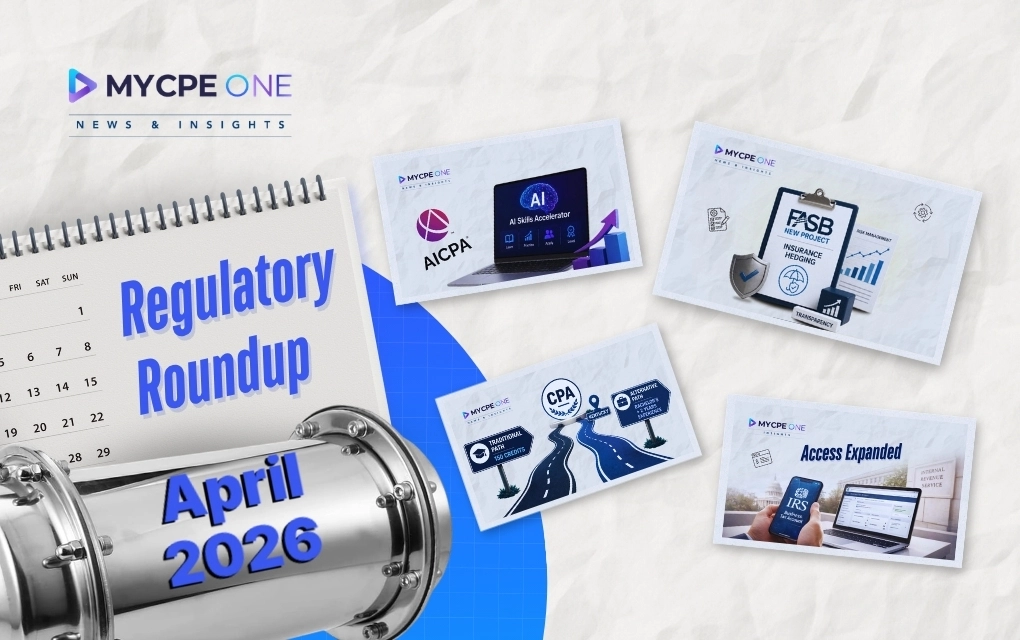
The month of April 2026 saw significant updates from regulatory bodies like the IRS, SEC, PCAOB, FASB, and AICPA, who are increasingly pushing for greater transparency, control, and accountability in financial practices. Highlights include the IRS tightening regulations on non-profits and implementing new tax rules, the SEC challenging enforcement limits, the PCAOB revising audit oversight, FASB's new moves on cryptocurrency and insurance accounting, and AICPA's emphasis on AI readiness.
April 2026 didn’t slow down on the compliance front; it doubled down. From the IRS tightening visibility on nonprofits and rolling out new tax rules, to the SEC navigating enforcement limits and the PCAOB recalibrating audit oversight, regulators are clearly pushing for more transparency, control, and accountability. Add in FASB’s moves on crypto and insurance accounting, plus AICPA’s focus on AI readiness, and you’ve got a month that signals one thing: the rules aren’t just evolving, they’re getting sharper. Here’s a quick breakdown of what actually matters.
Form 990 is no longer just a quiet annual filing for tax-exempt organizations. The IRS is pushing for deeper disclosures around government grants, contracts, fiscal sponsorships, governance, and executive compensation. That means nonprofits may need to show exactly who controls funds, how money moves, and where it ultimately lands. With fiscal sponsorships and related-party dealings now getting sharper attention, this “simple” form is starting to look more like an audit trail than paperwork.
The IRS has a lot going on as 2026 tax rules take shape. A new 1% remittance excise tax will apply to certain physical transfers sent abroad, while digital transfers appear outside the scope for now. At the same time, the IRS has clarified who qualifies under the “No Tax on Tips” rules and what counts as a real tip. Add April filing pressure to the mix, and tax pros have plenty to unpack.
New tax laws bring new confusion, and scammers know exactly how to cash in on it. The IRS is warning taxpayers about fake calculators, ghost preparers, and phishing schemes tied to OBBBA deductions for tips, overtime, and seniors. These scams promise big refunds with little documentation, often using polished, AI-written messages. For firms and finance teams, the issue is no longer just client awareness. It is an operational risk.
A tax extension gives taxpayers more time to file, not more time to pay. That simple distinction continues to trip up clients every year, especially when they file a “zero extension” without estimating or paying what they owe. For 2026, IRS automation and faster data matching make rough estimates even more important. Extensions can still be useful, but only when they are planned carefully, not treated like a free delay.
The SEC’s case against John R. Brodacki III and Castle Hill Financial Group shows how quickly client trust can turn into enforcement trouble when process disappears. Clients allegedly sent funds outside normal custodial channels, expecting investments in diversified products, but the money was reportedly diverted to personal and firm expenses. With Brodacki now deceased, the case shifts toward asset tracing, estate recovery, clawbacks, and the bigger question of how off-platform transfers went unchecked
The SEC’s disgorgement power is back under Supreme Court scrutiny, and the stakes are huge. At issue is whether the agency can force wrongdoers to give up illicit profits when victim losses are hard to quantify. Supporters say disgorgement keeps market misconduct from becoming a cost of doing business, while critics argue the SEC uses it too broadly. The case could reshape enforcement actions, from penny stock fraud to major disclosure disputes.
FASB is exploring whether to extend the portfolio layer method to insurance liabilities, aiming to close a long-standing gap between economic hedging and GAAP reporting. Insurers already use derivatives to manage interest rate risk, but current rules often create uneven earnings volatility. If expanded, this approach could better align gains and losses, reduce reliance on non-GAAP explanations, and improve financial clarity, though questions around scope and application still need to be resolved.
FASB’s ASU 2023-08 brings crypto assets like Bitcoin and Ethereum into fair value accounting, with gains and losses flowing directly through earnings. This replaces the old model that only recognized losses, often leaving financials disconnected from market reality. The update also introduces stricter disclosure requirements around holdings, valuation, and restrictions. While this improves transparency, it also means financial statements will now reflect crypto market swings much more visibly.
A surprising number of PCAOB-registered firms are staying on the sidelines, with over 60% performing no issuer or broker-dealer audits in 2025. The reasons go beyond simple choice, ranging from heavy compliance costs and litigation exposure to a market dominated by larger firms. While registration remains mandatory under SOX, the PCAOB is signaling that inactive status may not remain acceptable, raising questions about whether “registered but idle” will continue to hold value.
The PCAOB is reconsidering parts of its QC 1000 quality control framework after significant pushback from audit firms. While the standard aims to strengthen governance and internal audit systems, firms argue it adds cost and complexity without clear benefits. The board now appears to be shifting toward a more balanced approach, seeking stakeholder input and exploring targeted revisions, but the broader direction of tighter oversight and stronger accountability is unlikely to change.
Audit committees are asking sharper questions about AI, risk, and internal controls, and the AICPA is responding with its AI Skills Accelerator. Built with input from senior finance leaders, the program focuses on governance, practical adoption, and real-world application of AI in finance. As expectations for transparency and accountability rise, this initiative aims to help professionals move from experimentation to audit-ready implementation, where decisions driven by AI can withstand scrutiny.
The AICPA’s latest financial literacy push focuses on the real questions clients keep asking about retirement, taxes, investing, and long-term planning. Instead of theory, the guidance emphasizes practical steps like building emergency funds, stress-testing retirement income, and creating tax diversification across account types. As financial uncertainty grows, the message is clear: clients don’t just want answers, they want context, clarity, and plans that can hold up when life doesn’t go as expected.
Kentucky’s new legislation introduces an alternative CPA licensure pathway, allowing candidates to qualify with a bachelor’s degree, two years of experience, and the CPA exam. While the traditional 150-hour route remains, this added flexibility aims to address talent shortages without lowering standards. As more states explore similar changes, this move signals a broader shift toward balancing accessibility with maintaining the credibility of the CPA credential.
Maryland has joined the growing number of states offering multiple pathways to CPA licensure, including a new experience-first route that values real-world work over additional academic credits. With strong legislative support, the change reflects ongoing concerns around talent shortages and rising education costs. By keeping the CPA exam intact while expanding entry options, Maryland is aligning with a nationwide trend that prioritizes both rigor and accessibility
If there’s a common thread across April’s updates, it’s this: regulators want clearer data, stronger controls, and fewer gray areas. Whether it’s the IRS pushing traceability, the SEC defending enforcement tools, or the PCAOB tightening audit quality expectations, the direction is consistent. For professionals, this isn’t about reacting later, it’s about staying ahead now. Because as systems get smarter and oversight gets tighter, the margin for “we’ll fix it later” is disappearing fast.
Until next time…
Don’t forget to share this story on LinkedIn, X and Facebook
Subscribe now for $199 and get unlimited access to MYCPE ONE, from CPE credits to insights Magazine
📢MYCPE ONE Insights has a newsletter on LinkedIn as well! If you want the sharpest analysis of all accounting and finance news without the jargon, Insights is the place to be! Click Here to Join
You’ve reached the 3 free-content piece limit. Unlock unlimited access to all News & CPE resources.
Subscribe Today.
Already have an account?
Sign In