Join 250,000+
professionals today
Add Insights to your inbox - get the latest
professional news for free.
Join our 250K+ subscribers
Subscribe04 AUG 2025 / MONTHLY REGULATORY CAPSULE
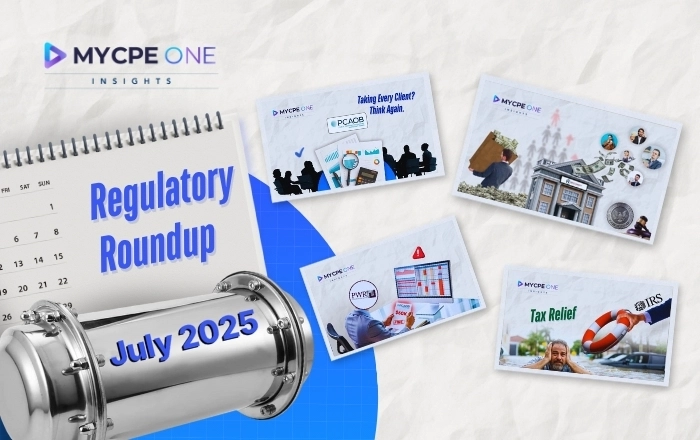
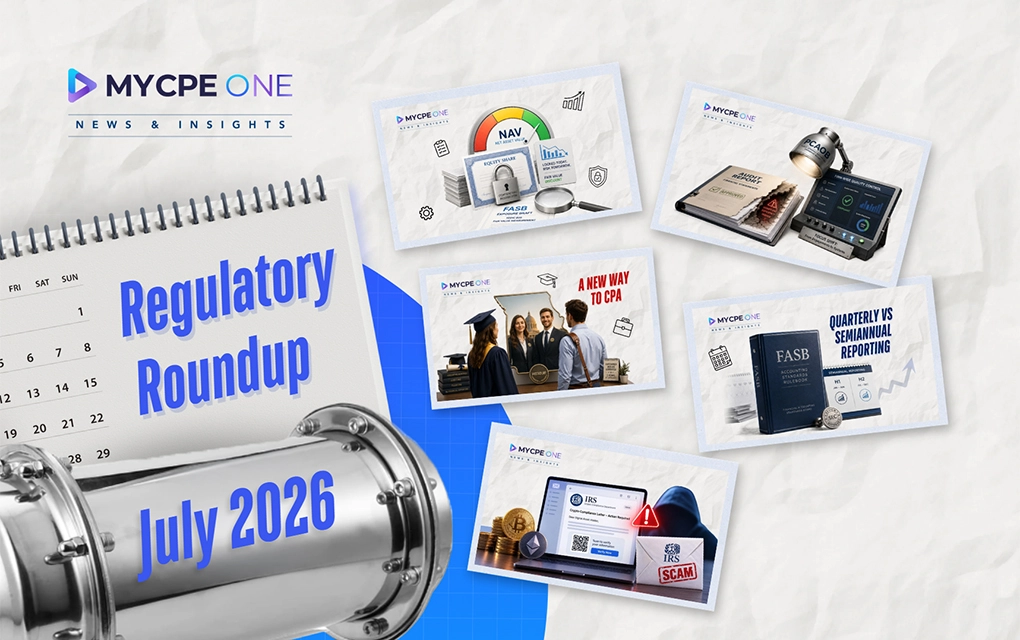
In July, the IRS targeted federal workers over back taxes, changed corporate audit protocols, provided tax relief for Texas storm victims, and demanded improved data protection from tax professionals. Meanwhile, the SEC opened up crypto ETFs and 401(k) plans and concluded a significant Ponzi scheme and an accounting probe. Regulatory bodies PCAOB and AICPA boosted audit oversight with severe penalties and updated fraud detection rules while supporting tax relief for abuse survivors. Furthermore, AICPA & CIMA introduced a Business Resilience Toolkit and North Carolina altered CPA licensure requirements. These changes reflect crucial shifts in tax, financial audit, and licensing protocols, impacting those in public practice, corporate compliance, and advisory roles.
July didn’t just bring regulatory updates; it brought turning points. The IRS took aim at federal workers over back taxes and revamped how corporate audits get done. The SEC opened the floodgates for crypto ETFs and 401(k) plans, while PCAOB penalties hit harder than ever, signaling a crackdown on audit complacency. Meanwhile, AICPA pushed for smarter fraud detection and backed critical tax relief for abuse survivors. Whether you’re in public practice or industry, these shifts aren’t background noise; they’re strategic inflection points. If you're advising clients, managing compliance teams, or planning your next career move, these are the updates you can’t afford to miss. Let’s break down what mattered, what moved, and what’s coming next.
The IRS sent over half a million federal workers a vague but ominous LT36 notice last month, part of a revived FERDI enforcement push that lets the agency garnish paychecks and pensions with minimal warning. The timing? Just as new OPM rules threaten jobs for tax noncompliance. Attorneys are calling it a “heat check before mass enforcement.” Is this cleanup, or quiet trimming? Click to explore the letter, legal risks, and what to do if you got one.
In a rare customer-friendly twist, the IRS is streamlining large corporate audits by killing off redundant paperwork and expanding tools like AIR and Fast Track Settlement. It’s part of a memo-driven push to cut audit cycle times and reduce friction with taxpayers. With more transparency, fewer delays, and less red tape, this LB&I shift might actually live up to the hype, but there’s more to the story.
After deadly floods swept through Kerr County, the IRS moved quickly with extended deadlines and automatic penalty relief. A new federal law now allows tax relief based on state-level disaster declarations, giving faster support to victims. The new rules, extended timelines, and casualty claim options offer rare breathing room, but only for those who act fast. See who qualifies, what forms to use, and which counties might be next.
The IRS is cracking down on data protection with its latest summer campaign, reminding all tax pros they must legally maintain a Written Information Security Plan (WISP). Backed by the FTC and the Gramm-Leach-bliley Act, this mandate isn’t optional, and failure to comply could mean penalties or worse after a breach. The IRS even offers a free WISP template, but many firms still aren’t ready. See what’s required and how to stay compliant.
The SEC just flipped the script on crypto ETFs, approving in-kind redemptions for Bitcoin and Ethereum funds, cutting fees, boosting liquidity, and signaling that crypto is no longer the awkward cousin at the ETF table. With Paul Atkins at the helm, the SEC is fast-tracking efficiency, even raising Bitcoin options limits. But before you pop the champagne, concerns over custody, valuation, and inter-agency conflicts still loom large.
Crypto could soon join gold and private equity in your 401(k), but SEC Chair Paul Atkins wants full transparency first. In coordination with the GENIUS Act and a looming White House executive order, Atkins is pushing disclosure rules before digital assets hit retirement portfolios. Meanwhile, a brewing turf war with the Labor Department raises serious compliance questions. Advisors, get ready: clients will want answers, and fast.
Brant Frost IV promised Main Street returns with Wall Street flash and delivered a $140M Ponzi scheme instead. The SEC says nearly 300 investors, many tied to Frost’s religious and political networks, were duped with fake gains and phony bridge loans. Now, the house of cards is collapsing, assets are frozen, and lawsuits are looming. But this is more than fraud, it’s a lesson in trust, due diligence, and how schemes still thrive in plain sight.
After months under scrutiny, CSX Corp. got the all-clear from the SEC over past accounting errors tied to labor and scrap costs. The company quietly corrected the issues without restating financials, and the Commission has now closed its investigation with no enforcement action. It’s a regulatory sigh of relief for the railroad giant, but questions remain about internal controls and how close the line was to a bigger breakdown.
Centurion ZD CPA & Co. just became the poster child for what not to do in auditing. The PCAOB revoked the firm’s registration and permanently barred its lead partner after a disastrous audit of Luckin Coffee, ignoring red flags in the wake of a $300M fraud. With inspection rights finally granted in China and Hong Kong, this case sends a message loud and clear: the audit bar just got higher. Who’s next on the enforcement radar?
PWR CPA learned the hard way that ignoring basics like fraud risk assessments, filing deadlines, and vetting new partners isn’t just sloppy, it’s sanctionable. The PCAOB fined the Houston firm $60K and barred it from registration until major changes are made. The case reflects the Board’s aggressive new enforcement streak and is a reminder that even non-Big Four shops aren’t immune. Could your firm pass today’s inspection gauntlet?
Before the first audit step comes the most overlooked one: client acceptance. In its latest audit focus memo, the PCAOB lays out best practices, from vetting scorecards to partner capacity checks, that separate strong firms from future headlines. As independence violations surge and quality controls face new pressures, the message is clear: say “no” more often and say it with rigor. Is your firm ready to stop the failure before it starts?
The AICPA’s Auditing Standards Board released a bold proposal aimed at sharpening how auditors detect, assess, and respond to fraud. From mandatory retrospective reviews to expanded requirements around management override and qualitative materiality, the exposure draft marks a significant overhaul. If finalized, these changes would replace AU-C Section 240 and could reshape audit training and execution through 2028 and beyond. So, what does this mean for your firm’s current approach to risk?
The AICPA is backing the bipartisan SAFE Act, a bill that would allow survivors of domestic abuse or abandonment to file taxes as if unmarried, cutting financial ties to their abusers and ensuring access to credits and deductions. The move has widespread support from advocacy groups and is being hailed as a critical step toward tax equity and survivor protection. Could this be the beginning of broader tax system reforms to protect vulnerable filers?
To help firms weather economic turbulence, AICPA & CIMA dropped a practical Business Resilience Toolkit packed with frameworks, risk-mapping tools, and strategic prompts. From inflation shocks to tax policy shifts, the guide is built to turn uncertainty into opportunity. With financial leaders now expected to be strategic business partners, the toolkit aims to support that evolution. Is your team equipped to pivot from reactive to proactive?
In a landmark shift, North Carolina passed a bipartisan bill creating a second path to CPA licensure, one that ditches the 150-credit-hour college requirement in favor of real-world experience. Starting in 2026, candidates can qualify with 120 hours and two years of work. This isn’t just state-level reform, it’s a blueprint for fixing the CPA pipeline crisis without lowering the bar. Other states are watching. Will your firm or school be ready when the ripple effect hits?
This month proved that compliance is no longer just a checkbox; it’s a competitive advantage. From North Carolina redefining CPA access to the PCAOB tightening engagement screening, July’s changes sent a clear message: evolve or get left behind. Financial professionals are being asked to lead in new ways, interpreting complex rules, spotting early risks, and helping clients stay agile amid nonstop change. Whether you're tracking crypto regulation, decoding new audit standards, or rethinking firm hiring policies, the game is shifting fast. Staying informed isn’t optional anymore; it’s part of the job. Want to stay ahead without drowning in jargon? Keep reading MYCPE ONE Insights. We’ve got your back.
Until next time…
Don’t forget to share this story on LinkedIn, X and Facebook
Subscribe now for $199 and get unlimited access to MYCPE ONE, from CPE credits to insights Magazine
📢MYCPE ONE Insights has a newsletter on LinkedIn as well! If you want the sharpest analysis of all accounting and finance news without the jargon, Insights is the place to be! Click Here to Join
Scale Your Accounting Firm the Smart Way with MYCPE ONE!
Your Trusted Offshore Partner for CPAs and Accounting Firms.
Struggling to scale? Let MYCPE ONE’s offshore accounting team help you grow faster and more efficiently.
With 500,000+ vetted professionals across 40 offices in 2 countries, we provide you access to top talent and advanced technology, all while handling the hiring process for you.
Trusted by 3,000+ firms, including 45+ BDO Alliance Firms and 40+ of the Top 200 Accounting Firms!
Start building your offshore dream team today with MYCPE ONE!
Scale smarter. Save bigger. Stay ahead.
You’ve reached the 3 free-content piece limit. Unlock unlimited access to all News & CPE resources.
Subscribe Today.
Already have an account?
Sign In