Join 250,000+
professionals today
Add Insights to your inbox - get the latest
professional news for free.
Join our 250K+ subscribers
Subscribe05 MAR 2026 / ACCOUNTING & TAXES
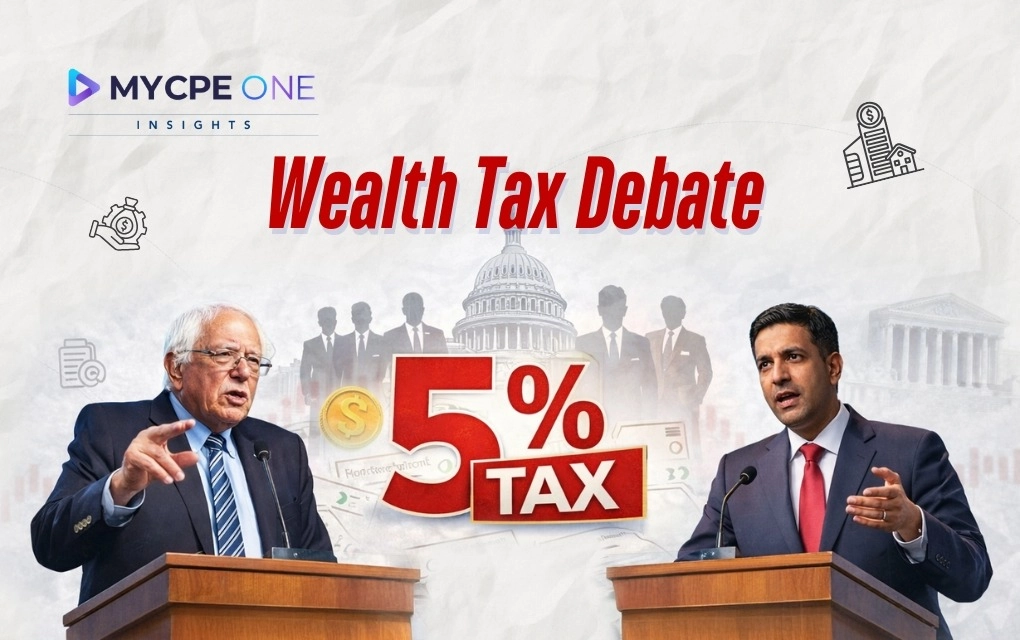
Senator Bernie Sanders and Representative Ro Khanna have proposed a new bill called the "Make Billionaires Pay Their Fair Share Act". The proposal would impose a 5% annual tax on Americans with a net worth over $1 billion, potentially generating an estimated $4.4 trillion in tax revenue over the next decade. This bill, targeted at addressing rising wealth inequality, would fund social programs such as $3,000 payments to households under $150,000 income, expanding Medicare, funding affordable housing, raising minimum salaries for teachers, and limiting childcare costs.
Imagine opening your mailbox and finding a $3,000 check from the federal government. That’s the headline-grabbing promise behind a new proposal from Senator Bernie Sanders and Representative Ro Khanna. Their bill, the “Make Billionaires Pay Their Fair Share Act,” would impose a 5% annual tax on Americans worth more than $1 billion. It sounds simple on the surface: tax the ultra-rich and redirect the revenue to working families. But the stakes are enormous. The plan targets about 938 billionaires who collectively hold roughly $8.2 trillion in wealth. Economists estimate the tax could generate $4.4 trillion over the next decade. Supporters call it overdue. Critics call it dangerous. And in Silicon Valley and Wall Street boardrooms, the question everyone is asking is the same: Is this a fair correction to rising inequality, or the start of a billionaire exodus?
To understand why this proposal is gaining traction now, start with one eye-popping statistic: U.S. billionaire wealth has surged 132% in just six years. Economists Emmanuel Saez and Gabriel Zucman estimate that billionaire fortunes grew 22% in 2025, 28% in 2024, and 20% in 2023. Meanwhile, the typical American household has struggled to keep pace with rising costs. Childcare alone eats up 8.9% to 16% of median household income, according to Department of Labor data. Housing shortages persist, and millions of Americans live paycheck to paycheck. Sanders framed the issue bluntly when introducing the bill: “At a time of unprecedented income and wealth inequality, this legislation demands that the billionaire class finally pay their fair share so we can create an economy that works for all of us.”
Khanna echoed the same divide, pointing out that while places like Silicon Valley generate extreme wealth, many families struggle to cover basic costs such as healthcare and housing. In other words, the wealth gap is no longer an academic debate. In Washington, it’s becoming political ammunition.
The timing is not random. This proposal lands at a moment when economic inequality, political strategy, and fiscal pressure are colliding.
In the first year alone, supporters say the program could deliver $12,000 to a family of four.
For progressive lawmakers, the pitch is simple: if billionaires have benefited most from the modern economy, they should contribute more to sustain it.
The numbers quickly become staggering when applied to the richest individuals in America. Based on current estimates:
Supporters argue that even after those payments, these individuals would remain extraordinarily wealthy. Musk, for example, would still retain roughly $792 billion after the first year. Over time, however, the tax could reshape billionaire fortunes. Economists estimate that if a 5% wealth tax had existed over the past decade, many top fortunes would be dramatically smaller today. For example, Bezos’s wealth might be closer to $61 billion instead of more than $240 billion. The goal is not just revenue, supporters say. It’s to slow the pace at which wealth compounds at the very top of the economic ladder.
The biggest criticism of wealth taxes has always been the same: the rich will simply leave. We’ve already seen hints of this behavior. States such as California and New York have debated wealth taxes or millionaire surtaxes, prompting warnings that high-net-worth individuals might relocate to lower-tax states like Florida or Texas. But the federal proposal changes the math. Because the Sanders-Khanna tax would apply nationwide, moving to another state wouldn’t eliminate the obligation. The only true escape route would be renouncing U.S. citizenship, which triggers a hefty exit tax. Some economists also argue that billionaire mobility is overstated. Research from states with higher income taxes suggests that wealthy individuals rarely relocate solely for tax reasons.
Lifestyle factors, business ties, and investment networks often anchor them in place. That doesn’t mean there would be zero impact. Wealth advisors expect billionaires to respond with aggressive tax planning, asset restructuring, and legal challenges. But a mass migration? The evidence so far suggests that the scenario may be more political rhetoric than economic reality.
Implementing a wealth tax introduces a set of technical challenges that accountants, tax attorneys, and financial professionals would need to address. Many billionaire fortunes are tied up in illiquid assets such as private companies or startup equity. Determining annual market value for those assets could spark frequent disputes with tax authorities. Some proposals suggest allowing founders to defer tax payments until a liquidity event, such as a stock sale or IPO. There are also unresolved legal questions. The United States has historically taxed income rather than net wealth, meaning any federal wealth tax would likely face constitutional challenges. Financial professionals expect the result could be years of litigation and regulatory guidance if such a system were implemented.
Whether the Sanders-Khanna proposal becomes law or not, it signals something bigger: the wealth-tax debate is moving from theory to mainstream politics. With billionaire wealth surging and economic inequality dominating public discussion, policymakers are increasingly willing to test bold ideas. For financial professionals, the implications are huge. If wealth taxes gain traction, the industry could see a surge in valuation disputes, asset restructuring strategies, and cross-border tax planning. For billionaires, the message is clear: the era of lightly taxed extreme wealth may be facing its biggest political challenge yet. And for everyone else? The debate over who should pay for America’s future is just getting started.
Until next time…
Don’t forget to share this story on LinkedIn, X and Facebook
Subscribe now for $199 and get unlimited access to MYCPE ONE, from CPE credits to insights Magazine
📢MYCPE ONE Insights has a newsletter on LinkedIn as well! If you want the sharpest analysis of all accounting and finance news without the jargon, Insights is the place to be! Click Here to Join
You’ve reached the 3 free-content piece limit. Unlock unlimited access to all News & CPE resources.
Subscribe Today.
Already have an account?
Sign In