MYCPE ONE
MYCPE ONE LOGO

Join 250,000+
professionals today

Add Insights to your inbox - get the latest
professional news for free.

MYCPE ONE insights

Fragmented Audits and the Fall of a £2.7B Lending Empire

Join our 250K+ subscribers

Join our 250K+ subscribers

Subscribe

10 MAR 2026 / ACCOUNTING & TAXES

Fragmented Audits and the Fall of a £2.7B Lending Empire

Fragmented Audits and the Fall of a £2.7B Lending Empire

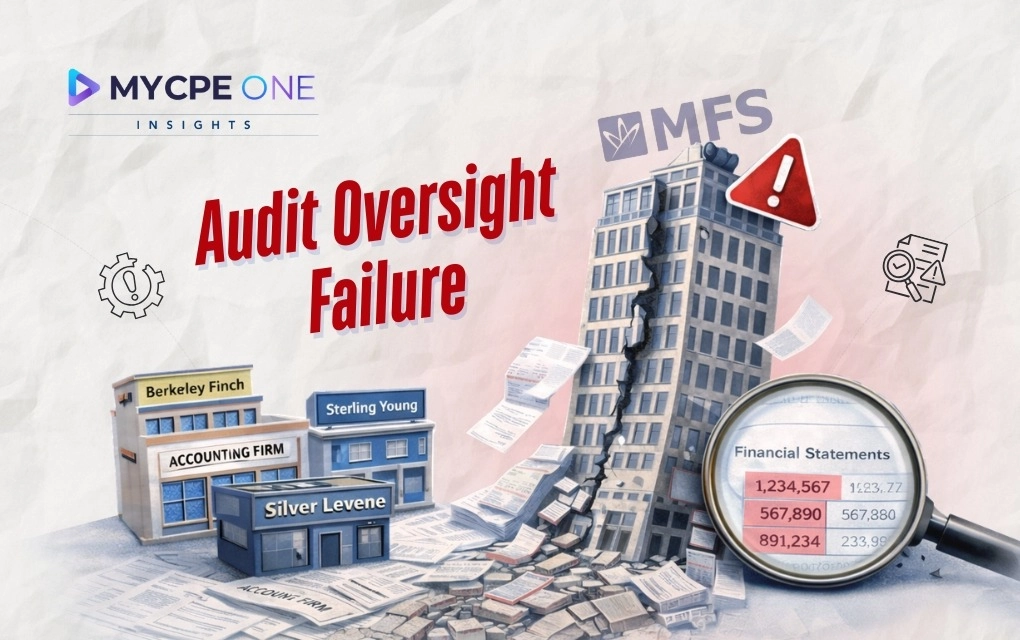
When a financial empire collapses, the first instinct is to ask who lost money. But sometimes the sharper question is who signed off on the numbers in the first place. That question now hangs over the dramatic collapse of Market Financial Solutions (MFS), a London-based property lender that quietly built a £2.5–£2.7 billion loan book before tumbling into administration and leaving creditors staring at a potential £930 million collateral gap. Banks, including Barclays, Apollo’s Atlas SP Partners, Jefferies, Santander, Wells Fargo, and TPG, suddenly found themselves exposed to billions in loans tied to the firm. And now a very uncomfortable realization is setting in across the financial industry. A lender handling billions in property loans was being audited by a patchwork of small accounting firms, some with just a handful of employees. As one senior UK auditor told the Financial Times, “It is a pulsating red flag when there is a patchwork quilt of small audit firms who can only ever see part of the picture.” That comment pretty much sums up why the MFS collapse has accountants, regulators, and lenders all asking the same question. How did the numbers pass inspection?

A Lending Boom Built on Speed

To understand the accounting problem, you first have to understand the business model. Founded in 2006 by Paresh Raja, MFS operated in the fast-growing niche of bridging finance, short-term property-backed loans used when borrowers need quick funding before securing long-term financing. Think of it as a financial pit stop.

The formula is simple:

  • rapid approvals
  • higher interest rates
  • heavy reliance on collateral

Over the past decade, as traditional banks pulled back from riskier lending after stricter regulations, non-bank lenders like MFS stepped into the gap. The result was explosive growth. Internal documents showed the company tripled its loan book over four years, reaching roughly £2.7 billion by 2025, supported by more than £2 billion in institutional funding from global banks and private credit funds. From the outside, it looked like another private credit success story. But behind the scenes, the audit structure looked surprisingly fragile. Instead of a single consolidated group audit by a major accounting firm, multiple smaller firms audited different pieces of the lending empire.

These included:

  • Berkeley Finch, which signed off on MFS’s 2024 accounts
  • Silver Levene, which audited parts of the group such as Zircon Bridging
  • Sterling Young, a firm with roughly four employees
  • FW Smith Riches & Co, which handled other subsidiaries

In isolation, none of these firms was doing anything unusual. But together, they created a fragmented audit environment where no single firm necessarily had a full view of the group’s financial exposure. That’s when the situation started looking a little sketchy.

The Accounting Puzzle Behind the Collapse

The crisis erupted in February 2026, when MFS entered administration, the UK’s version of insolvency protection. What investigators uncovered quickly raised eyebrows across financial markets. Creditors alleged that:

Source: Financial Times

  • £238 million in borrower repayments could not be accounted for
  • Collateral may have been double pledged across multiple lenders
  • Lenders backing £1.2 billion in exposure may have only £230 million in “true value” collateral

For context, in asset-backed lending, the collateral typically exceeds the loan value by 105% to 120%, creating a safety buffer. Here, the math appeared upside down.

Angela Gallo, a finance lecturer at Bayes Business School, summed it up bluntly: “To put it bluntly, having only £230 million against £1.2 billion in debt is catastrophic. This definitely looks like a mess.” The alleged problem centers on double pledging, where the same collateral is used to secure multiple loans. If true, it creates the illusion of strong collateral coverage when the assets are already committed elsewhere. In complex lending structures involving dozens of subsidiaries and properties, this kind of issue can hide in plain sight. And that’s where fragmented auditing becomes a serious accounting risk.

When a Patchwork Audit Structure Creates Blind Spots

In the MFS case, investigators are examining whether the use of multiple smaller audit firms created systemic blind spots in financial oversight. Three areas stand out.

  • Collateral Verification: Property-backed loans depend heavily on accurate valuations and clear ownership records. If the same property is pledged to several lenders, it can create inflated collateral coverage. Without centralized verification, duplicate pledges can slip through unnoticed.
  • Loan Book Transparency: Fast-growing lenders often refinance loans, move exposures between facilities, or restructure debt. When loan books expand rapidly, accounting complexity can outpace audit scrutiny. Reconstructing the full exposure becomes extremely difficult once the structure spans dozens of entities.
  • Institutional Due Diligence: Perhaps the most uncomfortable part of the story is that major global lenders relied on the audited numbers. Barclays alone reportedly has about £600 million of exposure, while Apollo’s Atlas SP Partners is tied to roughly £400 million. In private credit markets, where transparency is thinner than in public markets, investors often rely heavily on external audits and internal reporting.

If those systems are fragmented, problems can multiply quickly.

What Accounting and Finance Professionals Should Learn from This Mess

For accountants, auditors, and finance professionals, the MFS collapse is more than just another credit scandal. It’s a textbook case of how oversight structures can quietly weaken while balance sheets explode. Here are three key lessons.

Fragmented Auditing Creates Risk

  • Using multiple audit firms is not automatically problematic.
  • But when a financial institution grows rapidly, coordination between auditors becomes essential.
  • Without a consolidated group audit, important financial signals can disappear in the noise.

Private Credit Demands Deeper Collateral Testing

  • The private credit boom, now worth roughly $1.8 trillion globally, often involves complex asset-backed structures. Auditors increasingly need to verify:
    • collateral ownership
    • valuation assumptions
    • pledge exclusivity

These checks are becoming just as important as reviewing financial statements.

Rapid Growth Should Trigger Professional Skepticism

  • When a lender triples its loan book in a few years, accountants should ask one simple question. Are the controls growing as fast as the balance sheet?

Because if they are not, the balance sheet may be telling a story that is just a little too good to be true.

The Bigger Picture

The MFS collapse is the latest shock to hit private credit markets. Similar allegations of double pledging appeared in the failures of First Brands Group and Tricolor Holdings in the United States, both now under fraud investigation. JPMorgan CEO Jamie Dimon warned last year that more “cockroaches” could be lurking in credit markets, referring to hidden risks that emerge once one failure exposes the next. The MFS episode may prove to be another one of those moments. For accounting professionals, the message is clear. In a world where billions can move through complex lending structures, the size of the audit must match the size of the risk. Because if it doesn’t, the next collapse might not just expose a flawed lender. It might expose the entire financial ecosystem that signed off on it.

Until next time…

Don’t forget to share this story on LinkedIn, X and Facebook

Subscribe now for $199 and get unlimited access to MYCPE ONE, from CPE credits to insights Magazine

📢MYCPE ONE Insights has a newsletter on LinkedIn as well! If you want the sharpest analysis of all accounting and finance news without the jargon, Insights is the place to be! Click Here to Join

Unlock Annual Access to News & CPE Subscription

You’ve reached the 3 free-content piece limit. Unlock unlimited access to all News & CPE resources.
Subscribe Today.

News & Updates

  • Exclusive News & Insights
  • Latest Regulatory Updates
  • Accounting Industry Trends
  • Expert Insights
  • AI-Driven Audio & Summaries
  • Infographics & Videos
  • CPE-Approved Articles
  • Digital Magazine
  • Benchmarking Blogs

Unlimited CPE Access for 1 Year

  • 15,000+ Hours of Content
  • 500+ Subject Areas
  • Mandatory Ethics Courses
  • 250+ Compliance Packages
  • 50+ Virtual Conferences and Events Access
  • Format: Live, Audio, Video, E-Books
  • Audio Based Courses & Podcasts
  • Add External Certificates with AI
  • AI Compliance Tracking and Report
  • Instant Certification and Fast Reporting
  • Mobile App Access (iOS and Android)
  • Dedicated Support System
  • Practical Training Programs
  • AI Academy Access
  • Tax Academy Access
  • Audit Academy Access
  • Leadership Academy Access