Join 250,000+
professionals today
Add Insights to your inbox - get the latest
professional news for free.
Join our 250K+ subscribers
Subscribe13 JAN 2026 / ACCOUNTING & TAXES
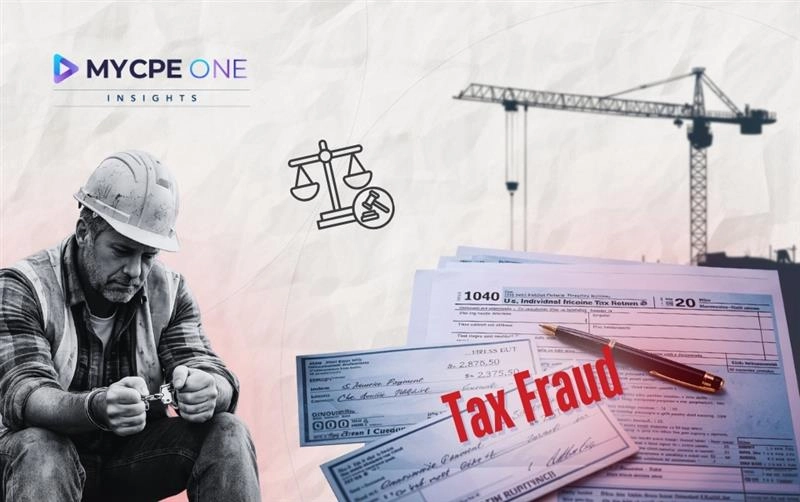
John Michael Sacco, owner of JMS Contracting, and Dariusz Pietron, owner of TJM Construction and Point Construction, have been found guilty by the IRS of long-running tax schemes for failing to property handle and report cash transactions. The case highlights that cash-heavy businesses still risk non-compliance with IRS requirements, and such continued failure can result in severe financial and legal consequences.
Every CPA who has worked with construction clients knows the rhythm. Checks come in, cash goes out, paperwork lags, and someone eventually says, “We’ll clean it up at year-end.” Most of the time, that clean-up never happens. In Massachusetts, two contractors learned the hard way that when the books stay messy long enough, the IRS stops waiting and starts counting. What unfolded in Boston federal court was not a sudden mistake or a one-off lapse. It was a long-running pattern, and it tells a bigger story about how old-school cash schemes still trip up modern businesses.
The playbook was not complicated, which is what makes it familiar. John Michael Sacco ran JMS Contracting for years, pulling in more than $9 million from customers between 2014 and 2021. Instead of routing receipts through business accounts, he cashed customer checks, paid subcontractors in cash, bought supplies off the books, and covered personal expenses from the leftovers. Dariusz Pietron followed a parallel path with TJM Construction and Point Construction. He underreported wages, skipped payroll tax withholding, and then went a step further by setting up shell companies to make employees look like subcontractors. That move reduced both employment taxes and workers’ compensation premiums.
Neither approach required exotic transactions or offshore accounts. These were cash-heavy businesses relying on informal controls, loose documentation, and the belief that regulators would not connect the dots. That belief tends to hold until it does not. As Adam Smith wrote in The Wealth of Nations, “All for ourselves, and nothing for other people, seems, in every age of the world, to have been the vile maxim of the masters of mankind.” Cash-only shortcuts fit that description a little too well.
Timing matters. Sacco’s conduct spanned seven years, long enough for patterns to emerge across filings, or the lack of them. Missing Forms 1099, inconsistent business bank deposits, and tax returns that did not align with customer payments created a trail. IRS Criminal Investigation lives for trails like that. Pietron’s case added another layer. Understated payroll does not just hit the IRS. It hits insurers. Once Travelers Insurance flagged wage discrepancies, the issue moved fast. When tax fraud crosses into mail fraud and insurance fraud, prosecutors sharpen their pencils.
This is not about flashy enforcement. It is about basic compliance failures stacking up over time. Once agencies compare notes, the math gets ugly. Sacco now owes just over $3.05 million in restitution. Pietron faces $1.1 million to the IRS and another $244,000 to Travelers, plus 18 months in prison. That is not small potatoes.
Cash-heavy industries still live in a gray zone culturally, even as enforcement tools improve. Construction, restaurants, landscaping, and trades often rely on speed over structure. Paying subs in cash feels efficient. Skipping paperwork feels harmless until it becomes routine. The present reality is simple. The IRS no longer needs perfect records to build a case. Bank deposit analysis, third-party reporting, insurance audits, and even supplier data can reconstruct income. When someone files returns some years, skips others, and ignores information reporting entirely, it raises eyebrows fast.
CPA firms see this tension every busy season. A client shows up with partial records, promises to fix payroll next quarter, and shrugs off 1099 compliance. Everyone is tired. Deadlines loom. The risk quietly compounds. One seasoned partner once told me, “It’s never the first bad year that sinks them. It’s the fifth.”
Looking ahead, these cases signal steady pressure, not a sudden crackdown. IRS Criminal Investigation continues to emphasize employment tax enforcement and cash concealment. Insurance carriers are also getting smarter, cross-checking payroll data against premium calculations. Expect more coordination, not less. State agencies, insurers, and federal investigators increasingly share information. Shell company tactics, misclassified workers, and cash wages stand out in a world obsessed with data matching.
For professionals advising small and mid-sized contractors, the future conversation shifts from cleanup to prevention. Once a client drifts into multi-year noncompliance, options narrow quickly. Voluntary disclosure becomes harder. Penalties multiply. And criminal exposure stops being theoretical. As Warren Buffett likes to say, “Only when the tide goes out do you discover who’s been swimming naked.” In these cases, the tide went out slowly, then all at once.
The takeaway is not flashy. It is practical. Cash schemes still fail the same way they did decades ago, just faster now. For professionals, the job is not to scare clients straight. It is to recognise when “we’ll fix it later” starts sounding like a rerun, and to act before the credits roll.
Until next time…
Don’t forget to share this story on LinkedIn, X and Facebook
Subscribe now for $199 and get unlimited access to MYCPE ONE, from CPE credits to insights Magazine
📢MYCPE ONE Insights has a newsletter on LinkedIn as well! If you want the sharpest analysis of all accounting and finance news without the jargon, Insights is the place to be! Click Here to Join
You’ve reached the 3 free-content piece limit. Unlock unlimited access to all News & CPE resources.
Subscribe Today.
Already have an account?
Sign In