Join 250,000+
professionals today
Add Insights to your inbox - get the latest
professional news for free.
Join our 250K+ subscribers
Subscribe09 DEC 2025 / ACCOUNTING & TAXES
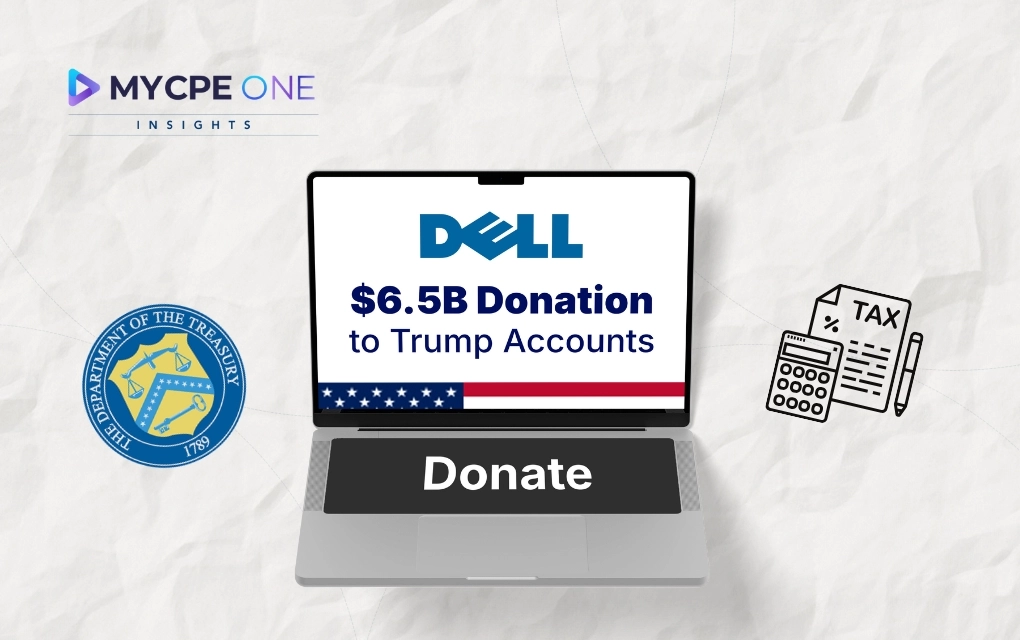
Michael and Susan Dell have made a $6.25 billion donation to America's Trump Accounts, a new investment vehicle designed for children, established under the One Big Beautiful Bill Act (OBBBA). While the donation aims to provide financial aid to millions of children, critics argue that it exemplifies how the ultra-wealthy are influencing the tax-philanthropy ecosystem, eliciting concerns around potential crony capitalism.
If you ever needed proof that the ultra-wealthy play financial chess while the rest of us juggle checkers, look no further than Michael and Susan Dell dropping $6.25 billion into America’s newest political-era invention, the Trump Accounts. It is one of the largest philanthropic commitments in modern history, and it landed with the kind of shock value usually reserved for earnings scandals. On paper, it looks like a heartwarming move to give millions of kids a financial head start. But when you look under the hood, you find a fascinating mix of philanthropy, tax engineering, corporate incentives, and some good old American “who’s really benefiting here,” the type of question that makes financial pros sit up straight. Let’s break it down without making taxes feel like a root canal.
Created under the One Big Beautiful Bill Act (OBBBA), Trump Accounts are investment vehicles designed for children, structured a bit like a hybrid between a 529 plan and a retirement account. Here is the quick download:
Experts say the program is “super exciting” for universal access and long-term savings, but they also warn that requiring parents to manually enroll will leave millions of eligible families behind. As one policy researcher put it, “Why add this extra step?”
The Dells’ pledge fills a major program gap. Because children born before 2025 do not qualify for the federal deposit, the $6.25 billion donation seeds:
And if fewer families enroll than expected, leftover dollars roll into older children’s accounts. The Treasury will distribute the funds directly once accounts are opened. It is a philanthropic moonshot, and experts believe the gift will inspire more organizations to join, thanks to a unique legal feature that lets nonprofits fund entire “classes” of children.
Here is where the financial gears start whirring.
The donation flows through the Dells’ charitable funds, triggering IRS rules for private foundations, not public charities.
That means:
OBBBA introduced two lesser-discussed tax changes:
Translation: If a corporation wants Dell-level PR and goodwill, they better be ready for a shrinking tax break. Philanthropy just got a little pricier.
That question is trendy. But the IRS is clear: direct transfers to individuals are gifts, not charitable donations. The workaround? Donations flow into a foundation or a qualifying nonprofit like Invest America, which then disperses funds in IRS-approved ways.
So, what does this mean for companies, CFOs, foundations, and other big givers?
Bottom line: Mega-philanthropy is not disappearing. It is just being repriced.
The Dell donation, generous as it is, plugs straight into a politically engineered savings program tied closely to the administration that created it. When billionaire money flows into government-designed pipes, it raises uncomfortable questions. Financial analysts have already started connecting dots:
When markets believe access beats innovation, something breaks. Capital flows to “policy-sheltered players,” not necessarily the best businesses. As the FT analysis noted: “When the rulebook appears adjustable for well-connected actors, market pricing begins to incorporate expectations of preferential treatment.” The Dell donation is not shady. It is allowed, transparent, and likely well-intentioned. But it is also a real-time case study in how philanthropy, tax law, and politics increasingly mix. And once that pattern sets in, the market tends to follow.
There is a lot of good news here. Millions of kids will get their first investment account, and many will enter adulthood with more savings than their parents ever had. But financially speaking, the bigger story is this: The ultra-wealthy are shaping the tax-philanthropy ecosystem faster than Washington can regulate it. And until the IRS finalizes every rule for Trump Accounts, there will be questions about:
The Dells’ $6.25 billion donation may go down as one of the most impactful philanthropic moves of the decade. It gives millions of kids a financial foothold and pushes the conversation forward on generational wealth. But the ripple effects are far more complex:
Kids may benefit. But the adults steering America’s tax code and capital markets need to keep their eyes wide open. If you want to follow the next twists in this story, including tax ramifications, market reactions, and how more donors respond, stay tuned. The future of philanthropy just got a plot twist.
Until next time…
Don’t forget to share this story on LinkedIn, X and Facebook
Subscribe now for $199 and get unlimited access to MYCPE ONE, from CPE credits to insights Magazine
📢MYCPE ONE Insights has a newsletter on LinkedIn as well! If you want the sharpest analysis of all accounting and finance news without the jargon, Insights is the place to be! Click Here to Join
Website Services for CPA & Accounting Firms - Starting $69/month.
Is your website attracting clients—or turning them away? MYCPE ONE’s Website Development Services, starting at just $69/month, create high-converting, professional websites tailored for accounting firms like yours.
With over 400 designs to choose from and a dedicated webmaster, we handle it all for you—no DIY required.
Get started today and create a website that works for your firm with MYCPE ONE!
Make a lasting impression. Boost conversions. Stay secure.
You’ve reached the 3 free-content piece limit. Unlock unlimited access to all News & CPE resources.
Subscribe Today.
Already have an account?
Sign In