
MYCPE ONE
MYCPE ONE LOGO

Join 250,000+
professionals today

Add Insights to your inbox - get the latest
professional news for free.

MYCPE ONE insights

Is the FIFA World Cup 2026 also a Tax Tournament?

Join our 250K+ subscribers

Join our 250K+ subscribers

Subscribe

15 JUN 2026 / ACCOUNTING & TAXES

Is the FIFA World Cup 2026 also a Tax Tournament?

Is the FIFA World Cup 2026 also a Tax Tournament?

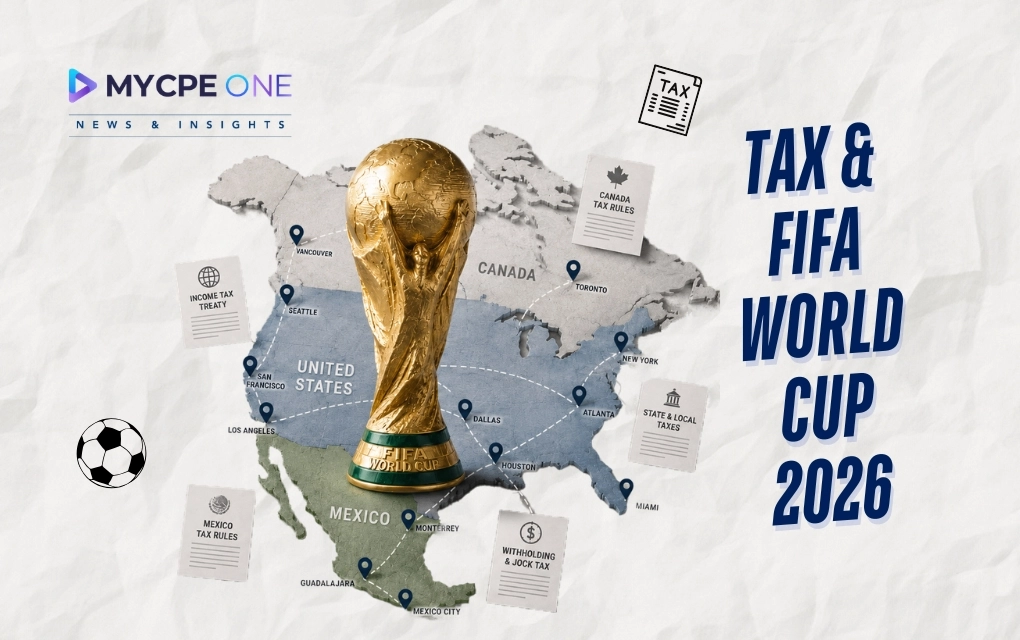
Every World Cup has its own soundtrack. For some, it is Shakira’s “Waka Waka” still refusing to leave the brain after all these years. For others, it is the stadium roar, the flag-draped fans, the office bracket nobody fully understands, and that one colleague who suddenly becomes a tactical expert every four years. That is the charm of FIFA fever. It turns a group-stage match into a lunchroom debate and makes millions of people care deeply about goal difference. The 2026 FIFA World Cup will take that energy to another level, with 48 teams, 104 matches, 16 host cities, and games across the United States, Canada, and Mexico.

But behind the anthem, the jerseys, the billion-dollar players, and the highlight reels sits a quieter contest: tax jurisdiction. When players, coaches, performers, media crews, sponsors, and event businesses move across borders, tax rules follow them like a defender who refuses to give space. For fans, the World Cup means travel plans, ticket prices, watch parties, and maybe one very expensive stadium snack. For tax professionals, it means income moving across borders, athletes working in multiple jurisdictions, and governments asking the oldest question in tax, “Where was the money earned?”

Is the World Cup also a tax tournament?

A foreign player does not need to live in the United States to create a U.S. tax issue. If that player performs services in the U.S., the income connected to those services may count as U.S. source income. That can include match compensation, appearance fees, promotional events, media obligations, training days, sponsor income, and bonuses tied to U.S. activity. That matters because most visiting World Cup players will not be U.S. citizens or U.S. tax residents. The U.S. generally cannot tax all of their worldwide income. It can, in many cases, tax income tied to work performed inside the country. That small distinction carries a big bill.

For independent contractors, performers, or nonemployee participants, U.S. source compensation may trigger Form 1042-S reporting and 30% federal withholding on the gross payment, unless a treaty benefit, exemption, or Central Withholding Agreement applies. Gross withholding means the IRS may take its cut before expenses enter the chat. Not exactly a locker room celebration. Employees follow different wage withholding rules, usually based on graduated rates. Either way, someone needs to classify the payment correctly, collect documentation, withhold tax, file the right forms, and avoid making a clean pass straight into a compliance problem.

Why do Ronaldo, Messi, and Mbappé make this more than theory?

Forbes estimated that Cristiano Ronaldo earned $300 million in the 12 months before the tournament, Lionel Messi earned $140 million, and Kylian Mbappé earned $95 million. The top 11 highest-paid World Cup players reportedly earned a combined $950 million. Those figures include on-field and off-field income, and not every dollar connects to the World Cup. Still, they make the point loud and clear: elite athletes do not just bring goals, assists, and highlight reels. They bring complex income streams.

Take a star player who competes in New Jersey, attends a sponsor event in Los Angeles, records media content in Miami, and later plays a knockout match in Canada. That player may face questions across federal tax, state tax, local wage tax, treaty relief, withholding, and foreign tax credits. In practice, a CPA firm advising a sports agent, event sponsor, or athlete management company would not wait until after the final whistle. The firm would map where the services happen, who pays whom, what forms apply, whether treaty relief exists, and whether a Central Withholding Agreement makes sense.

That is not glamour work. That is “spreadsheet open, coffee cold, partner wants answers by noon” work.

Can one match create a state tax bill?

The tournament schedule does not just decide who plays where. It helps decide which tax authority gets a look. States with individual income taxes often tax nonresidents on income earned from work performed inside the state. Professional athletes often face special allocation rules, commonly called the jock tax. These rules usually assign income based on duty days, meaning the number of workdays spent in the state compared with total duty days. A match in New Jersey can create a different result than a match in Miami or Houston. Florida and Texas do not impose a state individual income tax on wages, while New Jersey does. Washington also lacks a state wage income tax, which matters for matches in Seattle.

Local taxes can add one more layer. Philadelphia imposes a wage tax on nonresidents who work in the city. Kansas City, Missouri, has a 1% earnings tax that can apply to nonresidents earning income there. That means two players with similar compensation could face different tax outcomes simply because one match lands in Philadelphia and another lands in Dallas. For tax advisors, this is the part where the tournament map starts looking like a tax return with cleats on.

What does the IRS playbook say?

The IRS has already pointed foreign artists and athletes toward its Central Withholding Agreement program. A CWA lets eligible nonresident artists and athletes request withholding based on estimated U.S. net income, rather than the default gross-basis approach. That can matter a lot. A 30% gross withholding rate may overstate the final tax cost if the participant has substantial allowable expenses. A CWA can bring withholding closer to the actual expected liability, but the timing matters. The IRS generally requires Form 13930 at least 45 days before the first covered U.S. event. Late paperwork can get rejected. In tax, the clock does not care who won possession.

Tax treaties can help, but they do not automatically erase the issue. Many treaties give the performance country the right to tax income earned by athletes and entertainers. Foreign tax credits may reduce double taxation in the player’s home country, but they do not usually make the U.S. filing obligation disappear. The post-tournament filing step still matters. Nonresident individuals may need Form 1040-NR. Foreign corporations may need Form 1120-F. Withholding helps collect tax upfront, but it does not always close the file.

What’s Next?

The World Cup is a high-profile example of mobile income taxation. The same issues arise when executives, influencers, performers, or consultants work across borders: Where was the work performed? Who paid the income? Was withholding handled correctly? Does a treaty apply? Were the right returns filed? That is why World Cup tax coverage matters beyond sports. It shows how quickly tax obligations follow people, income, and work across jurisdictions. For players, every match location matters. For advisors, planning before kickoff is far easier than fixing problems after the whistle.

Until next time…

Don’t forget to share this story on LinkedIn, X and Facebook

Subscribe now for $199 and get unlimited access to MYCPE ONE, from CPE credits to insights Magazine

📢MYCPE ONE Insights has a newsletter on LinkedIn as well! If you want the sharpest analysis of all accounting and finance news without the jargon, Insights is the place to be! Click Here to Join

Unlock Annual Access to News & CPE Subscription

You’ve reached the 3 free-content piece limit. Unlock unlimited access to all News & CPE resources.
Subscribe Today.

News & Insights

  • Exclusive News & Insights
  • Latest Regulatory Updates
  • Accounting Industry Trends
  • Expert Insights
  • AI-Driven Audio & Summaries
  • Infographics & Videos
  • CPE-Approved Articles
  • Digital Magazine
  • Benchmarking Insights

Unlimited CPE Access for 1 Year

  • 15,000+ Hours of Content
  • 500+ Subject Areas
  • Mandatory Ethics Courses
  • 250+ Compliance Packages
  • 50+ Virtual Conferences and Events Access
  • Format: Live, Audio, Video, E-Books
  • Audio Based Courses & Podcasts
  • Add External Certificates with AI
  • AI Compliance Tracking and Report
  • Instant Certification and Fast Reporting
  • Mobile App Access (iOS and Android)
  • Dedicated Support System
  • Practical Training Programs
  • AI Academy Access
  • Tax Academy Access
  • Audit Academy Access
  • Leadership Academy Access