MYCPE ONE
MYCPE ONE LOGO

Join 250,000+
professionals today

Add Insights to your inbox - get the latest
professional news for free.

MYCPE ONE insights

The ETF Tax Strategy Built on a Wash Sale Gap

Join our 250K+ subscribers

Join our 250K+ subscribers

Subscribe

27 APR 2026 / ACCOUNTING & TAXES

The ETF Tax Strategy Built on a Wash Sale Gap

The ETF Tax Strategy Built on a Wash Sale Gap

The market has a funny way of rewarding creativity. Not innovation in the product sense, but creativity in how rules get interpreted. Right now, one of the quietest tax strategies on Wall Street is not about picking the right stock. It is about selling the wrong one at the right time. That is where exchange-traded funds, or ETFs, have stepped into a gray zone that is starting to look a little too convenient.

Is the wash sale rule quietly losing its teeth?

The wash sale rule under Section 1091 was built with a simple idea. You should not be able to sell a security at a loss, claim a tax benefit, and then buy the same thing right back within 30 days. No real economic change, no tax break. That worked fine in a world of individual stocks and bonds. Sell Apple, buy Apple again within a month, and the IRS says not so fast. Now, fast-forward to a market where ETFs dominate exposure. The U.S. ETF market crossed $10 trillion in assets, and investors are not just holding one fund per strategy. They are holding multiple funds that track nearly identical indexes.

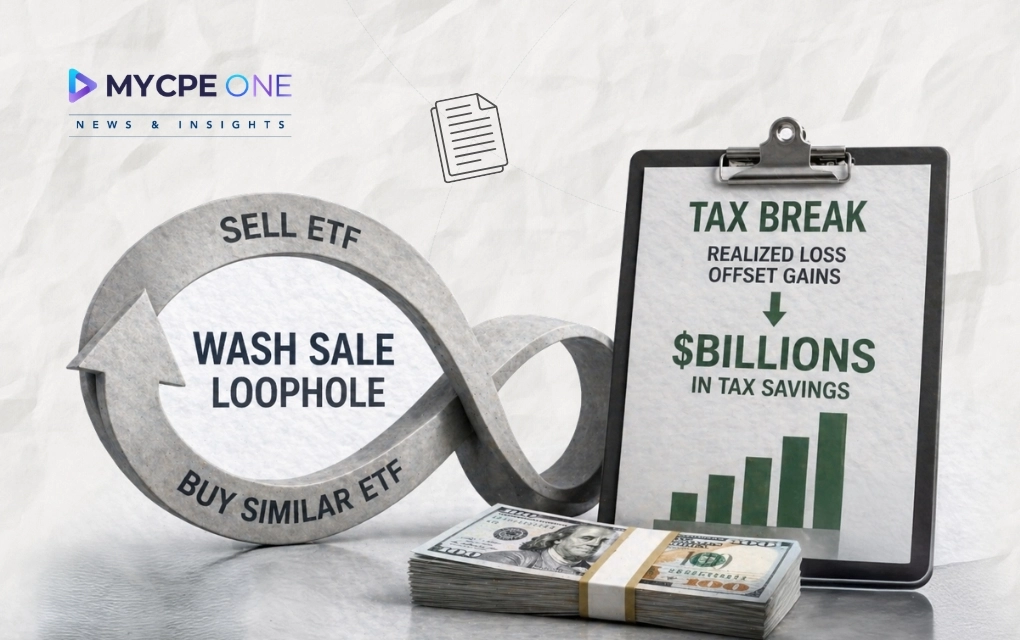
Here is where things get interesting. The rule says “substantially identical,” but the IRS has never clearly defined what that means for ETFs issued by different providers. That gap has opened the door to a strategy that looks a lot like a workaround. Sell one ETF at a loss, buy another that tracks the same index, keep your exposure, and book the loss. Clean. Efficient. And, depending on how you read the rule, technically allowed.

Are ETFs turning tax losses into a year-round play?

Traditional tax loss harvesting used to have a seasonal feel. Think late December, advisors cleaning up portfolios, trying to offset gains before year-end. That is not how it works anymore. Academic research analyzing more than 200,000 ETF observations found that tax-sensitive institutions are harvesting losses throughout the year, swapping between highly correlated ETFs with minimal friction. Why? Because ETFs make it easy. Instead of choosing between individual securities with different performance paths, managers can move from one S&P 500 ETF to another with nearly identical holdings. The correlation between some of these funds is close to 1.00, meaning the portfolio barely moves.

For example, selling Vanguard’s S&P 500 ETF and buying iShares’ equivalent keeps exposure to the same index. The investor stays in the market, avoids timing risk, and still realizes a tax loss. No change in investment thesis. No meaningful tracking error. Just a tax benefit. That is why researchers estimate that institutional investors have swapped about $417 billion worth of similar ETFs since 2001, generating roughly $84 billion in realized losses. That is not pocket change. That is real money leaving the tax base.

Is this smart planning or pushing the line?

On paper, this strategy sits in a legal gray area. The IRS has not issued clear guidance on whether two ETFs tracking the same index count as “substantially identical.” Without that definition, advisors and institutions are left to interpret the rule. Some see it as legitimate tax planning. Others see it as skating close to the edge. From a technical standpoint, the investor’s economic position barely changes. They sell exposure to the S&P 500 and immediately buy it through a different wrapper. If the market moves, their portfolio reacts almost identically. So, the question becomes simple. If nothing really changed, should the tax system treat it as a loss?

Critics argue that this violates the spirit of the wash-sale rule. Supporters argue that the letter of the law does not prohibit it. That gap between spirit and letter is where most tax strategies live, and it is where this one is getting attention. Even policymakers are starting to notice. An $84 billion pool of harvested losses tied to one strategy tends to get people talking, especially when tax revenue is under pressure.

What happens if the IRS decides to step in?

Right now, the IRS has been quiet. No formal ruling. No updated guidance tailored to ETFs. But it may not last. If regulators decide to tighten the definition of “substantially identical,” the impact could be immediate. ETFs tracking the same index could be grouped together, and those loss-harvesting swaps could get disallowed. For firms, that creates a few real concerns.

  • First, past positions could come under scrutiny, and retroactive disallowance is not off the table if enforcement becomes aggressive.
  • Second, compliance teams will need to rethink portfolio construction. Strategies built on ETF swapping may need to be redesigned, especially for tax-sensitive clients.
  • Third, advisory conversations will shift. Right now, many advisors present tax loss harvesting as a relatively straightforward benefit. If the rules change, that pitch gets more complicated.

Many CPA firms working with high-net-worth clients or institutional portfolios already rely on detailed tracking of capital gains and losses. If ETF classification rules tighten, tracking “substantial similarity” becomes another layer of judgment. And let’s be honest, that is not always clean.

So, what professionals should actually watch here?

This is one of those areas where nothing feels urgent until it suddenly is. For now, the strategy remains widely used. Technology platforms, portfolio tools, and even robo-advisors have made it easier to execute these swaps with precision. But the risk is building quietly. If you are advising clients or managing portfolios, a few questions are worth keeping in the back of your mind. Are your clients relying on ETF swaps as a core tax strategy? How much of their loss harvesting depends on highly correlated funds? What happens if those losses get challenged?

Takeaway

The wash sale rule was built for a simpler market. ETFs have changed the mechanics, and investors have adjusted quickly. Right now, ETF swapping sits in a gray zone that offers real tax advantages with minimal portfolio disruption. At the same time, the scale of the activity is hard to ignore, and it is drawing attention from policymakers. For accounting and tax professionals, this is not just a technical footnote. It is a developing issue that could reshape how tax loss harvesting gets applied in practice. For now, the door is open. The real question is how long it stays that way.

Until next time…

Don’t forget to share this story on LinkedIn, X and Facebook

Subscribe now for $199 and get unlimited access to MYCPE ONE, from CPE credits to insights Magazine

📢MYCPE ONE Insights has a newsletter on LinkedIn as well! If you want the sharpest analysis of all accounting and finance news without the jargon, Insights is the place to be! Click Here to Join

Unlock Annual Access to News & CPE Subscription

You’ve reached the 3 free-content piece limit. Unlock unlimited access to all News & CPE resources.
Subscribe Today.

News & Updates

  • Exclusive News & Insights
  • Latest Regulatory Updates
  • Accounting Industry Trends
  • Expert Insights
  • AI-Driven Audio & Summaries
  • Infographics & Videos
  • CPE-Approved Articles
  • Digital Magazine
  • Benchmarking Blogs

Unlimited CPE Access for 1 Year

  • 15,000+ Hours of Content
  • 500+ Subject Areas
  • Mandatory Ethics Courses
  • 250+ Compliance Packages
  • 50+ Virtual Conferences and Events Access
  • Format: Live, Audio, Video, E-Books
  • Audio Based Courses & Podcasts
  • Add External Certificates with AI
  • AI Compliance Tracking and Report
  • Instant Certification and Fast Reporting
  • Mobile App Access (iOS and Android)
  • Dedicated Support System
  • Practical Training Programs
  • AI Academy Access
  • Tax Academy Access
  • Audit Academy Access
  • Leadership Academy Access