
Join 250,000+
professionals today
Add Insights to your inbox - get the latest
professional news for free.
Join our 250K+ subscribers
Subscribe16 FEB 2026 / ACCOUNTING & TAXES
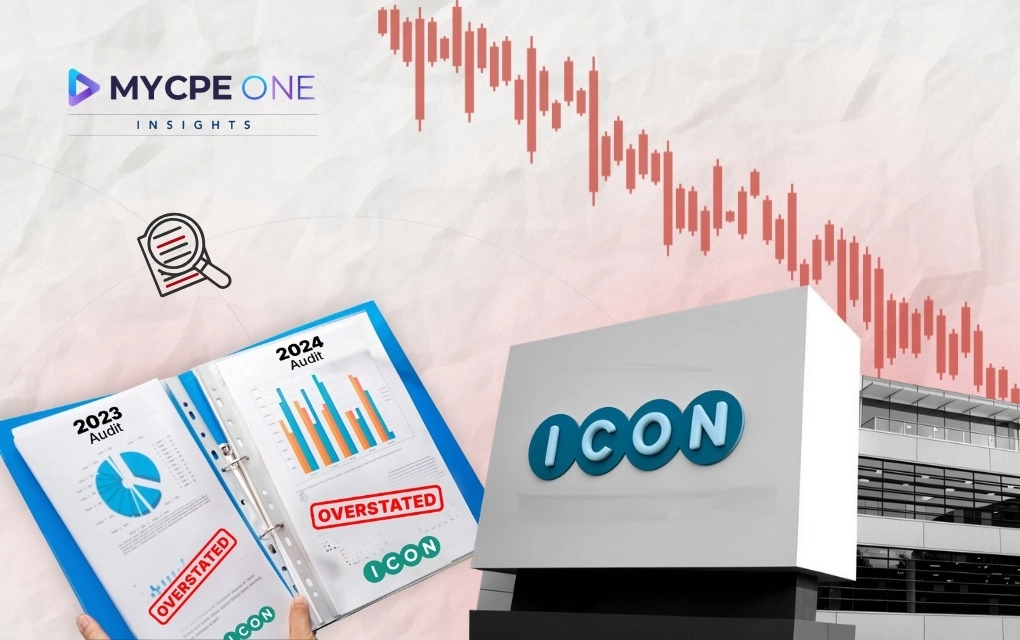
After ICON Plc admitted it may have overstated its revenue by less than 2% in recent years, its shares dropped by half. The clinical research giant's credibility and internal financial reporting have come under scrutiny, prompting an in-depth accounting investigation. This case underscores the importance of trust in financial reporting in public markets.
A less than 2% revenue overstatement should not erase half a company’s market value. Yet that is exactly what happened when clinical research giant ICON Plc disclosed that it may have overstated revenue in recent years and launched an internal accounting probe. Investors did not wait for restated numbers. They reacted to what the disclosure really signaled: a credibility problem inside the financial reporting process. And when a company pulls its full-year guidance, delays earnings, and admits it expects “material weaknesses” in internal controls, Wall Street doesn’t treat that like a rounding error. It treats it like smoke coming from inside the finance function.
ICON is a global contract research organization (CRO) that helps drug makers run clinical trials and manage commercialization strategies. Its business model depends heavily on long-term contracts, milestone billing, and progress-based revenue recognition. That is a perfect recipe for accounting judgment, and also the exact place where things can go sideways fast. The company disclosed that preliminary findings suggest 2023 and 2024 revenue may have been overstated by “less than 2%” in each year, and the investigation focuses on revenue recognition across fiscal years 2023 through 2025. On the surface, the numbers sound small. In reality, the issue is not the magnitude. It is the control environment that allowed the magnitude to happen at all.
ICON’s shares dropped as much as 50% in a single session, one of the steepest declines in the company’s public history. Even in premarket trading, the stock was down sharply before the bell. That kind of move doesn’t happen because investors think the company accidentally booked an extra 1.7% of revenue.
Markets punish uncertainty harder than bad news. And ICON served up uncertainty in bulk.
ICON’s disclosure is a classic example of why materiality is not just math. Yes, an overstatement of less than 2% might look immaterial in isolation. But small misstatements can be a symptom of something much bigger:
In contract-heavy businesses, revenue recognition lives and dies on estimates. If those estimates are biased even slightly in the wrong direction, timing differences compound across quarters. And timing is everything when a company is being valued on growth and execution.
The investigation began in late October 2025, following internal concerns that were escalated through management channels to the audit committee. That detail matters. Most accounting problems start as quiet internal questions, and they either get addressed early or turn into a headline later. In ICON’s case, the audit committee launched a formal internal probe and brought in outside legal counsel, supported by forensic and technical accounting firms. That is not a routine clean-up. That is what companies do when they need an independent record of what happened, how it happened, and whether the control failures rise to a level that regulators and auditors will care about.
Let’s be honest: most revenue overstatements are not cartoon-villain fraud. They usually come from an aggressive interpretation of accounting standards under pressure. For CROs like ICON, revenue is typically recognized over time as performance obligations are satisfied. That means management has to estimate:
If those assumptions are optimistic, revenue gets recognized early. Not fake revenue, just premature revenue. But in public markets, premature revenue is still wrong revenue. And if executive compensation, market expectations, or internal targets are tied to revenue growth, the incentive to “smooth” timing gets stronger. That is where judgment quietly becomes bias.
Accounting issues like this rarely start with a whistleblower saying “fraud.” They start with someone noticing inconsistencies:
ICON disclosed that concerns were reported through management channels, which triggered audit committee involvement. Once a probe starts, forensic reviews typically go contract by contract, system entry by system entry, and quarter by quarter. That is why ICON’s review spans multiple fiscal years. Accounting issues are rarely one bad entry. They are usually a repeatable process failure.
ICON’s case is a reminder that public markets don’t just price earnings. They price confidence in how earnings are produced. A small revenue overstatement can be survivable. A broken reporting system is what triggers the real panic. If you want more breakdowns like this on accounting risk, internal controls, and market trust failures, follow along for future updates.
Until next time…
Don’t forget to share this story on LinkedIn, X and Facebook
Subscribe now for $199 and get unlimited access to MYCPE ONE, from CPE credits to insights Magazine
📢MYCPE ONE Insights has a newsletter on LinkedIn as well! If you want the sharpest analysis of all accounting and finance news without the jargon, Insights is the place to be! Click Here to Join
You’ve reached the 3 free-content piece limit. Unlock unlimited access to all News & CPE resources.
Subscribe Today.
Already have an account?
Sign In