Join 250,000+
professionals today
Add Insights to your inbox - get the latest
professional news for free.
Join our 250K+ subscribers
Subscribe15 SEP 2025 / ACCOUNTING & TAXES
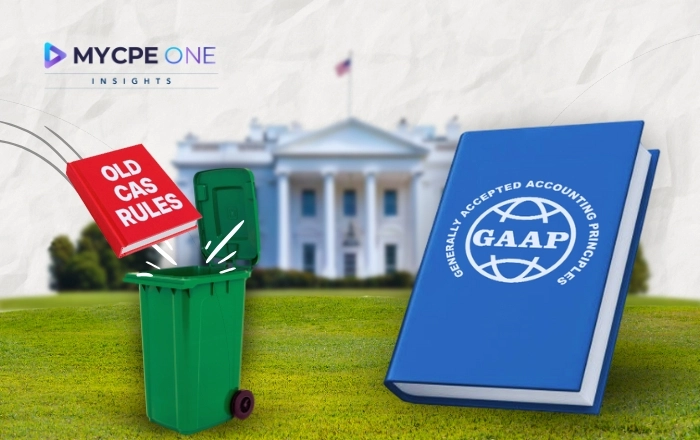
The White House is working to reduce bureaucratic overlap for federal contractors by replacing Cost Accounting Standards (CAS) with Generally Accepted Accounting Principles (GAAP) in three core areas. The move, expected to be finalised by early 2022, aims to streamline contractors' accounting procedures, allowing them to focus on performance rather than paperwork, potentially bringing significant time and cost savings to companies, especially in the defence sector.
Picture your finance team running a marathon in dress shoes, carrying two ledgers, and stopping at every mile marker for a paperwork check. That has been life for many federal contractors under Cost Accounting Standards (CAS). The White House wants to swap the dress shoes for sneakers and drop one of those ledgers. It’s not happening in isolation either. Just as President Trump’s new SEC appointee, Paul Atkins, is scrapping the agency’s aggressive “gotcha” enforcement style in favour of giving Wall Street firms notice and breathing room, the administration is also cutting red tape for contractors. Different arenas, same philosophy: trim redundant rules, lean on established frameworks, and let businesses focus on performance rather than paperwork. Here is what’s changing, why it matters, and how GAAP will shape filings going forward.
For more than 50 years, many contractors supporting defence, energy, space, and health programs have kept overlapping records to satisfy both CAS and GAAP. CAS applies when the government relies on a contractor’s costs to set prices or reimburse expenses. Over time, GAAP tightened under shareholder scrutiny, creating significant overlap with CAS; yet, the duplicative record-keeping persisted and turned into a substantial compliance lift across nearly $750 billion in annual federal contract spending.
The Cost Accounting Standards Board has proposed two rules that eliminate more than 60 “unnecessary and redundant” requirements. Agencies would lean on GAAP in three core areas instead of separate federal standards:
The Board expects to finalise the package by early next year. In parallel, the Office of Federal Procurement Policy (OFPP) is working to streamline roughly 2,000 pages of the Federal Acquisition Regulation back to statutory essentials, further reducing reliance on niche CAS provisions.
The deregulatory rhythm doesn’t stop at federal contracting. Atkins has made clear he wants the SEC focused on “crooks,” not nickel-and-diming firms on technical missteps. He slammed past billion-dollar record-keeping fines as little more than revenue-based invoices and instead pitched a back-to-school style fix: slap the ruler, give six months’ notice, and let firms course-correct before regulators storm in. His stance extends to crypto, too. Where Gensler treated most tokens as securities and sued exchanges into compliance, Atkins is championing tokenised assets, 24/7 blockchain trading, and a US-based crypto hub. The same deregulatory spirit that trims CAS rules is now shaping Wall Street’s watchdog: fewer bespoke hoops, more reliance on frameworks investors and companies already trust.
The policy logic is simple: one trusted rulebook beats two overlapping ones. As OMB senior advisor Kevin Rhodes put it, “Holding contractors responsible for properly and transparently accounting for their costs is good stewardship, but forcing contractors to maintain overlapping books and records is wasteful and creates barriers that discourage talented companies from working with the Government to meet the needs of our taxpayers.” That message dovetails with Atkins’ take on SEC enforcement: restore predictability, give notice, and stop piling on duplicate or arbitrary requirements. In both cases, the goal is to clear friction while keeping accountability intact.
If you are a prime or a major sub, here is how GAAP-first filings could change your day-to-day:
The policy climate is trending toward fewer bespoke rules and more reliance on established financial frameworks. That vibe lines up with other federal signals that favour predictability over paperwork sprawl. The message to contractors is not “anything goes.” It is “bring clean GAAP, show your work, and stop duplicating effort.” The proposed CAS cuts aim to retire duplicate ledgers, standardise on GAAP where it is already robust, and reduce oversight that adds little investor or taxpayer protection. If the rules are finalized on the current timeline, 2026 will mark a turning point: finance teams that adapt early will close faster, audit cleaner, and spend less time buried in reconciliation. In a race where efficiency equals advantage, the winners will be those who lace up early for GAAP’s single-rulebook marathon.
Until next time…
Don’t forget to share this story on LinkedIn, X and Facebook
Subscribe now for $199 and get unlimited access to MYCPE ONE, from CPE credits to insights Magazine
📢MYCPE ONE Insights has a newsletter on LinkedIn as well! If you want the sharpest analysis of all accounting and finance news without the jargon, Insights is the place to be! Click Here to Join
Digital Marketing Services for CPA & Accounting Firms - Starting $399/month.
Struggling to attract new clients? MYCPE ONE’s Digital Marketing Services help accounting firms stand out, generate leads, and grow revenue effortlessly.
With expertise in SEO, paid ads, social media, and targeted PPC, MYCPE ONE maximizes your marketing efforts to deliver high ROI and broader industry reach.
Invest in digital marketing for your firm today—see the difference with MYCPE ONE!
Stand out. Generate leads. Grow revenue.
You’ve reached the 3 free-content piece limit. Unlock unlimited access to all News & CPE resources.
Subscribe Today.
Already have an account?
Sign In