Join 250,000+
professionals today
Add Insights to your inbox - get the latest
professional news for free.
Join our 250K+ subscribers
Subscribe18 AUG 2025 / ACCOUNTING & TAXES
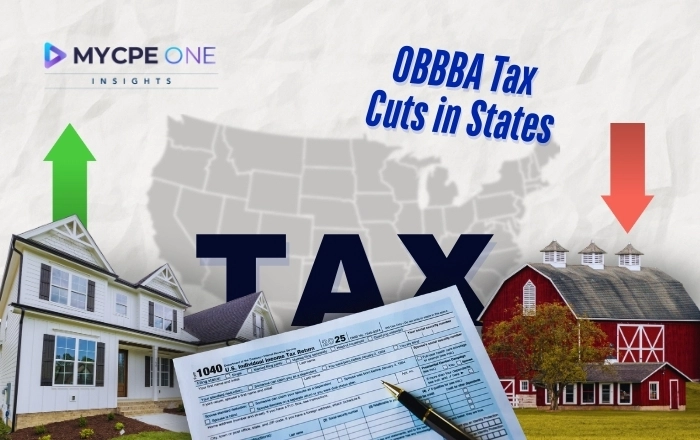
The One Big Beautiful Bill Act (OBBBA) implemented in 2025 has significantly reshuffled United States taxation regimes with its permanent individual tax cuts and bonus deductions, leading to state-by-state variations in tax revenues. Though the Act generates large tax cuts for states like Wyoming, it places high-tax coastal states under renewed pressure due to the new State and Local Tax (SALT) cap of $40,000, which is predicted to drop back to $10,000 in 2029, potentially altering the balance of coastal and inland economics and causing increased complexity for tax professionals and businesses.
Before the One Big Beautiful Bill Act (OBBBA) shook things up in 2025, states were already juggling tax conformity rules tied to the 2017 Tax Cuts and Jobs Act (TCJA). That law capped state and local tax (SALT) deductions at $10,000, forcing higher-tax states like New York, California, and New Jersey to scramble for workarounds. Many turned to pass-through entity (PTE) tax regimes so business owners could sidestep the SALT cap, while others wrestled with how to treat research and experimentation (R&E) expenses, bonus depreciation, and interest deduction limits. For states, it was never a one-size-fits-all deal. Some followed federal changes immediately (rolling conformity), others lagged with static conformity, and many cherry-picked what worked best for their budgets. In short: state treasuries had to hustle to keep revenue steady.
Fast forward to today, and OBBBA is rewriting the playbook. By making individual tax cuts permanent and sweetening the pot with deductions for tips, overtime income, and R&D expenses, states are staring at both opportunities and headaches. The Tax Foundation pegs the average federal tax cut per filer at $3,752 in 2026, but the variation is striking. Wyoming filers will pocket an average cut of $5,375, while West Virginians will see just $2,503. At the county level, mountain hotspots like Teton County, WY will rake in an eye-popping $37,373 per filer, while rural Loup County, NE, gets stuck with just $824. That’s a spread bigger than the gap between Wall Street bonuses and Main Street paychecks.
For states, here’s the kicker: the new $40,000 SALT cap (dropping back to $10,000 in 2029) puts coastal states back in the hot seat. High-tax states will lose more revenue if residents lean into deductions, while low-tax states won’t feel the same pinch. On top of that, permanent 100% bonus depreciation and domestic R&D expensing narrow the federal tax base, leaving states to decide whether to play along or decouple to protect their coffers. As Steve Kralik of Armanino noted, “The percentage of pass-through entities actually taking advantage of PTE regimes is surprisingly low, partly because the rules are complex and vary so much state by state.” That means the OBBBA’s expansion hasn’t fully translated into tax savings for everyone just yet.
Here’s where the bill hits different:
The Congressional Budget Office highlighted that the poorest 10% of households could lose 3.1% of income annually, while the wealthiest 10% stand to gain 2.7%. That’s the kind of split that fuels debates long after the ink dries.
The OBBBA isn’t just tinkering with tax bills, it’s reshaping state economies. The Tax Foundation estimates it could create 938,000 full-time equivalent jobs nationwide, with California adding more than 132,000 and Texas about 81,000. On the flip side, smaller states like Vermont would see just 1,700 new jobs. High-income resort counties will likely see surges in spending power, real estate activity, and investment, while rural states with smaller cuts may struggle to keep pace. Add in potential state budget shortfalls from lost revenue (especially if they conform to costly provisions like bonus depreciation), and you get a patchwork of winners and losers across the country.
In higher-tax states, the expanded SALT cap could juice consumer spending in the short run. But when the cap drops back to $10,000 in 2029, brace for a possible pullback. Meanwhile, low-tax states may quietly benefit from business migration if companies decide their tax dollars stretch further in places like Florida, Nevada, or Wyoming.
For tax pros, the OBBBA is both a challenge and a golden opportunity. Clients are already asking, “Where’s my piece of the pie?” Professionals can step up their game by:
Bottom line? Tax professionals who bring sharp insight and proactive planning will help clients keep more money in their pockets while steering clear of state-level tax traps.
The OBBBA is hotter than wings on Hot Ones for taxpayers in some states, but a slow burn for others. High earners in resort counties are feasting, while lower-income rural filers are just getting crumbs. States will keep tinkering with conformity, and tax lawyers are already whispering about possible litigation around foreign R&D and international income rules. For now, one thing’s clear: the OBBBA has locked in a decade of tax shake-ups. The winners will be those who plan early, lean on professional guidance, and stay nimble as states flex their revenue-collecting muscles. Stay ahead of tax changes like OBBBA and get expert insights straight to your inbox. Subscribe now to MYCPE ONE Insights newsletter.”
Until next time…
Don’t forget to share this story on LinkedIn, X and Facebook
Subscribe now for $199 and get unlimited access to MYCPE ONE, from CPE credits to insights Magazine
📢MYCPE ONE Insights has a newsletter on LinkedIn as well! If you want the sharpest analysis of all accounting and finance news without the jargon, Insights is the place to be! Click Here to Join
Transforming Finance & Accounting Operations for Enterprises!
We help 100+ clients streamline F&A operations with our full-suite outsourcing services—eliminating the need for in-house teams. Partner with us for Top-tier finance & accounting talent, Cutting-edge technology, and World-class infrastructure.
Our Full-Suite F&A Services Include:
We collaborate with CPA and accounting firms to drive real business value.
Schedule a no-obligation discovery callYou’ve reached the 3 free-content piece limit. Unlock unlimited access to all News & CPE resources.
Subscribe Today.
Already have an account?
Sign In