Join 250,000+
professionals today
Add Insights to your inbox - get the latest
professional news for free.
Join our 250K+ subscribers
Subscribe05 JUN 2026 / ACCOUNTING & TAXES
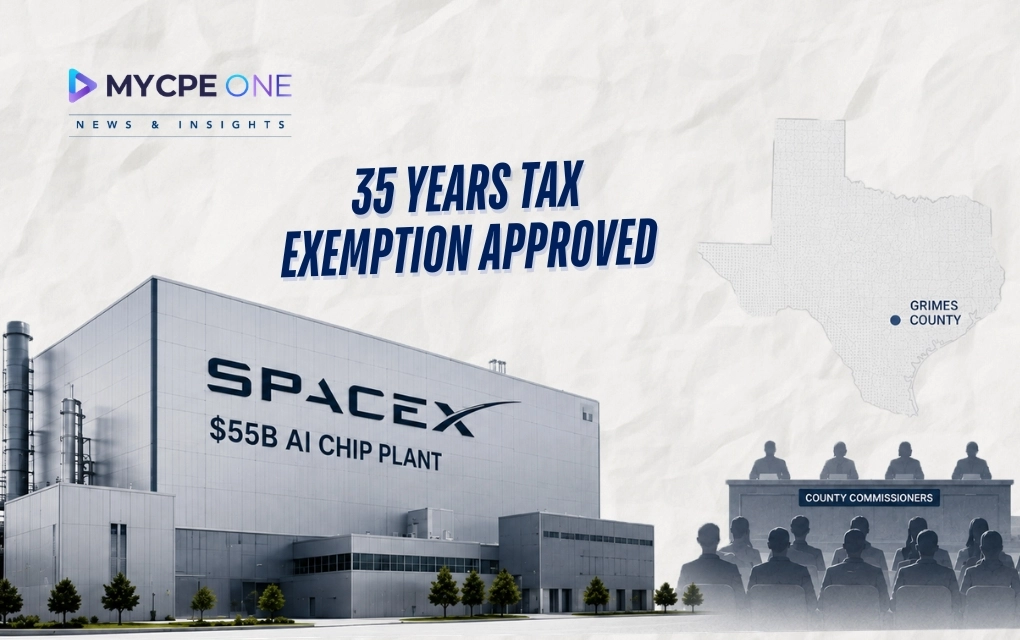
Grimes County, Texas approved a 100% property tax break for SpaceX's new $55 billion Terafab AI chip facility amid ongoing debate over the potential fiscal costs and benefits. The decision has sparked questions among critics and residents about why one of the world's most valuable companies headed by the world's richest person, Elon Musk, needs such a significant tax incentive, and whether the future benefits in terms of job creation and strengthening US tech leadership, particularly given the projected big initial public offering (IPO) for SpaceX, will outweigh the immediate loss of tax revenue.
A $55 billion chip plant has sparked a major debate in Grimes County, Texas. Residents are asking why SpaceX needs a 100% property tax break for its planned Terafab AI chip facility, even as Elon Musk pursues one of the world’s most valuable companies. The county approved the tax abatement by a 4-1 vote, clearing a key hurdle for the project. SpaceX says the plant will create about 1,800 jobs and strengthen U.S. technology leadership. Critics argue the county is giving up future tax revenue in exchange for uncertain benefits. For tax and finance professionals, the dispute highlights a growing issue: how local governments balance AI-driven economic development with long-term fiscal responsibility.
SpaceX’s Terafab project lands at the crossroads of three big forces: AI demand, domestic chip manufacturing, and local economic incentives. That combination can make a county’s tax base look bigger on paper, while actual cash collections tell a much tighter story. The approved structure reportedly gives SpaceX a 100% property tax abatement over 35 years, paired with a payment in lieu of taxes arrangement. The numbers cited in reporting include a $10 million upfront payment and $20 million annually for 35 years. That equals about $710 million over the term. That is real money, no question. But against a $55 billion facility, the math gets messy fast.
If a high value industrial facility entered the tax rolls at full taxable value, the annual property tax bill could reach far beyond a fixed $20 million payment, depending on final assessed values, exemptions, local rates, and equipment treatment. The public finance concern is simple: fixed payments may look attractive in year one, then lose purchasing power as costs rise, roads need repair, schools need funding, and emergency services need capacity.
The backlash is not simply anti-business sentiment. Residents support growth but have raised concerns about water use, roads, emissions, emergency services, transparency, and the county’s future identity. Some also question why a company linked to the world’s richest person needs such a generous tax incentive. From their perspective, taxpayers are giving up revenue today in exchange for promised benefits tomorrow, and they want to know whether the county negotiated the strongest possible deal. Commissioner David Tullos, the lone no vote, reportedly criticized both the agreement and the process. That matters because incentive deals depend on clear terms, accountability, and public trust. Without those elements, even a major project can face skepticism from the start.
The local tax deal looks even more sensitive because SpaceX is preparing for what could become the largest IPO ever. The company is reportedly seeking to raise up to $86 billion at a valuation near $1.78 trillion. Musk would retain heavy voting control, while the combined SpaceX and xAI story gives investors a sweeping pitch: rockets, Starlink, AI models, chips, data centers, and future space infrastructure under one roof. That is a big swing. Goldman Sachs projections reportedly show SpaceX’s AI revenue rising from $3.2 billion in 2025 to $322 billion by 2030. Total revenue projections reportedly reach $474 billion by 2030. At the same time, xAI posted a major loss in 2025, and the valuation depends on AI assumptions that need to pencil out over time.
This is where public finance and Wall Street meet in the same room. SpaceX asks investors to believe AI will become a giant profit engine. It asks Grimes County to believe the Terafab will become a durable local economic engine. Both claims may prove right, but both require disciplined skepticism. The Big Short is not a perfect comparison, and this is not a mortgage bond story. Still, the professional instinct applies: look under the hood before the market gets carried away. Revenue projections, tax abatements, and economic impact studies all deserve more than a victory lap.
If the Terafab delivers as promised, Grimes County could gain jobs, business activity, and a stronger role in the AI and semiconductor supply chain. The concern is the downside. Fixed payments may not keep pace with inflation, while roads, water systems, schools, and emergency services could face rising costs. A $55 billion facility can transform a local economy, but growth does not automatically translate into fiscal strength. That is why residents and officials are focused on accountability. The county needs clear reporting, enforceable commitments, and performance standards to ensure the promised benefits outweigh the long-term costs. The debate also reflects a broader national issue: AI infrastructure requires not only capital and technology, but also local communities willing to host and support it.
The debate surrounding SpaceX’s Terafab project is bigger than a single tax abatement or a single county. It reflects a growing national challenge: how communities balance the promise of AI-driven economic growth with the responsibility of protecting long-term public finances. For tax professionals, accountants, and public finance leaders, the lesson is straightforward. Incentive agreements should be evaluated with the same rigor applied to any major investment decision. Headline numbers and projected benefits matter, but so do cash flows, risk allocation, performance requirements, and accountability measures. If Terafab delivers on its promises, Grimes County could become a key player in the next generation of American manufacturing and AI infrastructure. If expectations fall short, residents will be left asking whether the incentives were worth the cost. Either way, the project serves as a reminder that economic development is not just about attracting investment—it is about ensuring that growth creates lasting value for the communities that make it possible.
Until next time…
Don’t forget to share this story on LinkedIn, X and Facebook
Subscribe now for $199 and get unlimited access to MYCPE ONE, from CPE credits to insights Magazine
📢MYCPE ONE Insights has a newsletter on LinkedIn as well! If you want the sharpest analysis of all accounting and finance news without the jargon, Insights is the place to be! Click Here to Join
You’ve reached the 3 free-content piece limit. Unlock unlimited access to all News & CPE resources.
Subscribe Today.
Already have an account?
Sign In