MYCPE ONE
MYCPE ONE LOGO

Join 250,000+
professionals today

Add Insights to your inbox - get the latest
professional news for free.

MYCPE ONE insights

Accounting Seed’s Take on Modern Financial Reporting

Join our 250K+ subscribers

Join our 250K+ subscribers

Subscribe

28 JAN 2026 / BUSINESS

Accounting Seed’s Take on Modern Financial Reporting

Accounting Seed’s Take on Modern Financial Reporting

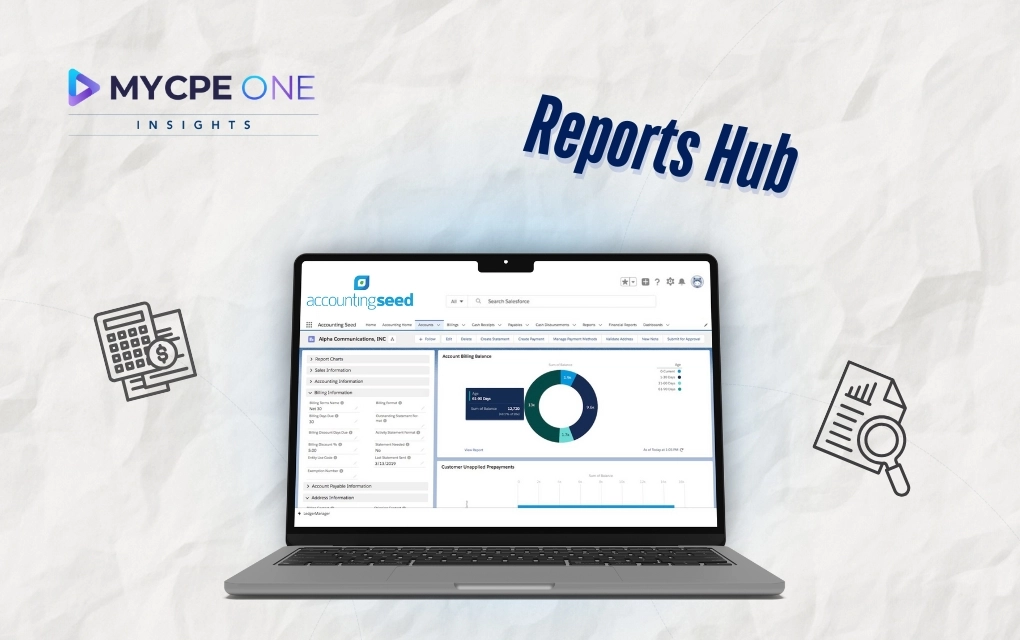
Every finance team knows this moment. Someone asks for a slightly different view of the numbers, maybe by entity, maybe by product, maybe just “as of yesterday.” What follows is a familiar routine: export, tweak, re-run, reconcile, hope nothing breaks. By the time the file lands back in leadership’s inbox, the moment has passed, and the data already feels stale. That is the muscle Accounting Seed is trying to relax with its new Financial Reports Hub. It is not a flashy finance theatre. It is a direct response to how reporting actually works inside fast-growing companies that live inside Salesforce and are tired of being stuck in the weeds.

What problem is Accounting Seed trying to solve?

The headline says “dynamic reporting,” but the real issue runs deeper. Reporting friction has quietly become one of the biggest time sinks inside accounting and finance teams. High transaction volume, multi-entity structures, constant period questions, and leadership requests that change mid-conversation all push teams back into spreadsheets. Accounting Seed’s Financial Reports Hub attacks that pain point by removing the rebuild cycle entirely. Reports do not need to be rerun every time a dimension changes. Data loads into memory at runtime, so users can filter, pivot, and regroup on the fly. The numbers stay intact while the view changes. That matters more than it sounds. In most firms, reporting delays are not caused by a lack of data. They are caused by the manual gymnastics required to reshape it.

How does the Financial Reports Hub work?

The Hub introduces a grid-based reporting model that feels closer to how accountants think than how legacy tools behave. Rows and columns can be rearranged dynamically to view performance by accounting period, entity, project, product, account, or GL variables. Behind the scenes, the Financial Reporter pulls directly from transaction-level data rather than summarised tables. That design choice removes a long-standing reporting bottleneck. Accounting periods no longer need to be closed just to run financials. For teams juggling month-end close, board reporting, and audit prep at the same time, that alone is a quiet win.

Source: Account Seed.com

The system supports standard financials out of the box. Profit and loss variations, balance sheets, trial balances, and general ledger detail are already built in. Users can copy and customize these reports rather than starting from scratch. Exports still exist, but they are no longer the starting point. They are the last step, not the work itself.

Why does Salesforce-native reporting matter here?

Accounting Seed has always leaned hard into its Salesforce-native positioning, and the Financial Reports Hub doubles down on that bet. All reporting lives in the same environment as CRM, operations, and billing data. There is no sync delay, no version mismatch, and no separate reporting warehouse to reconcile. That architecture becomes especially relevant for companies running multi-entity or project-heavy structures. Finance teams can analyze results across entities without stitching together files or explaining why totals differ across systems. CEO Nasser Chanda framed it bluntly. Companies relying on QuickBooks or NetSuite alongside Salesforce are still juggling systems. Accounting Seed keeps everything in one place, reducing risk and speeding decision-making. For firms with skin in the game around data accuracy, that integration story is not marketing fluff. It is operational risk management.

What does this mean for stretched finance teams?

CFO Pete Lambert’s comments land closer to home than most product quotes. Accounting teams are being asked to do more with the same headcount. Close cycles are tight. Audit requests never slow down. Leadership wants insight, not just totals. The Financial Reports Hub shifts effort away from report maintenance and toward interpretation. Instead of rebuilding files, teams spend time explaining what changed and why it matters. Picture a controller at a mid-sized SaaS company. Revenue spikes in one region while margins dip elsewhere. With traditional tools, that question triggers a series of exports and reconciliations. With dynamic reporting, the answer appears in minutes. Group by product, pivot by period, drill into transactions, and move on. That is not automation hype. That is time reclaimed.

How does this compare to Traditional Reporting tools?

Legacy reporting tools assume static parameters. Change one filter, and the system expects a rerun. That design made sense when data volumes were smaller and reporting cycles were slower. Modern finance teams do not work that way. Questions evolve mid-meeting. Executives want side-by-side comparisons without waiting. Auditors ask follow-ups after initial walkthroughs. The Financial Reports Hub supports those realities. Views update instantly. Columns hide or reappear. Pivot modes switch without recalculation. Saved configurations let teams present the same data differently to a COO, an audit partner, or a board committee. In practical terms, it cuts down on version confusion and spreadsheet sprawl. Anyone who has chased the “final_final_v3.xlsx” file knows why that matters.

Yes, adoption is early. The Hub launched as part of Accounting Seed’s Winter ’26 release and initially rolled out through a pilot program. Companies with high transaction volumes are encouraged to review performance considerations before enabling it. That cautious rollout is not a red flag. It reflects the reality of transaction-heavy environments and the need to ensure performance holds up at scale. Accounting Seed reports more than 50,000 users across its platform, but there is no public count yet for the Hub specifically. For finance leaders, the better question is not adoption numbers. It is a trajectory. Accounting Seed has already rolled out AI agents for collections, bill pay, and general ledger workflows. The Financial Reports Hub fits squarely into that strategy of reducing manual touchpoints across the accounting cycle.

Where does this Leave Accounting firms?

This release highlights a broader shift in the evolution of financial reporting. The nuts and bolts still matter. Accuracy, controls, and audit trails remain non-negotiable. What is changing is the expectation around speed and flexibility. Clients and executives no longer accept “we will get back to you tomorrow” for internal reporting questions. They expect answers during the conversation. Tools like the Financial Reports Hub do not replace judgment. They remove friction. That distinction matters. As Peter Drucker wrote, “Efficiency is doing things right. Effectiveness is doing the right things.” Finance teams need both. The open question is how quickly firms adapt their workflows to take advantage of this shift. Dynamic reporting only delivers value if teams stop treating Excel as the default workspace.

The Final Call

The Financial Reports Hub is not about prettier reports. It is about changing the cadence of financial conversations. When reporting becomes interactive, finance teams move from reactive support to proactive insight. For high-growth companies running inside Salesforce, that shift could be meaningful. Less time wrestling files. More time explaining results. Fewer errors are creeping in through manual steps. The technology will keep evolving. Adoption will take time. But the direction is clear. Financial reporting is finally starting to match how accountants actually work, and that is a development worth watching closely.

Until next time…

Don’t forget to share this story on LinkedIn, X and Facebook

Subscribe now for $199 and get unlimited access to MYCPE ONE, from CPE credits to insights Magazine

📢MYCPE ONE Insights has a newsletter on LinkedIn as well! If you want the sharpest analysis of all accounting and finance news without the jargon, Insights is the place to be! Click Here to Join

Unlock Annual Access to News & CPE Subscription

You’ve reached the 3 free-content piece limit. Unlock unlimited access to all News & CPE resources.
Subscribe Today.

News & Updates

  • Exclusive News & Insights
  • Latest Regulatory Updates
  • Accounting Industry Trends
  • Expert Insights
  • AI-Driven Audio & Summaries
  • Infographics & Videos
  • CPE-Approved Articles
  • Digital Magazine
  • Benchmarking Blogs

Unlimited CPE Access for 1 Year

  • 15,000+ Hours of Content
  • 500+ Subject Areas
  • Mandatory Ethics Courses
  • 250+ Compliance Packages
  • 50+ Virtual Conferences and Events Access
  • Format: Live, Audio, Video, E-Books
  • Audio Based Courses & Podcasts
  • Add External Certificates with AI
  • AI Compliance Tracking and Report
  • Instant Certification and Fast Reporting
  • Mobile App Access (iOS and Android)
  • Dedicated Support System
  • Practical Training Programs
  • AI Academy Access
  • Tax Academy Access
  • Audit Academy Access
  • Leadership Academy Access