MYCPE ONE
MYCPE ONE LOGO

Join 250,000+
professionals today

Add Insights to your inbox - get the latest
professional news for free.

MYCPE ONE insights

How a $77M Accounting Miss Rocked Hub Group’s Financials

Join our 250K+ subscribers

Join our 250K+ subscribers

Subscribe

13 MAY 2026 / BUSINESS

How a $77M Accounting Miss Rocked Hub Group’s Financials

How a $77M Accounting Miss Rocked Hub Group’s Financials

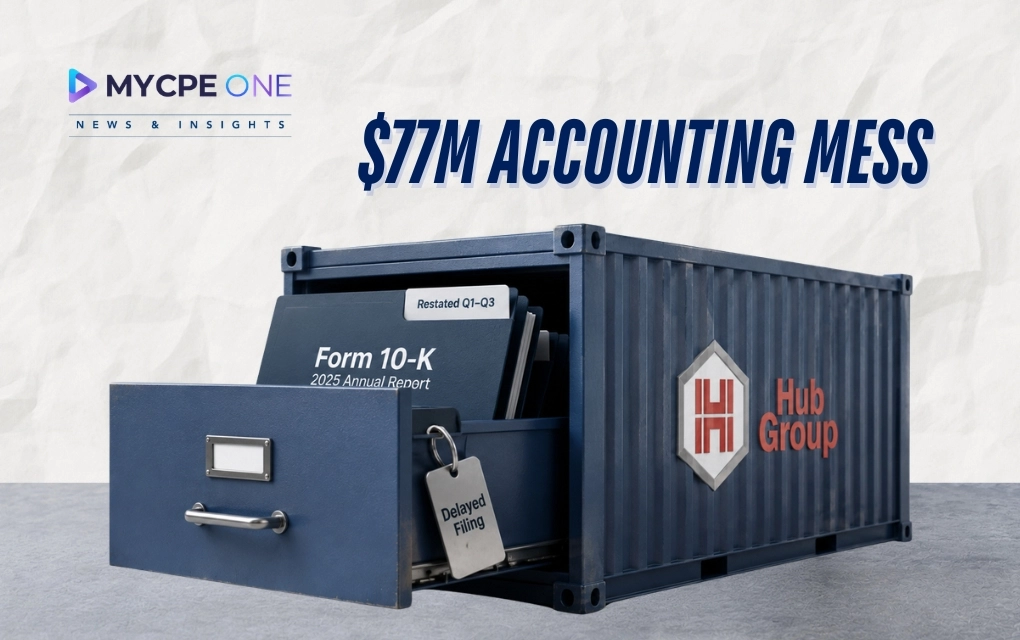
Every accounting team has that one spreadsheet nobody wants to touch. It works quietly for years, until one day it blows a hole through earnings. That is roughly what happened at Hub Group in early 2026. The transportation giant disclosed a $77 million understatement in purchased transportation expenses and accounts payable tied to the first three quarters of 2025. What began as a delayed earnings filing quickly turned into broader restatements, Nasdaq compliance pressure, analyst downgrades, and serious questions around internal controls. For accounting professionals, this is more than a filing delay story. It is a reminder of how small operational accounting weaknesses can quietly snowball into a full-scale financial reporting crisis.

So… where did the numbers go?

Hub Group’s original disclosure sounded fairly clinical. The company identified a $77 million understatement in purchased transportation costs tied to the first nine months of 2025. Later filings expanded the issue further, with management acknowledging certain transactions were “prematurely or incorrectly recognized” or lacked adequate support. Purchased transportation costs sit at the heart of a logistics company’s income statement. These expenses include payments to third-party carriers, trucking providers, rail partners, and delivery operators. If those costs are understated, margins instantly look healthier than reality.

Analysts estimated the error represented more than 65% of Hub Group’s EBIT during the affected periods. Deutsche Bank suggested operating margins may have dropped from a reported 4.4% to nearly 1.4% after adjustments. That is not trimming the edges. That is taking a chainsaw to profitability metrics. The ugly part? The company eventually widened its review into 2023 and 2024, suggesting the underlying issue may not have started in 2025 at all. That is usually when audit committees stop sleeping well.

Did internal controls fall asleep at the wheel?

Hub Group has not accused executives of fraud, and no regulator has publicly alleged intentional misconduct. That distinction matters. Still, the company admitted its disclosure controls and internal controls for 2025 were likely ineffective. In accounting language, that is a flashing red light. Public companies process millions of transactions through accrual systems every quarter. Transportation accounting gets especially messy because invoices arrive late, fuel surcharges fluctuate constantly, and carrier settlements can span reporting periods. Good controls exist specifically to catch timing mismatches before filings go public. Somewhere along the way, those safeguards appear to have broken down.

Maybe accrual models failed. Maybe AP reconciliation processes lagged behind operations. Maybe supporting documentation never matched recorded estimates. Maybe multiple small errors piled up until they became impossible to ignore. Right now, outside observers do not know the full root cause. What we do know is this: the issue survived long enough to affect multiple reporting periods and force delayed SEC filings. That changes the conversation from “mistake” to “systemic accounting weakness.” It starts feeling less like accounting and more like an episode of The Bear, except the stress comes with SEC deadlines instead of restaurant inspections.

Why are analysts split on the recovery story?

Some analysts believe Hub Group can recover because the accounting issue does not appear to impact cash flow directly. The company still reported steady intermodal demand and new business wins, which suggests the operational side of the business remains intact. From that perspective, Hub looks damaged, not doomed. Others are far less convinced.

The bigger concern is credibility. Once a company expands a restatement into prior years, investors start questioning everything: Were margins ever as strong as reported? Were liabilities understated longer than management realized? Can future guidance still be trusted? That uncertainty matters more than the raw dollar amount.

The situation worsened after Nasdaq issued a delinquency notice tied to the delayed Form 10-K filing. Hub now faces a compliance deadline while auditors continue reviewing prior periods and internal controls. At the same time, securities law firms have launched investigations into whether investors were misled by earlier financial statements. The core issue is no longer just a $77 million accounting error. It is whether investors still trust the numbers coming out of the company. Wall Street can tolerate weak freight markets. What it hates is shaky accounting.

Could this spread into older financials too?

If the underlying calculation or accrual problem dates back earlier than 2025, prior-year results may also need adjustments. Even modest changes to 2023 or 2024 numbers could alter historical EBITDA trends, leverage metrics, operating margin comparisons, and covenant calculations. Now multiply that across a public company processing billions in freight activity. This is why transportation accounting has always been a pressure cooker for cutoff testing and accrual accuracy. Timing errors rarely stay isolated for long.

A slowing freight environment and shrinking margins tend to expose weaknesses that booming markets conveniently hide.

What should professionals learn from this mess?

The obvious lesson is not “double-check your spreadsheets.” Every accounting conference in America already says that 400 times a year. The real lesson is this: operational accounting risks often hide inside ordinary processes that nobody views as strategic. Accounting teams should pay close attention to:

  • Accrual models relying heavily on estimates
  • Manual journal entries near quarter-end
  • Unsupported AP adjustments
  • Reconciliation timing gaps between operations and finance
  • Weak documentation trails
  • Rapid-close environments where staff override review procedures

This also reinforces why internal audit functions matter, especially in industries with large transaction volumes and thin margins. A 2% revenue misstatement may sound manageable at first glance. Yet in Hub Group’s case, it reportedly wiped out a huge portion of operating profitability. That is the accounting equivalent of finding out your “small leak” has been soaking the foundation for three years.

What happens next?

Hub Group says it intends to regain Nasdaq compliance before the September 2026 deadline. The company continues working through its 2025 audit and delayed filings while reviewing earlier reporting periods. Operationally, the business still appears functional. Intermodal demand remains steady, and management says profitability initiatives continue moving forward. The bigger issue now is trust. Restatements rarely end when amended numbers finally arrive. Investors will want evidence that controls improved. Auditors will likely increase scrutiny. Analysts will stress-test future guidance harder than before. Boards typically demand tighter oversight after public reporting failures.

Until next time…

Don’t forget to share this story on LinkedIn, X and Facebook

Subscribe now for $199 and get unlimited access to MYCPE ONE, from CPE credits to insights Magazine

📢MYCPE ONE Insights has a newsletter on LinkedIn as well! If you want the sharpest analysis of all accounting and finance news without the jargon, Insights is the place to be! Click Here to Join

Unlock Annual Access to News & CPE Subscription

You’ve reached the 3 free-content piece limit. Unlock unlimited access to all News & CPE resources.
Subscribe Today.

News & Updates

  • Exclusive News & Insights
  • Latest Regulatory Updates
  • Accounting Industry Trends
  • Expert Insights
  • AI-Driven Audio & Summaries
  • Infographics & Videos
  • CPE-Approved Articles
  • Digital Magazine
  • Benchmarking Blogs

Unlimited CPE Access for 1 Year

  • 15,000+ Hours of Content
  • 500+ Subject Areas
  • Mandatory Ethics Courses
  • 250+ Compliance Packages
  • 50+ Virtual Conferences and Events Access
  • Format: Live, Audio, Video, E-Books
  • Audio Based Courses & Podcasts
  • Add External Certificates with AI
  • AI Compliance Tracking and Report
  • Instant Certification and Fast Reporting
  • Mobile App Access (iOS and Android)
  • Dedicated Support System
  • Practical Training Programs
  • AI Academy Access
  • Tax Academy Access
  • Audit Academy Access
  • Leadership Academy Access