Join 250,000+
professionals today
Add Insights to your inbox - get the latest
professional news for free.
Join our 250K+ subscribers
Subscribe11 FEB 2026 / BUSINESS
CPE Approved
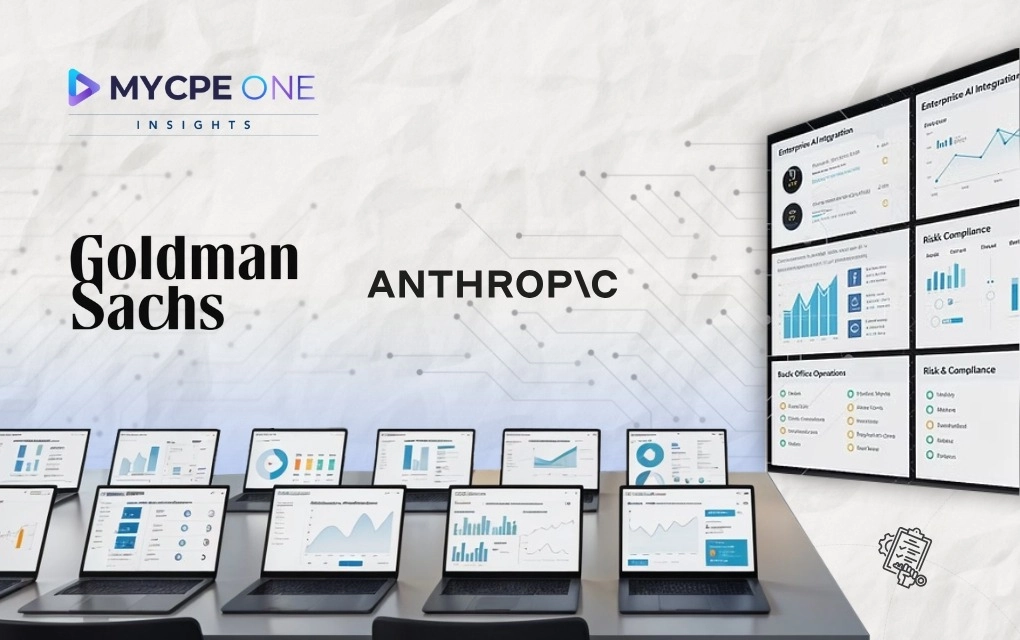
Goldman Sachs is working alongside engineers from AI company, Anthropic, to create automated systems to perform accounting and compliance work, in a bid to increase efficiency and control staffing growth. CIO Marco Argenti describes these systems as "digital co-workers", able to carry out traditionally labor-intensive tasks like reading large amounts of documents, applying rules, and identifying discrepancies - with a focus on the goal to enhance Goldman's trade and transaction accounting and client vetting and onboarding.
If you’ve ever watched a trade break at 4:58 p.m. on a Friday, you already know this truth: most “back-office” work isn’t glamorous, but it is brutally unforgiving. One mismatched data field, one missing document, one misapplied policy, and suddenly you’re staring at a reconciliation issue that eats half a day and ruins everyone’s weekend. So, when Goldman Sachs says it’s building AI agents with Anthropic’s Claude to automate accounting and compliance workflows, the headline might sound dramatic. The reality is more interesting and more relevant to every CPA, controller, auditor, and compliance lead watching the profession get dragged into the AI era, whether we like it or not. This is not Goldman “trying AI.” This is Goldman embedding Anthropic engineers inside the bank for six months to build autonomous systems that behave like internal junior staff, except faster, more consistent, and never tired. That should get your attention.
Goldman Sachs is not a bank that moves slowly when it smells a structural advantage. And right now, the advantage is clear: the bank wants to reorganize itself around generative AI over multiple years, while keeping headcount growth under control. That matters because Goldman, like most large financial institutions, runs on armies of professionals doing high-volume, rules-heavy work:
None of this work is optional. None of it is “nice to have.” And most of it scales linearly with volume. If business grows 15%, the instinct is to hire 15% more people, or burn out the existing team trying. Goldman’s message is basically: we want the growth, but we don’t want the headcount explosion. That’s the play.
Goldman’s CIO Marco Argenti described these systems as “digital co-workers,” which is corporate language for: not a chatbot. These are autonomous AI agents built on Anthropic’s Claude models, designed to do work that looks like:
Goldman’s first two targets tell you everything:
Goldman wants Claude-based agents to collapse the time it takes to do these workflows. Not improve it by 10%. Collapse it. That’s a big claim, and it’s the part worth watching.
Here’s the funny part: Goldman started this AI journey in a place most of us expected, coding. They tested an autonomous AI coder called Devin last year and rolled it out broadly to engineers. That’s the standard “AI saves developer time” story. Then Goldman realised something that should make accountants sit up straight:
Accounting isn’t hard because debits and credits are confusing. It’s hard because:
and every exception has a different fact pattern
Most of the job is detective work. Goldman basically looked at Claude and said, “Wait… this thing might actually be able to do the detective work.” That is the shift.
Goldman is being careful in its public messaging. Argenti said it’s “premature” to assume job losses. That sounds comforting, but let’s be honest: the bank also said the broader AI strategy aims to constrain headcount growth. That’s the quiet part. This is how large organizations reduce labor costs without doing layoffs:
The result looks like “efficiency gains” on paper. But it also means fewer entry-level roles over time. And this is where the accounting profession should feel a little uneasy. Back-office accounting, compliance, and onboarding are some of the biggest “training grounds” for junior talent in large organisations. If AI agents absorb the grunt work, the ladder changes. That doesn’t mean the profession dies. It means the first rung gets pulled up.
Publicly, Goldman is careful. Executives say it’s premature to talk about job cuts. That’s fair. But they are equally clear that the strategy is to inject capacity without expanding teams. That’s a familiar pattern in large institutions.
For accounting and compliance, that doesn’t mean roles disappear overnight. It means fewer new seats open over time, especially at the junior level. That shift is subtle, but it’s where long-term impact shows up.
Here’s the takeaway, and it’s not “learn to code.” Goldman’s move signals a shift in what organizations value:
Documentation and auditability matter more, not less: Ironically, AI agents make audit trails more important. Regulators will not accept “the AI said so.”
They will demand:
If you work in compliance or internal audit, you’re not getting less work. You’re getting different work.
Entry-level roles will change fast: if junior roles shrink, firms will need to rethink how they train people. The profession already struggles with pipeline issues. AI could make that worse if leaders don’t plan for it.
Goldman isn’t making a philosophical statement about accountants. It’s running a live stress test on how much procedural work still needs a human in the loop. The answer won’t be all or nothing. Regulators will still demand accountability. Clients will still expect judgment. Risk will still land on people, not models. But the floor is moving. For accounting and compliance professionals, the signal is clear. Value is shifting away from doing the steps and toward designing, supervising, and defending them. Goldman is betting that the grind can be automated. The rest of the profession has to decide what comes after the grind.
Click here to get your CPE Credit.
Until next time…
Don’t forget to share this story on LinkedIn, X and Facebook
Subscribe now for $199 and get unlimited access to MYCPE ONE, from CPE credits to insights Magazine
📢MYCPE ONE Insights has a newsletter on LinkedIn as well! If you want the sharpest analysis of all accounting and finance news without the jargon, Insights is the place to be! Click Here to Join
You’ve reached the 3 free-content piece limit. Unlock unlimited access to all News & CPE resources.
Subscribe Today.
Already have an account?
Sign In