
Join 250,000+
professionals today
Add Insights to your inbox - get the latest
professional news for free.
Join our 250K+ subscribers
Subscribe11 NOV 2025 / BUSINESS
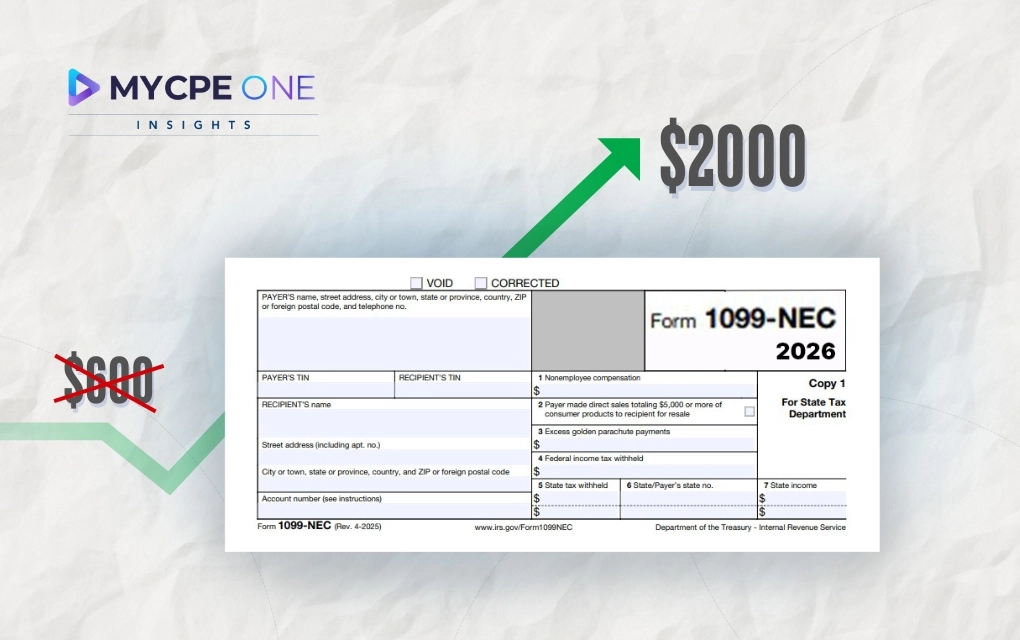
The One Big Beautiful Bill Act (OBBBA) passed in July 2025 modernizes the IRS' rules, introducing critical changes in tax reporting. It increases the threshold for Form 1099 NEC filing to $2,000 from 2026, implements inflation-adjustments from 2027, limits fines for failure to file required 1099 forms, reinstates the $20,000 and 200 transactions rule for 1099-K and expands casualty loss deductions. These changes simplify tax reporting and offer relief to taxpayers, improving procedures that have remained the same since 1954, a crucial development for small business reporting.
If the IRS had a museum, Form 1099’s $600 reporting rule would sit right next to rotary phones and typewriters. That number has survived since 1954, before color TV, before credit cards, before most payroll software was even a twinkle in a developer’s eye. Enter the One Big Beautiful Bill Act (OBBBA), signed in July 2025, which finally retires that relic. Starting in 2026, businesses will only need to file Form 1099-NEC when total payments to a contractor exceed $2,000. Even better, the new threshold will rise with inflation beginning in 2027. It’s like the IRS finally joined this century. But don’t confuse relief with relaxation. The IRS still means business. For 2025 forms filed in 2026, skipping a required 1099 could cost $340 per form, and if it’s “intentional disregard,” that jumps to the greater of $680 or 10 percent of what should’ve been reported. No cap, no mercy. As for worker classification? Let’s just say the IRS loves to turn an “independent contractor” into “employee” faster than you can say au
Remember the collective groan when the American Rescue Plan Act (ARPA) dropped the 1099-K threshold from $20,000 and 200 transactions to $600 flat? Yeah, taxpayers were about as happy as auditors during a network outage. The IRS tried to soften the blow with a slow rollout: $5,000 in 2024, $2,500 in 2025, and $600 in 2026. But then came the OBBBA, Congress’s version of hitting “undo.” The new law permanently restores the old rule: $20,000 and 200 transactions, retroactive to 2021. That means third-party platforms like Venmo, PayPal, Zelle, Airbnb, and eBay can breathe again, at least federally. Still, states play by their own rulebooks. Some mirror the IRS; others go rogue. So, if you do business in multiple states, maybe keep your tax pro on speed dial.
Fun fact: When Form 1099-K debuted in 2011, the IRS said it would “simplify compliance.” That aged about as well as “this meeting will be quick.”
Here’s a twist of good news: The OBBBA also sweetens casualty loss deductions for individuals hit by disasters. Before the Tax Cuts and Jobs Act (TCJA), taxpayers could deduct losses from “sudden, unexpected, or unusual” events, such as floods, fires, or burst pipes. Then, TCJA limited that break to federally declared disaster areas through 2025. Starting in 2026, OBBBA makes the deduction permanent and extends it to state-declared disasters too. That’s a win for taxpayers in hurricane, wildfire, or tornado zones who previously fell through the cracks.
And here’s the real kicker: you can claim the loss a year early by amending your prior return. For example, if a hurricane wipes out your property in 2025, you can file an amended 2024 return to get that refund faster. But the IRS loves proof. Advise clients to take photos, record videos, and store evidence somewhere safe, preferably not in the same flooded basement. Small businesses get an even better deal: they can deduct qualified casualty losses in full without those pesky income thresholds.
The OBBBA isn’t just another alphabet soup of tax code tweaks. It’s the first real modernization of small-business reporting in decades. Raising the 1099-NEC threshold means less paperwork for mom-and-pop shops and fewer “gotcha” penalties for honest mistakes. Reverting the 1099-K rule spares payment apps and gig workers from drowning in unnecessary forms. And expanding casualty loss deductions shows that Washington still knows how to toss taxpayers a lifeline, occasionally. So, what should you do now? Update your payroll systems. Refresh contractor records. Test your 2026 filing logic. And if you’ve got clients in disaster-prone states, help them document everything like it’s evidence in a Netflix docuseries. As Mark Twain once said, “The secret of getting ahead is getting started.” That advice feels tailor-made for tax season.
For once, a tax bill actually delivers what it promises: simpler reporting and faster relief. The 1099-NEC finally gets an inflation-proof upgrade, the 1099-K goes back to sanity, and casualty losses become a permanent, practical deduction for those who need it most. After seventy years of a $600 threshold that wouldn’t budge, this one’s a genuine refresh. It might not make accountants jump for joy, but it might just make tax season a little less painful. And in this line of work, that’s as good as gold.
Until next time…
Don’t forget to share this story on LinkedIn, X and Facebook
Subscribe now for $199 and get unlimited access to MYCPE ONE, from CPE credits to insights Magazine
📢MYCPE ONE Insights has a newsletter on LinkedIn as well! If you want the sharpest analysis of all accounting and finance news without the jargon, Insights is the place to be! Click Here to Join
Earn CPE Credits by Simply Reading Articles – Starting at Just $199/Year!
50 of the Top 200 Accounting Firms trust MYCPE ONE for their team’s learning—why not you? With 15,000+ approved content hours, 500+ emerging subject areas, and automated compliance tracking, staying ahead has never been easier.
We don’t just create boring tax, accounting, and audit content—our platform offers engaging, insightful, and trending material that your team will actually enjoy while earning CPE credits.
Sign up today, go through the comprehensive list of features and unlock unlimited learning!
You’ve reached the 3 free-content piece limit. Unlock unlimited access to all News & CPE resources.
Subscribe Today.
Already have an account?
Sign In