Join 250,000+
professionals today
Add Insights to your inbox - get the latest
professional news for free.
Join our 250K+ subscribers
Subscribe21 APR 2026 / BUSINESS
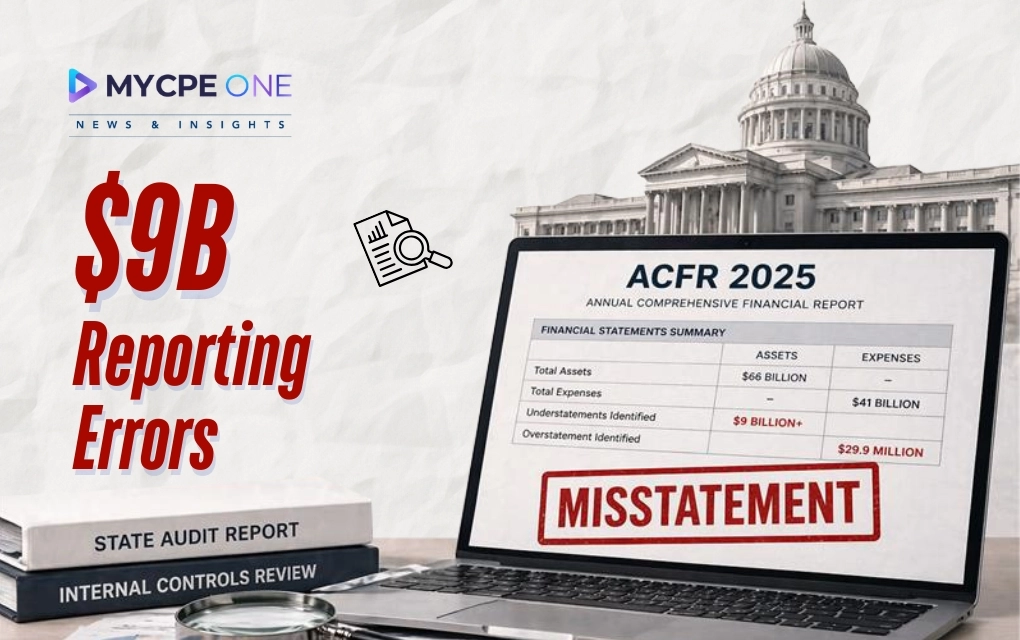
An audit of Missouri's financial statements unveiled a $9 billion discrepancy due to human error in calculation and a lack of effective controls across agencies. The error, tied mainly to retirement system investments, sheds light on vulnerabilities in financial reporting and implications for budget decisions, federal funding, and public trust.
Somewhere between a late-night Excel session and a “we’ll fix it in review” mindset, Missouri’s financial statements picked up a $9 billion problem. Not fraud. Not missing cash. Just good old-fashioned human error, scaled up to numbers that make even seasoned CPAs pause mid-coffee. If you’ve ever fat-fingered a formula and watched a balance swing wildly, you already get the vibe. Now imagine that happening across a statewide report covering $66 billion in assets. That’s the story Missouri’s latest audit is telling.
Short answer: nowhere. Long answer: it was buried in calculation mistakes inside fiduciary funds, mainly tied to retirement system investments. The April 2026 audit of Missouri’s fiscal year 2025 Annual Comprehensive Financial Report flagged more than $9 billion in understated balances. The causes read like a greatest hits list of spreadsheet headaches:
One set of errors alone knocked about $8.2 billion off reported balances because digits got flipped during manual entries. Another $912 million gap came from using old multiplier rates in pension calculations. Add roughly $145 million from missed transfers and contributions, and you’ve got a full-blown reconciliation mess. Nothing illegal. Just messy. And very avoidable.
Let’s be real. Excel is the MVP in accounting. It’s also the coworker who occasionally shows up late and swears nothing broke. Missouri’s Division of Accounting relied heavily on manual spreadsheets without built-in validation rules. That meant errors could slip through even after supervisory review. Think of it like reviewing a tax return where the numbers “look right” but nobody re-runs the math. The auditor didn’t mince words. These issues were labeled a “material weakness.” That’s not a casual note. That’s audit-speak for “this could seriously mess up your financial reporting if left unchecked.” And this isn’t a one-off. Similar issues showed up in prior years, including a wild $718 billion overstatement in fiscal 2023 tied to retirement contributions. Yes, billion with a “B.” That one got corrected before final reporting, but the pattern stuck around. So, the question becomes: how many times does this need to happen before systems catch up?
The audit didn’t just point fingers at spreadsheets. It highlighted deeper control issues across agencies, especially in how data is reviewed, approved, and reconciled. For example, the Department of Social Services’ MO HealthNet Division handled about $1.4 billion in receipts but still had gaps in access controls and reconciliation processes. Some employees could make changes without full oversight. Reviews weren’t always documented. Not every transaction got the scrutiny it should. That’s not ideal. Or as one auditor might say off the record, “That’s a bit loose.” Even the statewide accounting system, SAM II, still allows certain self-approval scenarios. That’s like letting someone sign off on their own expense report. Technically possible. Professionally questionable.
You might be thinking, “Okay, but they caught it, right?” Yes. Auditors identified and corrected the errors before the final report went out. But here’s the thing. Financial reporting isn’t just about fixing mistakes. It’s about preventing them. When errors of this scale depend on audit intervention to get corrected, it raises a bigger question: what happens when something slips through? Public sector reporting carries real consequences. Budget decisions, federal funding, public trust. All of it ties back to accurate numbers. As the saying goes, “trust, but verify.” Right now, Missouri is leaning a little too hard on the “verify” side.
Every audit cycle seems to land on the same recommendation: automate more, rely less on manual processes. Missouri agencies have started moving in that direction. Plans include integrating systems for real-time calculations and tightening review procedures. The Department of Revenue is refining its review process. The Division of Accounting is looking at improving software capabilities. Good steps. Slow steps.
Why slow? Because replacing legacy systems is expensive, complex, and politically sensitive. You don’t just flip a switch and upgrade statewide financial infrastructure. It’s more like renovating a house while living in it. Still, the alternative is sticking with processes that keep producing “oops” moments in the billions.
If you work in accounting, this probably feels familiar. Maybe not at a $9 billion scale, but the mechanics are the same.
We’ve all seen it. Maybe even lived it. The Missouri case just puts a spotlight on what happens when those small process gaps scale up. Way up. It’s also a reminder that internal controls aren’t just compliance checkboxes. They’re the guardrails that keep numbers from going off the rails.
One bad calculation is a mistake. A recurring pattern is a system issue. Missouri’s audits show improvement, sure. Some controls are stronger. Some processes are tighter. But the same core problems keep resurfacing, just with different numbers attached. So, here’s the real question for finance teams everywhere: are your controls catching errors, or preventing them? Because if you’re still relying on someone spotting a flipped digit after the fact, you might be closer to your own “$9 billion moment” than you think. And no one wants to explain that in a year-end meeting.
Until next time…
Don’t forget to share this story on LinkedIn, X and Facebook
Subscribe now for $199 and get unlimited access to MYCPE ONE, from CPE credits to insights Magazine
📢MYCPE ONE Insights has a newsletter on LinkedIn as well! If you want the sharpest analysis of all accounting and finance news without the jargon, Insights is the place to be! Click Here to Join
You’ve reached the 3 free-content piece limit. Unlock unlimited access to all News & CPE resources.
Subscribe Today.
Already have an account?
Sign In