MYCPE ONE
MYCPE ONE LOGO

Join 250,000+
professionals today

Add Insights to your inbox - get the latest
professional news for free.

MYCPE ONE insights

How Roomba Maker iRobot Slid From Amazon’s Deal to Bankruptcy

Join our 250K+ subscribers

Join our 250K+ subscribers

Subscribe

16 DEC 2025 / BUSINESS

How Roomba Maker iRobot Slid From Amazon’s Deal to Bankruptcy

How Roomba Maker iRobot Slid From Amazon’s Deal to Bankruptcy

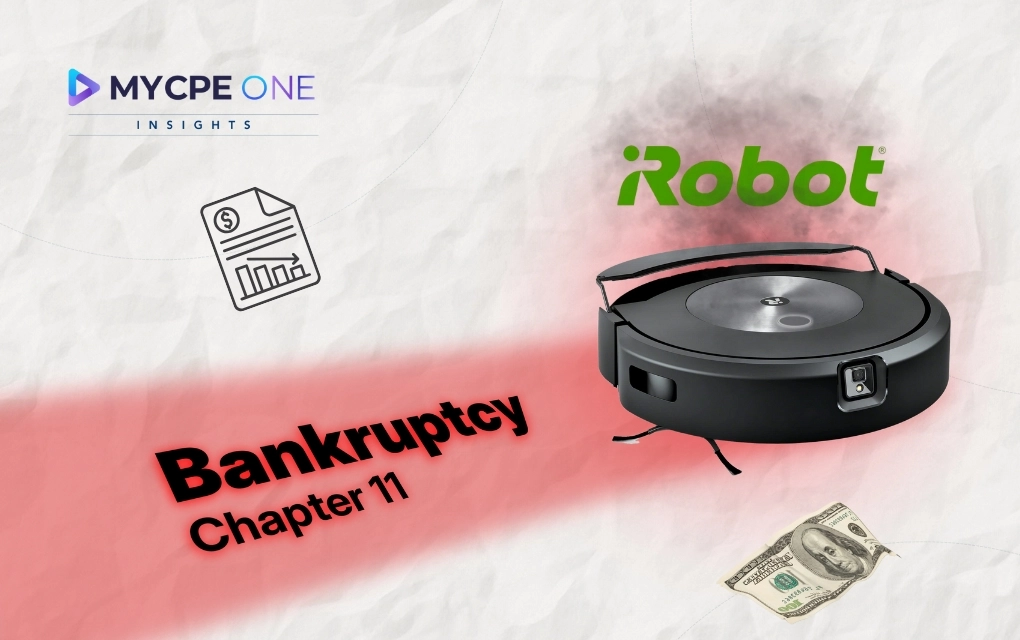
Some stories start with a bang. iRobot’s latest chapter starts with a thud, the kind your Roomba makes when it bonks into the sofa leg for the tenth time. One of America’s most familiar home gadgets just hit the corporate equivalent of low battery mode, and this time there’s no dock to save it. So how did the MIT-born pioneer of household robotics go from a $3.56 billion darling in 2021 to filing Chapter 11 in Delaware with a valuation closer to $140 million? Pull up a chair. This one has tariffs, takeover drama, and enough financial bruises to make even seasoned CPAs say holy smokes.

When the Floor Started Getting Dusty

For two decades, Roomba had the room to itself. Then everyone’s cousin in Shenzhen decided they could make a robot vacuum too and sell it for the price of a decent lunch. By 2024, competition from Chinese rivals like Ecovacs hammered margins, forcing iRobot to slash prices and pour cash into tech upgrades just to keep its 42% U.S. market share alive. Revenue that once peaked at $1.56 billion in 2021 drifted to $1.06 billion in 2022, then slid again to $974 million in 2024. Net losses piled up, hitting $154 million in 2022 and another $145.5 million in 2024. Then came the tariffs. A 46% duty on vacuum imports from Vietnam added a cool $23 million to costs in 2025. Planning became guesswork. Inventory cycles slowed. And that “temporary” debt from a 2023 refinancing ballooned into a $190 million headache. If you’ve ever looked at a cash flow statement and thought this thing needs a miracle, you get the picture.

The Amazon Deal that Never Made it to Checkout

Remember when Amazon tried to buy iRobot for $1.7 billion? For a moment, Roomba looked ready to join Alexa, Ring, and the rest of Jeff Bezos’s smart home Avengers. The compatibility pitch practically wrote itself. But Brussels had other ideas. EU regulators warned that Amazon could bury competing vacuums on its site, and by early 2024, the deal was as good as cooked. With Valentine’s Day set as the deadline for an EU ruling, both sides walked away before regulators swung the hammer. iRobot pocketed a chunk of the breakup fee, but the glow faded fast. Most of the cash went straight into loan repayments and advisory bills while the company laid off 31% of its workforce, shuttered projects, and tried to avoid Nasdaq delisting as its stock drifted below one dollar. Some analysts joked that iRobot needed a Roomba to sweep up the fallout. The humor wore off quickly.

Picea Steps in with the Chequebook

When iRobot slipped behind on payments, its main supplier, Shenzhen-based Picea Robotics, quietly bought up the company’s outstanding debt from Carlyle. By late 2025, iRobot owed Picea nearly $100 million plus additional overdue balances. The writing was on the wall. On December 15, 2025, iRobot filed a pre-packaged Chapter 11 plan. The deal is simple: Picea wipes out the 2023 loan, cancels another $74 million owed under its manufacturing contract, and takes 100% ownership. Shareholders get zero. Bondholders get a partial recovery. Operations, warranties, and app support continue for now. It’s the corporate finance version of turning in your keys and hoping the landlord keeps the lights on.

Who Wins, Who Loses, and Who’s Left with Dustpan

Let’s start with the obvious. Shareholders take the hardest hit. Prediction markets had already priced in a 100% chance of bankruptcy before 2027, and the stock’s final 13% slide last week sealed the sentiment. Anyone holding equity now has a tax loss harvesting story for the ages. For employees, the picture is mixed. Jobs remain stable in the short run due to bankruptcy protections, but the long-term strategy will be led from Shenzhen. Will R&D stay in Massachusetts? Will cost cuts shift production further into Asia? Fair questions, and no one has firm answers.

For Picea, this is a strategic jackpot. Overnight, the company jumps from contract manufacturer to owner of the most recognisable consumer robotics brand on the planet. It picks up Roomba’s intellectual property, market presence in the U.S. and Japan, and a distribution network that took decades to build. In Wall Street terms, Picea bought the house, the furniture, and the keys for pennies on the pandemic-era dollar. For customers, life goes on. The robots still clean. The app still works. The servers still hum. If you bought a Roomba last month, relax. It’s not turning into a paperweight.

What Comes After the Cleanup Crew Leaves

The near future is a balancing act. iRobot’s leadership, including CEO Gary Cohen, portrays the move as a reset button that restores stability after years of bleeding cash. Privately held companies can take bigger swings without worrying about quarterly earnings calls, which could help Picea reorganize the brand, slim down product lines, and navigate tariffs with more flexibility. But innovation may slow as integration starts. Roomba’s legendary engineering culture grew inside MIT hallways and Boston labs, not Shenzhen boardrooms. Will that spark survive? And what happens when your contract manufacturer becomes your boss?

For regulators, the Amazon failure raises bigger questions. If Big Tech can’t buy struggling U.S. hardware companies due to visibility risks on marketplace shelves, does that push more American tech IP into foreign hands? Several policy experts are already asking whether blocking Amazon inadvertently opened the door for Picea. For finance pros, this bankruptcy is a reminder that even beloved brands crumble without margin discipline. Pandemic surges can be sugar highs. Tariffs change cost structures overnight. And debt taken “just for flexibility” has a habit of sticking around like glitter after a craft project.

The Takeaway

iRobot didn’t fail because people stopped liking clean homes. It failed because costs spiked, rivals undercut, regulators intervened, and debt crowded out strategy. The company that once symbolised accessible robotics has now become a case study in competitive pressure and geopolitical trade tension. The Roomba will keep rolling, just under new ownership. For the rest of us, especially those advising clients in hardware, manufacturing, or cross-border supply chains, the question is simple. If a pioneer with a head start, global brand, and MIT pedigree can stumble, what safeguards do the rest of us need? Because in finance, as in housekeeping, dust never disappears. It just piles up where you aren’t looking.

Until next time…

Don’t forget to share this story on LinkedIn, X and Facebook

Subscribe now for $199 and get unlimited access to MYCPE ONE, from CPE credits to insights Magazine

📢MYCPE ONE Insights has a newsletter on LinkedIn as well! If you want the sharpest analysis of all accounting and finance news without the jargon, Insights is the place to be! Click Here to Join

Website Services for CPA & Accounting Firms - Starting $69/month.

Is your website attracting clients—or turning them away? MYCPE ONE’s Website Development Services, starting at just $69/month, create high-converting, professional websites tailored for accounting firms like yours.

With over 400 designs to choose from and a dedicated webmaster, we handle it all for you—no DIY required.

Get started today and create a website that works for your firm with MYCPE ONE!
Make a lasting impression. Boost conversions. Stay secure.

Schedule a call today!

Unlock Annual Access to News & CPE Subscription

You’ve reached the 3 free-content piece limit. Unlock unlimited access to all News & CPE resources.
Subscribe Today.

News & Updates

  • Exclusive News & Insights
  • Latest Regulatory Updates
  • Accounting Industry Trends
  • Expert Insights
  • AI-Driven Audio & Summaries
  • Infographics & Videos
  • CPE-Approved Articles
  • Digital Magazine
  • Benchmarking Blogs

Unlimited CPE Access for 1 Year

  • 15,000+ Hours of Content
  • 500+ Subject Areas
  • Mandatory Ethics Courses
  • 250+ Compliance Packages
  • 50+ Virtual Conferences and Events Access
  • Format: Live, Audio, Video, E-Books
  • Audio Based Courses & Podcasts
  • Add External Certificates with AI
  • AI Compliance Tracking and Report
  • Instant Certification and Fast Reporting
  • Mobile App Access (iOS and Android)
  • Dedicated Support System
  • Practical Training Programs
  • AI Academy Access
  • Tax Academy Access
  • Audit Academy Access
  • Leadership Academy Access