Join 250,000+
professionals today
Add Insights to your inbox - get the latest
professional news for free.
Join our 250K+ subscribers
Subscribe11 MAR 2026 / BUSINESS
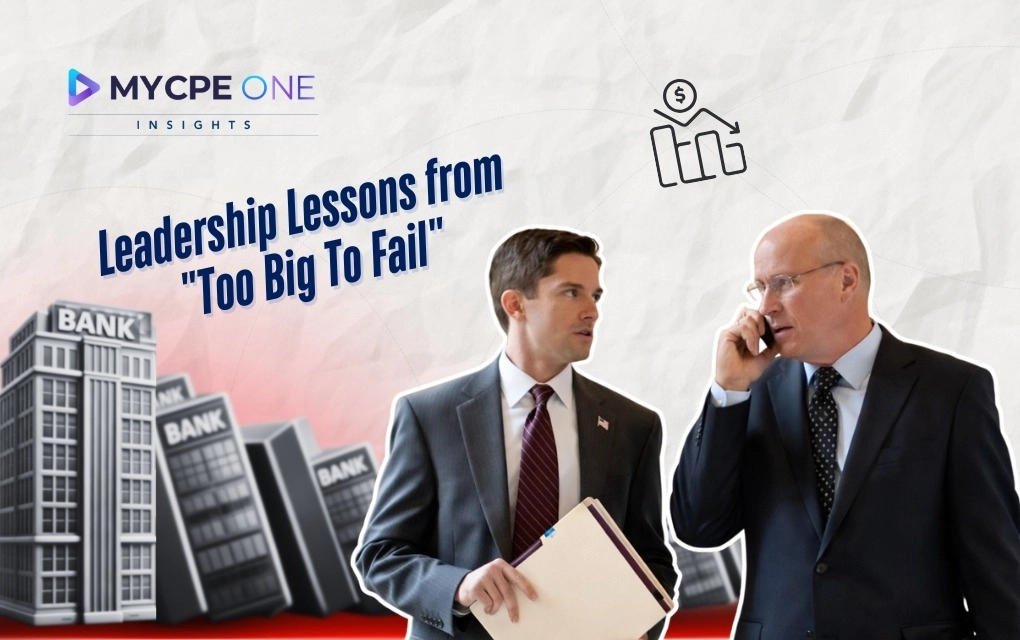
The 2008 financial crisis, majorly depicted in the HBO film "Too Big to Fail," still holds relevance for accounting and finance professionals due to the interconnectedness of large financial institutions, often dubbed "too big to fail" (TBTF), that underlie the financial system. Policymakers scrambled to salvage the crumbling credit system by injecting billions of dollars into major banks, highlighting the immense concentration of decision-making within financial markets mediated by a small group of CEOs, which serves as a critical lesson for these professionals in understanding systemic risk, leadership, and liquidity challenges in crisis situations today.
The phrase “too big to fail” sounds almost mythical, like something from a superhero movie. Giant institutions standing tall, untouchable, carrying the weight of the economy on their shoulders. Yet the story behind that phrase is far less heroic. It is messy, human, and full of last-minute decisions made in rooms where nobody quite knows what the next hour will bring. The HBO film Too Big to Fail captures that moment in 2008 when the financial system stood on the edge of a cliff. Treasury Secretary Hank Paulson, Federal Reserve Chair Ben Bernanke, and a handful of Wall Street executives spent frantic weeks trying to prevent a collapse that could have frozen credit across the United States. The crisis revealed something uncomfortable. The modern financial system had become so interconnected that the failure of a few institutions could threaten everything from mortgages to payrolls. For accounting, finance professionals, and leaders, the story still matters. It raises questions about risk, accountability, and the strange reality that sometimes markets depend on the very institutions they cannot afford to lose.
The concept of “too big to fail,” often shortened to TBTF, refers to institutions so large and interconnected that their collapse could destabilize the entire economy. The 2008 financial crisis turned that theory into a painful reality. Consider Lehman Brothers. On September 15, 2008, the investment bank filed for bankruptcy with roughly $691 billion in assets. By the end of the day, global markets had lost about $700 billion in value. Banks quickly stopped lending to one another, and the credit system began freezing up. That moment forced policymakers into emergency mode. Within weeks, the U.S. government approved the $700 billion Troubled Asset Relief Program, better known as TARP. The plan injected capital into major banks such as JPMorgan Chase, Citigroup, and Wells Fargo. AIG, deeply entangled in credit default swaps, received support totaling about $182 billion.
The logic behind those decisions was simple, even if it felt uncomfortable. If the financial plumbing of the economy stopped working, businesses could not borrow, payrolls could stall, and households would lose access to mortgages and credit. In other words, the problem was not just failing banks. It was a system where everything had become connected.
One moment from the crisis still captures the scale of concentration inside modern finance. In October 2008, Treasury officials summoned the CEOs of nine major banks to Washington. The government urged them to accept $125 billion in capital injections to stabilize the financial system. Think about that scene for a moment. The health of the U.S. economy depended on decisions made by fewer than a dozen executives sitting in one room.
For professionals working in accounting firms or corporate finance departments, that level of concentration feels familiar. Large financial institutions dominate capital markets, influence credit flows, and shape economic activity across industries. The crisis revealed how tightly those connections had grown. Mortgage securities tied banks to housing markets. Credit derivatives linked insurers to banks. Short-term funding markets connected firms through repurchase agreements and wholesale lending. Once trust disappeared, everything started shaking.
Ben Bernanke once summarized the problem in simple terms. Financial crises often begin with a market shock, but the real damage arrives when credit stops flowing. When banks lose confidence in each other, lending dries up and the broader economy feels the pain almost immediately. That lesson remains relevant today. Liquidity risk rarely jumps off the page in a balance sheet. Yet once confidence evaporates, even institutions that look stable can suddenly find themselves scrambling.
The film also highlights a sharp contrast in leadership styles during the crisis.
Officials like Paulson and Bernanke pushed aggressive measures to prevent systemic collapse. Their decisions faced political backlash, but they focused on stabilizing the broader economy. Meanwhile, critics argue that Lehman Brothers' leadership underestimated the severity of the firm’s problems. As market pressure intensified, executives blamed short sellers and external forces rather than confronting structural weaknesses in their balance sheet. That contrast illustrates an old but important leadership principle. When problems escalate quickly, denial becomes expensive.
Accounting professionals see versions of this dynamic during corporate failures. Warning signs often appear early. Rising leverage, complex financial instruments, aggressive revenue assumptions, or thin liquidity cushions may show up quietly in financial disclosures. The challenge lies in recognizing those signals before the situation spirals out of control. A veteran audit partner once joked during a conference panel that markets reward confidence until they do not. “In good times,” he said, “everyone feels like a genius. In bad times, you find out who actually read the risk disclosures.” The room laughed, but the message landed.
For professionals inside the accounting and finance world, the crisis still reads like a master class in judgment.
Financial crises rarely arrive as a single dramatic event. They build slowly through incentives, blind spots, and decisions made behind closed doors. The story of Too Big to Fail reminds us that markets depend on something surprisingly fragile. Trust. Once that disappears, even the largest institutions start looking a little less invincible.
After the financial crisis, regulators moved quickly to strengthen oversight. The Dodd-Frank Act introduced stricter capital requirements, stress testing, and tighter supervision of systemically important financial institutions. Banks now hold larger capital buffers than they did before 2008. The Federal Reserve conducts annual stress tests that simulate severe economic downturns to determine whether large banks could survive another crisis. Those reforms improved stability, but the underlying debate never disappeared.
Large institutions still dominate global financial markets. Corporate debt levels have grown significantly across many economies. Financial innovation continues to create new instruments that regulators sometimes struggle to monitor. Put simply, the system looks sturdier on paper, yet complexity has not vanished.
Until next time…
Don’t forget to share this story on LinkedIn, X and Facebook
Subscribe now for $199 and get unlimited access to MYCPE ONE, from CPE credits to insights Magazine
📢MYCPE ONE Insights has a newsletter on LinkedIn as well! If you want the sharpest analysis of all accounting and finance news without the jargon, Insights is the place to be! Click Here to Join
You’ve reached the 3 free-content piece limit. Unlock unlimited access to all News & CPE resources.
Subscribe Today.
Already have an account?
Sign In