MYCPE ONE
MYCPE ONE LOGO

Join 250,000+
professionals today

Add Insights to your inbox - get the latest
professional news for free.

MYCPE ONE insights

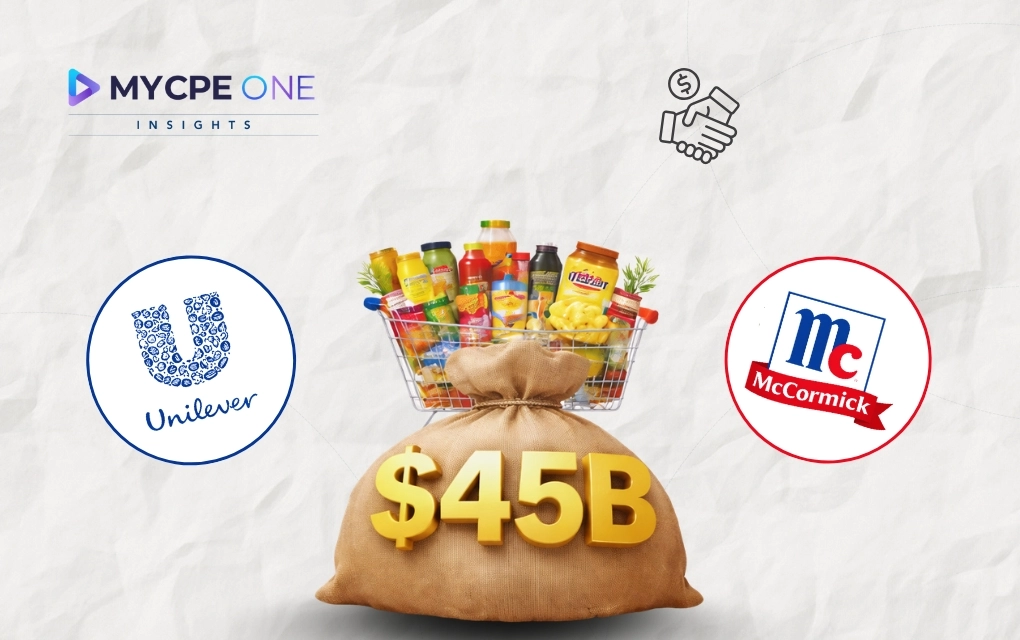
McCormick Lands Unilever Food Business in $45B Deal

Join our 250K+ subscribers

Join our 250K+ subscribers

Subscribe

01 APR 2026 / BUSINESS

McCormick Lands Unilever Food Business in $45B Deal

McCormick Lands Unilever Food Business in $45B Deal

When you combine a €50.5 billion consumer goods giant with a $7 billion spice powerhouse, you are not just shuffling brands on a grocery shelf. You are redrawing the map of global packaged food. Last year, Unilever generated €50.5 billion in group revenue, with its food division contributing €12.9 billion and €2.9 billion in underlying operating profit. McCormick, by comparison, posted about $7 billion in revenue and roughly $1 billion in operating income. Now, through a deal that values Unilever’s food business at roughly $44.8 billion and creates a combined enterprise worth about $65–66 billion, the two are building what could become a global flavor heavyweight. This is not just another food deal. It is a strategic pivot years in the making.

Source: Reuters

From Butter Barons to Beauty Boss

Unilever’s food roots go back to 1860, when Dutch families built fortunes in butter trading. The 1929 merger of Margarine Unie and Lever Brothers created one of Europe’s earliest industrial giants. For decades, brands like Hellmann’s, Knorr, Marmite, and Colman’s were pantry royalty. But consumer tastes shifted. Health-conscious shoppers started walking away from processed foods. GLP-1 weight-loss drugs added more pressure. Private labels chipped away at pricing power. Meanwhile, Unilever’s beauty and personal care portfolio, Dove, Vaseline, and Axe, showed stronger growth and better valuation multiples.

Source: Reuters

Activist investor Nelson Peltz built a stake in 2022 and pushed for a sharper focus. Two CEOs exited. Fernando Fernández, formerly head of beauty and later CFO, took the helm in 2025. He spun off the ice cream business and signaled that food might not have a permanent seat at the table. There were even talks with Kraft Heinz about combining Unilever’s food unit with Kraft’s condiments division. That megamerger, which would have united Heinz ketchup and Hellmann’s mayo, fizzled out. But the message was clear: Unilever wanted out, or at least mostly out, of food. Then McCormick stepped in.

Source: Reuters

Reverse Morris Trust and the Power Split

Unilever will spin off its food division and merge it with McCormick in a tax-efficient Reverse Morris Trust structure. This allows the transaction to be tax-free for US federal income tax purposes, minimizing the tax hit that has derailed similar deals in the past. The numbers matter. Unilever and its shareholders will receive 65% of the fully diluted combined company’s equity, equivalent to about $29.1 billion based on recent trading averages. Unilever will also receive $15.7 billion in cash. The combined enterprise will be worth around $65–66 billion. Leadership will remain anchored in Hunt Valley, Maryland. McCormick will keep its name, its NYSE listing, and establish an international headquarters in the Netherlands. The Indian food business will be excluded from the transaction.

McCormick CEO Brendan Foley will lead the combined entity, with senior representation from Unilever Foods. The new company expects approximately $600 million in annual cost synergies, with about $100 million reinvested into growth. Fernando Fernández framed it this way: the deal gives shareholders exposure to “two leading companies in two focused areas.” Translation: one pure-play home and personal care giant, and one global flavor leader. Still, not everyone is cheering. RBC analyst James Edwardes Jones questioned why Unilever would dispose of a business dominated by Hellmann’s and Knorr, brands it owned outright, for what he called a minimal control premium while leaving shareholders with a majority stake in what he described as a sprawling food entity. That skepticism showed up fast. Unilever shares dropped sharply on announcement, and McCormick also saw a sell-off. Wall Street clearly thinks this is not a slam dunk.

Reading Between the Lines

Around the same time, Unilever implemented a global hiring freeze “at all levels” for at least three months, citing widening conflict in the Middle East. Officially, it is about geopolitical uncertainty. But in context, it also reflects tighter capital discipline. Unilever has an ongoing €800 million cost-cutting program through 2027. The $15.7 billion cash component will help fund up to €6 billion in share buybacks, pay down debt, and support acquisitions in beauty, wellbeing, personal care and home care. When a company is reshaping itself this aggressively, freezing hiring is not just about macro risk. It is about preserving flexibility. Fernández is clearly tightening the belt before doubling down on higher-growth categories.

Source: Reuters

A Flavor Powerhouse

For McCormick, this is transformational.

The combined business will unite McCormick’s spices, French’s mustard, Cholula, and Frank’s RedHot with Unilever’s Hellmann’s, Knorr, and Marmite. It creates a global flavor platform with roughly $20 billion in annual revenue. As Foley put it, McCormick differentiates itself by “flavoring calories while others compete for them.” That positioning becomes even stronger with Unilever’s global distribution, especially in emerging markets where Unilever has deep reach. Net leverage for the combined company is expected to be 4.0x or less at closing. That is meaningful but manageable if synergies materialize and growth accelerates.

Analysts estimate the combined entity could deliver 5 to 7% growth if distribution expansion and cost synergies play out. That is the bull case. The bear case? High leverage, integration risk, and continued consumer migration toward fresh foods and private labels. If those trends intensify, scale alone will not save margins.

Slim Down or Get Left Behind

This deal fits a broader pattern. Consumer goods companies are slimming down to sharpen growth profiles and close valuation gaps. Unilever wants to be a pure-play home and personal care company, where beauty, wellbeing and personal care could represent roughly two-thirds of turnover post-separation. Those categories benefit from premiumization, science-led innovation and faster-growing channels. The food side becomes a focused, scale-driven flavor specialist. The earlier Kraft Heinz talks show that this was never just about one buyer. Unilever has been exploring exits for years. McCormick simply offered the cleanest path, especially with the tax advantages of the Reverse Morris Trust. Now the question is execution.

So, Home Run or Headache?

On paper, Unilever gets $15.7 billion in cash, majority ownership in a $65 billion food giant, and a cleaner growth story in beauty and home care. McCormick gets instant global scale and iconic brands that CEOs have reportedly eyed for decades. But integration risk is real. Shareholders must decide whether they want “US paper” in a more leveraged food company. Analysts are already split. Markets reacted with caution. This is not just a condiment combo. It is a high-stakes portfolio reshuffle that could redefine two global players. If synergies hit, distribution expands, and consumer demand stabilizes, this could look like a savvy pivot. If not, critics will say Unilever gave up full ownership of the crown jewels for a complicated halfway exit. Either way, the pantry just got a whole lot more interesting.

For financial professionals watching consumer staples, the takeaway is clear: portfolio focus, tax structuring and capital allocation discipline are now just as important as brand power. The flavor of the future will be decided not just in the kitchen, but in the boardroom.

Until next time…

Don’t forget to share this story on LinkedIn, X and Facebook

Subscribe now for $199 and get unlimited access to MYCPE ONE, from CPE credits to insights Magazine

📢MYCPE ONE Insights has a newsletter on LinkedIn as well! If you want the sharpest analysis of all accounting and finance news without the jargon, Insights is the place to be! Click Here to Join

Unlock Annual Access to News & CPE Subscription

You’ve reached the 3 free-content piece limit. Unlock unlimited access to all News & CPE resources.
Subscribe Today.

News & Updates

  • Exclusive News & Insights
  • Latest Regulatory Updates
  • Accounting Industry Trends
  • Expert Insights
  • AI-Driven Audio & Summaries
  • Infographics & Videos
  • CPE-Approved Articles
  • Digital Magazine
  • Benchmarking Blogs

Unlimited CPE Access for 1 Year

  • 15,000+ Hours of Content
  • 500+ Subject Areas
  • Mandatory Ethics Courses
  • 250+ Compliance Packages
  • 50+ Virtual Conferences and Events Access
  • Format: Live, Audio, Video, E-Books
  • Audio Based Courses & Podcasts
  • Add External Certificates with AI
  • AI Compliance Tracking and Report
  • Instant Certification and Fast Reporting
  • Mobile App Access (iOS and Android)
  • Dedicated Support System
  • Practical Training Programs
  • AI Academy Access
  • Tax Academy Access
  • Audit Academy Access
  • Leadership Academy Access