Join 250,000+
professionals today
Add Insights to your inbox - get the latest
professional news for free.
Join our 250K+ subscribers
Subscribe22 JAN 2026 / BUSINESS
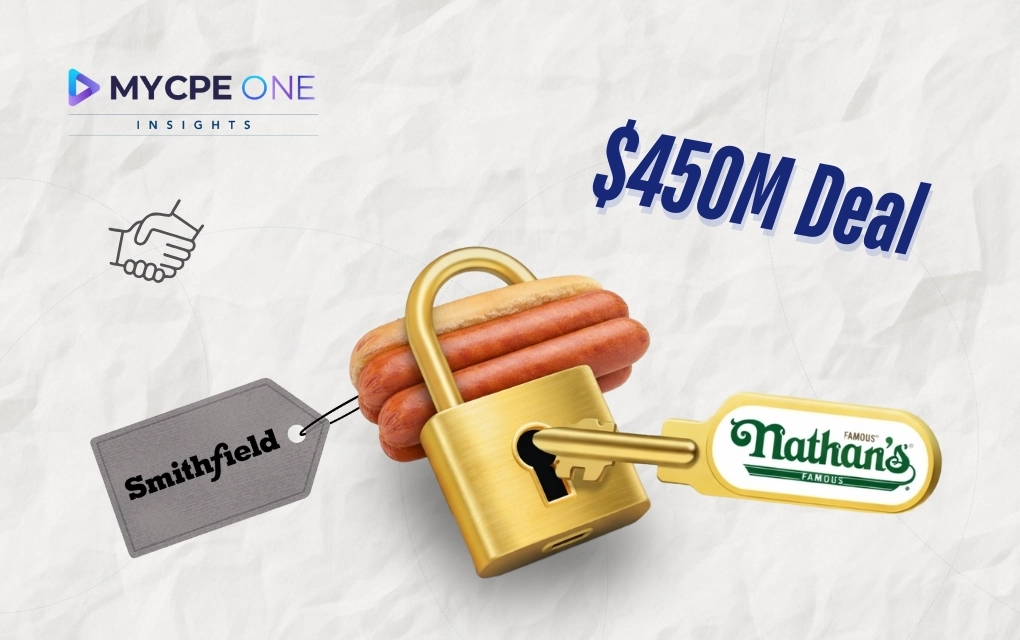
Smithfield Foods has purchased American hotdog brand Nathan's Famous for $450m in a bid to secure long-term economic stability and remove the risk of expired licensing agreements, royalty expenses and goodwill connected to others' intellectual property. The acquisition removes uncertainties connected to licensing as Smithfield already held the exclusive rights to manufacture, market and sell Nathan's products in the US and Canada. The arrangement also provides value by eliminating licensing fees, streamlining brand strategising and enhances the efficiency of marketing spend. The deal will ensure steady cash flow for Smithfield, amidst inflation pressures, by absorbing costs through its scale.
Every CPA who has ever reviewed a long-term licensing agreement knows the feeling. You flip to the expiration date, do the math, and realize the clock is the real risk. That is exactly what is going on behind Smithfield Foods’ $450 million all-cash purchase of Nathan’s Famous. This is not about nostalgia, Coney Island vibes, or who wears the Mustard Belt on July 4. It is about locking down economics, margin control, and strategic certainty before a license turns into leverage. Smithfield already made the hot dogs. Now it owns the name on the bun.
On paper, Smithfield did not need Nathan’s. It already held the exclusive license to manufacture, market, and sell Nathan’s Famous products in the US and Canada, plus Sam’s Club locations in Mexico. That agreement runs through 2032. Plenty of time, right? Not really. Licenses expire. Renewal terms get renegotiated. Royalties creep up. Strategic priorities change. From a packaged meats perspective, that uncertainty sits right in the middle of Smithfield’s largest revenue segment. Owning the brand removes that overhang completely. As Smithfield put it, the deal secures its rights to Nathan’s “into perpetuity.” For accountants, that phrase translates cleanly: no renewal risk, no future royalty expense, no goodwill tied to someone else’s IP.
The price tag, $102 per share or about $450 million, reflects that certainty. Nathan’s reported roughly $150 million in revenue and $24 million in profit in fiscal 2025. On a back-of-the-envelope basis, Smithfield is paying up for predictability, not growth fireworks. And frankly, predictability is nothing in food manufacturing right now.
Smithfield expects about $9 million in annual cost synergies within two years of closing. That number raised a few eyebrows because it sounds modest relative to the purchase price. But cost synergies are only half the story. The real value sits below operating income. Eliminating licensing fees improves gross margin. Consolidating brand strategy simplifies distribution economics. Marketing spend becomes more efficient when you are not coordinating with a licensor. None of that always shows up cleanly in synergy press releases. Nathan’s, for its part, has been dealing with inflation head-on. In its most recent SEC filing, the company disclosed a 27% increase in branded product sales costs year over year, including a roughly 20% jump in average hot dog cost per pound. Those pressures do not disappear post-acquisition, but Smithfield’s scale gives it more room to absorb them without denting brand pricing.
From a valuation standpoint, this is a clean exit for Nathan’s shareholders. The board controls nearly 30% of the stock and unanimously approved the deal. The market liked it too. Nathan’s shares jumped nearly 9%, while Smithfield stock finished slightly down after an early pop. That split reaction tells you where the perceived upside sits.
Public reaction has fixated on Smithfield’s ownership. The company is based in Virginia, but its majority owner is Hong Kong-listed WH Group, which acquired Smithfield in 2013 for $4.7 billion. That history has drawn political attention before, especially during the Trump administration. Here is the inside baseball reality. Nathan’s manufacturing already sat under Smithfield. The supply chain did not suddenly change hands this week. From a regulatory standpoint, this deal mostly converts a licensing relationship into outright ownership. It does not meaningfully expand foreign control over US food production beyond what already existed. That said, optics matter. Nathan’s is not just another protein SKU. It is a 110-year-old American brand tied to July 4, ESPN broadcasts, and a very specific slice of cultural memory. Smithfield knows this, which is why it moved quickly to confirm the Coney Island contest will continue uninterrupted. You do not mess with tradition unless you want a PR headache.
This deal fits a broader pattern. Inflation has squeezed margins across consumer staples. Brands with strong recognition but modest growth profiles suddenly look more attractive when paired with scaled operators who can protect profitability. Nathan’s is a perfect example. It sells hot dogs, not hype. Revenue growth will never look like a tech chart. But brand loyalty is durable, distribution is established, and the economics are easy to model. For Smithfield, that combination supports steady cash flow, not moonshots. It also reflects a shift in how companies think about intangible assets. Licensing works when both sides have leverage. When one side controls manufacturing, distribution, and shelf space, ownership starts to look cleaner. Accountants see this logic all the time in client restructurings. Eliminate friction, simplify contracts, and make earnings easier to explain.
First, expect more deals like this. Mature brands with strong name recognition but limited standalone scale will continue to get absorbed by larger operators looking for certainty. Second, pay attention to how companies frame synergy numbers. The real story often sits in margin protection, not headline savings. Finally, this deal is a reminder that boring can be beautiful. A century-old hot dog brand does not sound exciting, but predictable cash flow never goes out of style. As one old finance line goes, “the most valuable asset is the one you do not have to explain every quarter.” Smithfield just made its packaged meats story easier to tell. And in a year where cost pressure, consumer sensitivity, and regulatory noise are all in play, that clarity counts.
Until next time…
Don’t forget to share this story on LinkedIn, X and Facebook
Subscribe now for $199 and get unlimited access to MYCPE ONE, from CPE credits to insights Magazine
📢MYCPE ONE Insights has a newsletter on LinkedIn as well! If you want the sharpest analysis of all accounting and finance news without the jargon, Insights is the place to be! Click Here to Join
You’ve reached the 3 free-content piece limit. Unlock unlimited access to all News & CPE resources.
Subscribe Today.
Already have an account?
Sign In