


Join 250,000+
professionals today
Add Insights to your inbox - get the latest
professional news for free.
Join our 250K+ subscribers
Subscribe16 APR 2026 / BUSINESS
Solar power firm, SunPower, saw revenues of $300 million in 2025, lower than previous (later corrected) estimates of over $308 million, due to errors in financial reporting. The company blamed mistakes in controls and flawed accounting for impacting its reports, revealing material weaknesses that spanned revenue, costs, operating expenses and interest expense, causing SunPower share price to drop by 4.9% and leading to an ongoing credibility crisis within the firm.
SunPower’s latest disclosure is not just another restatement headline. It is a reminder of how fragile financial reporting can become when controls lag behind growth. The company reported audited 2025 revenue of $300.0 million, sharply higher than $108.7 million in 2024, but notably lower than the $306.5 million preliminary figure and the $308.7 million it had earlier reported across its quarterly updates. That gap alone tells you something broke in the reporting pipeline. Add to that a delayed 10-K filing and ongoing audit scrutiny, and the picture becomes even more uncertain. And when a company has to tell investors that multiple quarters “should no longer be relied upon,” this is no longer about rounding differences. It is about credibility, controls, and whether the numbers were ever fully understood in the first place. And when those kinds of errors show up across multiple quarters, this stops being a bookkeeping issue. It becomes a governance story.
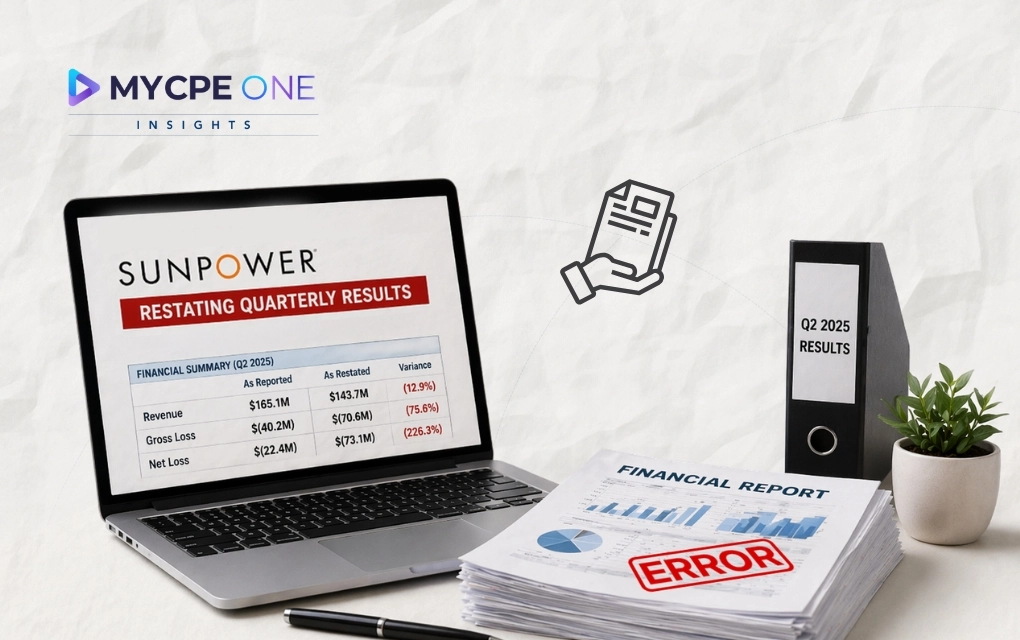
SunPower’s April 2026 disclosure confirmed material errors across three quarters of 2025. We’re not talking about a single adjustment. The issues cut across revenue, cost of revenue, commissions, operating expenses, and interest expense.
The financial hit is real:
That mismatch between revenue and profit tells you something deeper broke. This wasn’t just overstated sales, it points to cost misclassification and flawed accounting logic. The company blamed duplicate bookings in a legacy IT system. Fair enough. But here’s the real takeaway: duplicate entries don’t survive unless controls let them slide. And that’s where the market starts raising eyebrows.
Let’s call it what it is, this is a control failure, not just an accounting error.
SunPower openly admitted to “material weaknesses in internal control over financial reporting.” That includes breakdowns in:
Even Reuters-style coverage flagged this as more than a one-off issue, calling it a broader governance risk.
Internally, the cracks were clear:
The company is now replacing its old Albatross system with Salesforce. But swapping software won’t magically fix broken processes. Here’s the blunt truth: Errors don’t scale unless the system lets them.
These errors didn’t show up during quarterly reporting. They surfaced during the year-end audit.
Timeline check:
That’s not a coincidence. That’s the audit doing what internal processes failed to do. Independent auditors forced reconciliation across periods, and the numbers didn’t line up. This is classic. Quarterly reporting leans on estimates and system outputs. The annual audit digs deeper, tests assumptions, and cross-checks everything. And when that happens, weak controls get exposed fast.
If this feels familiar, it should. SunPower has a history of restatements:
Across all these years, the same themes keep showing up:
That repetition is the real red flag. As one practical takeaway from industry coverage puts it: recurring restatements usually signal deeper control problems, not isolated mistakes. And investors know it.
The market didn’t shrug this off.
Source: Reuters
That discount isn’t random. It reflects skepticism. Even with revenue growth and a flashy 55% gross margin in Q4 2025, analysts aren’t buying the story just yet. The consensus rating? “Hold.” Why? Because those margins may not stick. Management itself said a 38% margin is the normal baseline. The rest could be a one-time cleanup effect. Add in rising operating expenses, up 8.5% quarter over quarter, and the picture gets even murkier.
Restatements don’t just tweak financials. They ripple across the business:
SunPower has already felt this pressure before, including liquidity challenges and restructuring moves. The company even secured a $55 million equity line of credit, a lifeline, sure, but also a dilution signal for shareholders. This is why restatements are treated as governance signals, not just accounting corrections.
SunPower has laid out a cleanup plan:
Sounds good on paper. But here’s the kicker: execution is everything. The company is targeting over $400 million in revenue for 2026. Ambitious, no doubt. But that’s not the metric to watch. Investors should focus on:
In short, this isn’t a growth story right now. It’s a credibility rebuild.
SunPower’s restatement is more than a financial reset. It’s a credibility test. The company has shown it can grow revenue and improve margins. But recurring control failures raise a bigger question: can investors trust the numbers going forward? Until SunPower proves it can deliver clean audits, stable reporting, and consistent controls, every headline figure will come with an asterisk. And in finance, that’s the kind of baggage that doesn’t go away overnight.
Until next time…
Don’t forget to share this story on LinkedIn, X and Facebook
Subscribe now for $199 and get unlimited access to MYCPE ONE, from CPE credits to insights Magazine
📢MYCPE ONE Insights has a newsletter on LinkedIn as well! If you want the sharpest analysis of all accounting and finance news without the jargon, Insights is the place to be! Click Here to Join
You’ve reached the 3 free-content piece limit. Unlock unlimited access to all News & CPE resources.
Subscribe Today.
Already have an account?
Sign In