Join 250,000+
professionals today
Add Insights to your inbox - get the latest
professional news for free.
Join our 250K+ subscribers
Subscribe06 AUG 2025 / ECONOMY
CPE Approved
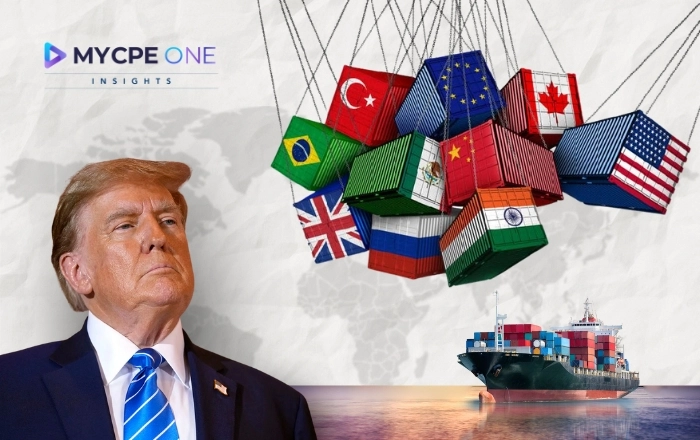
President Donald Trump's second-term administration has upped tariff rates from 10% to 50% on dozens of trading partners, impacting international supply chains, investment sentiment, and American consumers. This includes a 35% tariff on Canada, 50% on Brazil, and similar levels on India and Taiwan, with more tariff hikes expected in the near future. This massive tariff increase is perceived as a geopolitical strategy rather than just an economic policy, affecting prices of various goods and potentially slowing economic growth worldwide.
If you thought the tariff drama had ended with Trump’s first term, welcome to round two. President Donald Trump is back, and this time he’s coming for everyone. With a single executive order, he cranked up tariff rates from 10% to 50% across dozens of trading partners. Canada? Slammed with 35%. Brazil? Toasted at 50%. India? Now facing a 50% hit for buying Russian oil. China? Waiting nervously for a semiconductor surprise next week. And don’t even get us started on that 40% penalty on transshipped goods. This isn’t just about trade. It’s a full-on geopolitical chess match disguised as an economic policy, one that's rattling supply chains, spooking investors, and hitting Americans where it hurts: their wallets. The new tariffs cover everything from bananas and coffee to semiconductors and luxury watches. The rules are changing fast, and the consequences are already being felt.
Trump’s trade tariff began in April with what he dubbed “Liberation Day,” marking the symbolic start of his second-term crackdown on unfair trade practices. That day saw the rollout of “reciprocal tariffs”, a policy designed to match or exceed the duties imposed by other nations on U.S. exports. While the original 10% universal tariff was meant as a floor, Trump made it clear that “offending nations” would face much higher rates. Countries with large trade surpluses or lax IP enforcement were flagged early. These Liberation Day tariffs were initially delayed, allowing time for negotiations, but when talks broke down, the hammer dropped.
These duties became the backbone of the One Big Beautiful Agreement (OBBA) doctrine: tariff pressure, followed by targeted deals that include U.S. investment commitments or trade balance pledges. It’s less about WTO rules and more about bilateral leverage.
Trump’s tariff rollout reads like a global penalties list:
And more is coming. Trump teased a pharma tariff hike to 250% by 2026 and is planning a semiconductor tariff blitz next week.
India, once seen as a linchpin of Trump’s Indo-Pacific strategy, is now under one of the most aggressive tariff campaigns of the president’s second term. After months of stalled trade talks and diverging positions on Ukraine and oil diplomacy, New Delhi was initially hit with a 25% tariff. That quickly escalated to a 50% flat rate after Trump accused India of “buying massive amounts of Russian oil and selling it on the open market for big profits,” calling the move punishment for undermining U.S. efforts to pressure Moscow.
Former RBI Governor Raghuram Rajan has openly criticized the policy, calling it more about “exercising power” than negotiation. “It’s hard to negotiate with a gun to your head,” he told Brazil’s Valor, warning that such tactics could damage the long-term U.S.–India relationship. Rajan estimated that $80 billion of Indian exports to the U.S. could become unviable and that retaliatory tariffs on roughly $40 billion in U.S. goods, including Apple products, could hurt American companies. Rajan’s broader concern is volatility. “If today it’s 50% on India and Brazil, and tomorrow another target, global supply chains won’t just shift, they’ll keep shifting,” he said. “People remember these things for a long time, and turning them away is rarely smart geopolitics.”
Example: A copper tariff of 50% impacts $15B in goods. That hits HVAC systems, phones, and electrical grids. It doesn’t just sting, it shocks.
Trump’s tariff agenda isn’t cooling off; if anything, it’s heating up. Here’s what’s on deck:
Tariffs have always been a blunt tool. Trump’s second-term playbook has turned them into an all-purpose battering ram: negotiating weapon, punishment, revenue generator, and nationalistic rally cry. But for CFOs, accountants, importers, and global brands, this is more than policy theater. It’s a logistical and financial storm. Inflation is back. Forecasting is harder. Cross-border contracts are costlier. And there’s no telling who’s next. Whether you're sourcing copper, selling bananas, or exporting semiconductors, it's time to rethink your risk models. Because Tariffnado 2025 isn’t a blip, it’s the new baseline. Stay tuned for compliance checklists, tariff rate trackers, and expert briefings tailored for accountants, tax professionals, and financial leaders navigating the new normal.
Get Your CPE Credit From Here
Until next time…
Don’t forget to share this story on LinkedIn, X and Facebook
Subscribe now for $199 and get unlimited access to MYCPE ONE, from CPE credits to insights Magazine
📢MYCPE ONE Insights has a newsletter on LinkedIn as well! If you want the sharpest analysis of all accounting and finance news without the jargon, Insights is the place to be! Click Here to Join
Transforming Finance & Accounting Operations for Enterprises!
We help 100+ clients streamline F&A operations with our full-suite outsourcing services—eliminating the need for in-house teams. Partner with us for Top-tier finance & accounting talent, Cutting-edge technology, and World-class infrastructure.
Our Full-Suite F&A Services Include:
We collaborate with CPA and accounting firms to drive real business value.
Schedule a no-obligation discovery callYou’ve reached the 3 free-content piece limit. Unlock unlimited access to all News & CPE resources.
Subscribe Today.
Already have an account?
Sign In