Join 250,000+
professionals today
Add Insights to your inbox - get the latest
professional news for free.
Join our 250K+ subscribers
Subscribe20 MAY 2026 / ECONOMY
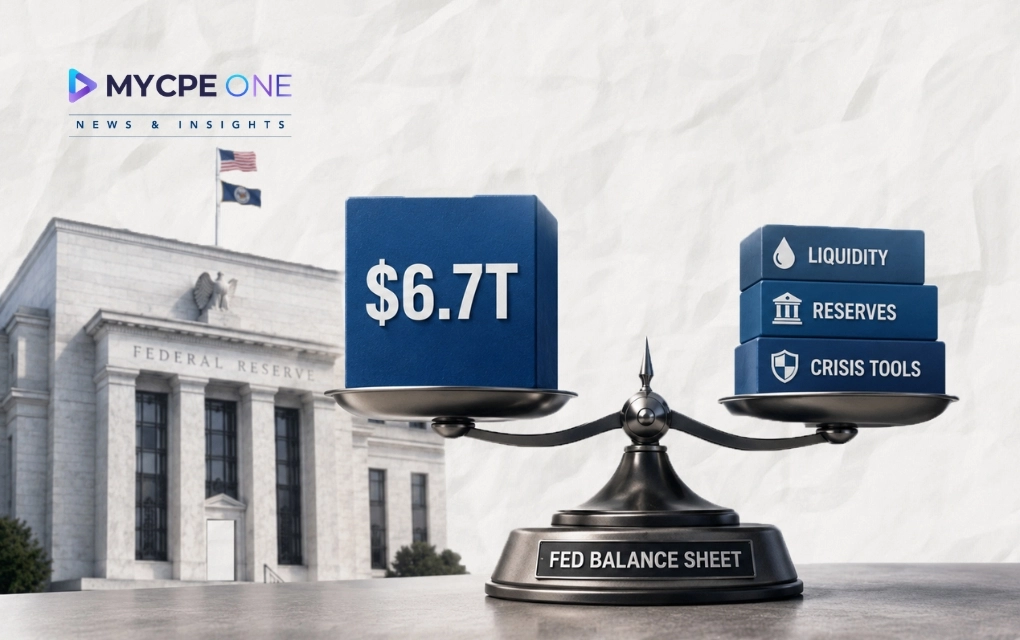
Newly confirmed Federal Reserve Chair Kevin Warsh aims to shrink the Federal Reserve’s balance sheet, which currently boasts assets near $6.7 trillion, in order to make markets safer and policy more credible; however, critics argue he should focus on improving the organisation's playbook rather than resizing it. As bank deposits and regulation continue to evolve post-Global Financial Crisis, the relevance and realistic expectations surrounding the size of the Fed's balance sheet has become a debated topic among financial leaders.
The Federal Reserve’s balance sheet has become Washington’s favorite oversized receipt. Everyone can see the number, everyone has an opinion, and almost nobody agrees on what the total actually proves. Kevin Warsh, the newly confirmed Fed chair, arrives with a clear target in sight: a smaller Fed balance sheet. The Senate confirmed Warsh in May 2026, putting him in charge at a moment when the Fed’s assets still sit near $6.7 trillion, far below the 2022 peak near $9 trillion but nowhere close to the pre-2008 world. That number looks huge because it is huge. Yet the real question for CPAs, controllers, auditors, and finance leaders is not whether $6.7 trillion sounds tidy on a chart. It is whether shrinking it would make markets safer, funding cleaner, and policy more credible, or whether the Fed would simply trade one large footprint for a different one.
Source: Reuters
Warsh has long criticized the Fed’s post-crisis bond buying, especially when emergency tools turned into long-running market support. Former Fed officials now argue that he should focus less on the headline size and more on the playbook: what the Fed buys, when it buys, and how clearly it explains the purpose. That distinction matters. The Fed’s assets mainly include Treasury securities and agency mortgage-backed securities. Its liabilities include bank reserves, currency in circulation, and the Treasury General Account. Barr’s May 2026 speech put the issue bluntly: shrinking the balance sheet alone represents the wrong goal if the move weakens bank liquidity or forces the Fed to intervene more often in money markets.
For finance teams, this is not ivory tower stuff. If reserve scarcity pushes overnight funding rates around, banks feel it first. Then corporate borrowers, treasury teams, and audit committees start asking why cash management costs moved when nobody touched the invoice stack. That is when the “Fed balance sheet debate” walks right into the controller’s Monday morning.
The Fed cannot shrink its balance sheet like a company trimming old software licenses. Banks need reserves to settle payments, meet liquidity rules, and survive stress without turning every bad week into a fire drill. Barr noted that reserves totaled about $3 trillion of the Fed’s $6.5 trillion in liabilities at the time of his speech. He also warned that reserves support bank safety, payment system efficiency, and financial stability. That is why former Chicago Fed President Charles Evans reportedly called a return to the old $800 billion balance sheet unrealistic. The banking system has changed. Deposits grew, regulations changed, payment systems sped up, and large banks now operate under liquidity expectations built after the Global Financial Crisis.
PIMCO’s analysis makes a similar point: the Fed’s balance sheet reflects demand for its liabilities. As bank deposits grow, demand for reserves tends to grow with them. That means the balance sheet can rise even without a fresh round of crisis-era quantitative easing. In other words, part of the growth comes from the system’s own wiring, not some rogue money printer in a basement.
The Fed already tried the “quiet shrink” approach. Quantitative tightening reduced the balance sheet by more than $2 trillion from its peak, and markets took it pretty well this time. That matters because the 2019 repo spike remains the ghost in the machine. Back then, money market stress forced the Fed to stop and rethink. The current question is whether regulators can lower bank reserve demand without weakening bank resilience. Some proposals would let banks rely more heavily on the discount window, Treasury bills, or other liquid securities instead of reserves. Supporters say that could free up hundreds of billions in reserve demand, maybe more over time.
Source: PIMCO
Barr sees danger in that logic. He argues that counting certain pledged assets as if they were reserves or Treasury securities could reduce bank self-insurance. That sounds neat in a policy memo, but in a real stress event it can look like telling banks, “Don’t worry, the umbrella is somewhere in the garage.”
The biggest issue now is communication. Former Fed officials have pointed to the Bank of England’s 2022 bond market intervention as a model: policymakers clearly said the purchases were temporary and aimed only at stabilizing markets. The Fed struggled with that clarity during COVID, when emergency bond buying slowly blended into broader economic support. That matters because markets care less about the balance sheet number itself and more about what the Fed is trying to accomplish. Kevin Warsh may want a smaller balance sheet, but he first needs to define the problem he is solving: inflation risk, market distortion, political optics, or Treasury market functioning. Each path leads somewhere different.
For accounting and finance professionals, the practical signals are straightforward: watch money market spreads, liquidity rule changes, Treasury issuance patterns, and Fed messaging around future asset purchases. If overnight rates start acting weird relative to reserve rates, that may signal reserves are getting too tight again.
Janet Yellen once said quantitative tightening should feel “like watching paint dry.” That is still the ideal outcome. If the Fed shrinks its balance sheet and markets barely notice, policymakers will call it a success. Still, this debate is bigger than one headline number. The Fed’s balance sheet now sits at the center of bank liquidity, payment systems, Treasury markets, and financial stability. Shrinking it may satisfy political critics, but building a clearer and more disciplined strategy will matter far more in the long run.
Until next time…
Don’t forget to share this story on LinkedIn, X and Facebook
Subscribe now for $199 and get unlimited access to MYCPE ONE, from CPE credits to insights Magazine
📢MYCPE ONE Insights has a newsletter on LinkedIn as well! If you want the sharpest analysis of all accounting and finance news without the jargon, Insights is the place to be! Click Here to Join
You’ve reached the 3 free-content piece limit. Unlock unlimited access to all News & CPE resources.
Subscribe Today.
Already have an account?
Sign In