MYCPE ONE
MYCPE ONE LOGO

Join 250,000+
professionals today

Add Insights to your inbox - get the latest
professional news for free.

MYCPE ONE insights

How Shrinkflation Is Squeezing Americans’ Wallets

Join our 250K+ subscribers

Join our 250K+ subscribers

Subscribe

22 JUN 2026 / ECONOMY

How Shrinkflation Is Squeezing Americans’ Wallets

How Shrinkflation Is Squeezing Americans’ Wallets

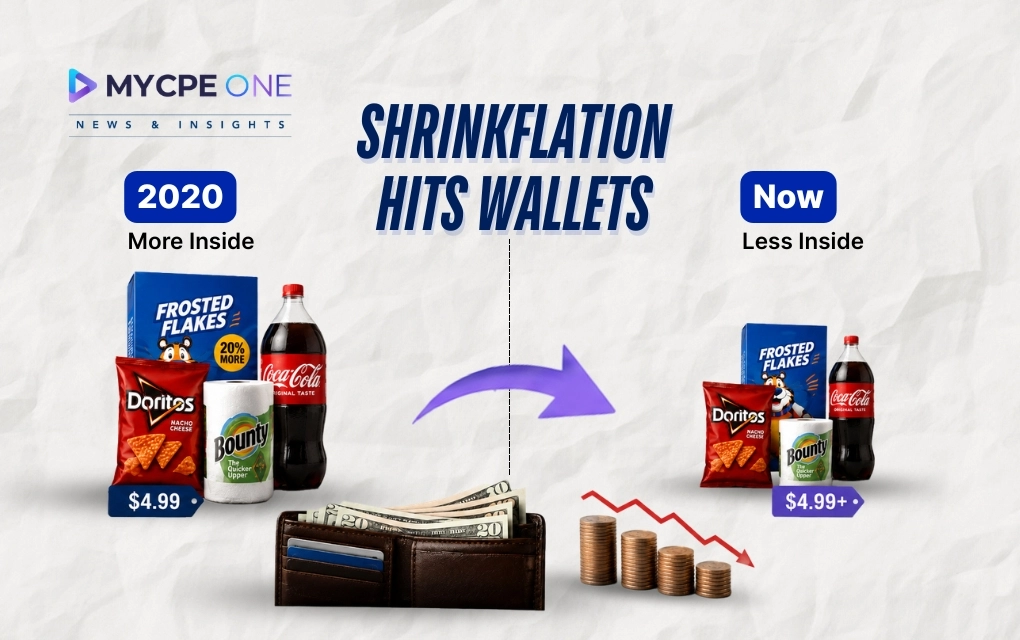
Remember when a family-sized bag of chips actually felt family-sized? Or when a 2-liter soda did not require a mini financial analysis before checkout? That era feels like ancient history now. Today, shoppers walk into Walmart, Target, Kroger, or Costco, pick up the same Frosted Flakes, Doritos, Coca-Cola, paper towels, or toothpaste, and the shelf price looks familiar. The logo is the same. The packaging still gives off “same old product” energy. Then you get home, open it up, and something feels off. The bag is lighter. The box empties faster. The roll runs out sooner. That is shrinkflation, the quiet price hike hiding in plain sight.

It is not just annoying grocery math. It is a real consumer finance issue. Americans are now paying an average of $741 more per year compared with 2020 to buy the same groceries, according to research tracking common household brands. For families already squeezed by rent, gas, insurance, and food inflation, that extra hit is not pocket change. It is another silent drain on the household budget. And even with the recent U.S.-Iran peace deal raising hopes for lower energy prices, shoppers should not expect grocery packages to magically puff back up. Shrinkflation may have started as a response to rising costs, but it has become a pricing strategy.

What Is Shrinkflation, and Why Does It Feel So Sneaky?

Shrinkflation happens when companies reduce a product’s size, weight, or quantity while keeping the price the same, or even raising it slightly. The total shelf price may not jump, but the cost per ounce, sheet, packet, or serving climbs. That is why shoppers often miss it. A price increase hits you in the face. A smaller box does not. You notice when gas rises 50 cents a gallon. You may not notice when a cereal box loses a few ounces, or when a paper towel roll has fewer sheets. The trick works because most consumers compare shelf prices, not unit prices. The Government Accountability Office refers to this as product downsizing. Its recent analysis showed that downsizing does not usually come with a clear label on the package. That leaves consumers doing detective work in the aisle, squinting at ounces, serving sizes, and price-per-unit labels.

Source: US Government Accountability Office

How Did Grocery Math Get This Wild?

Shrinkflation is not new, but it accelerated after 2020 as manufacturers faced higher costs for materials, labor, packaging, transportation, and energy. Rather than repeatedly raising prices, many companies reduced package sizes to protect margins. Research from InvestorsObserver found that many brands, including Frosted Flakes, Doritos, Coca-Cola, Campbell’s soup, and M&M’s, often raised prices first and shrank packages later. Coca-Cola illustrates the trend. A 2-liter bottle rose from $1.89 in 2020 to $2.79, while a 12-pack increased from $4.89 to $8.89. The company also expanded its 7.5-ounce mini cans, which cost significantly more per ounce than larger formats. “The mini can costs more than twice as much per sip. Most people had no idea,” said InvestorsObserver analyst Sam Bourgi.


Source: US Government Accountability Office

Doritos and Frosted Flakes also reduced package sizes after price increases, while M&M’s saw a 102% jump in price per ounce. By contrast, Skittles and Reese’s Miniatures kept package sizes unchanged and simply raised prices. That suggests shrinkflation was not always driven by necessity. As Bourgi put it: “If rising costs forced brands to shrink packages, every brand would have done it. They didn’t.”

Who Gets Hit When the Bag Gets Lighter?

Shrinkflation affects nearly everyone, but low-income households feel it most because groceries and essentials consume a larger share of their budgets. Bourgi warned that shrinkflation can have an “enormous effect on low-income households, where every dollar, every ounce, and every serving matters.” When products shrink while prices stay high, families often have to buy more frequently, switch brands, or cut spending elsewhere. That can make inflation feel worse than official data suggests.

GAO found that downsizing affected less than 5% of reviewed products, but the impact was significant in frequently purchased categories such as paper towels, toilet paper, and coffee. Among downsized items, per-unit prices rose between 12% and 32%. Consumer behavior is also shifting. While baby boomers were more likely to spot shrinkflation, Gen Z showed the strongest reaction, with 80% saying they stopped buying products because of it. For brands, that signals a growing risk: once shoppers feel misled, they are more willing to switch.

Will the Iran Peace Deal Fix This? Not So Fast

The recent U.S.-Iran peace agreement could ease energy costs by helping reopen the Strait of Hormuz, a key route for global oil shipments. Lower oil prices could reduce pressure on transportation, packaging, and food distribution, offering some relief to consumers. But shrinkflation is not just an energy story. Experts, including Patrick De Haan, Mohamed El-Erian, and Kathy Bostjancic, caution that any economic benefits will take time to materialize, and some higher costs may persist even after markets stabilize. More importantly, lower costs do not guarantee bigger packages. Many products that shrank between 2022 and 2024 have remained smaller even as inflation cooled. Once companies learn that consumers will accept reduced sizes, there is little incentive to reverse course. That is the long-term challenge: shrinkflation can outlast the cost pressures that created it.

Source: US Government Accountability Office

What Happens Next for Shoppers and the Economy?

Consumers are getting smarter. More shoppers now check unit prices, compare package sizes, switch brands, and call out companies online. That matters because shrinkflation depends on low visibility. Once shoppers start reading the fine print, the strategy becomes riskier. Regulators may also push for more transparency. GAO highlighted several policy options, including clearer downsizing labels, more consistent unit price labeling across states, consumer education, and restrictions on practices considered unfair or deceptive. France already requires retailers to disclose product downsizing through in-store labels. In the U.S., more than a dozen states and territories, along with Washington, D.C., have laws requiring unit price disclosures.

For the broader economy, shrinkflation creates a trust problem. It widens the gap between official inflation data and consumer experience. Even if inflation cools, shoppers may still feel that groceries are unaffordable because the value per dollar has permanently declined. For finance professionals, retailers, and consumer brands, the lesson is simple: margin protection has a reputational cost. A company may win in the short term by shrinking a package instead of raising the price. Yet if consumers feel tricked, brand loyalty can take a hit.

The Bottom Line

Shrinkflation is not a glitch in the grocery system. It is a pricing strategy that became more visible after years of inflation, supply chain stress, and energy shocks. The U.S.-Iran peace deal may help lower energy costs over time. It may reduce some pressure on transportation and commodities. It may even cool parts of the inflation story. But it will not force companies to bring back bigger boxes, heavier bags, or fuller rolls. That is why shrinkflation is likely to remain a longer-term pricing challenge. The average American is paying $741 more per year for the same groceries compared with 2020. That number captures the frustration in one clean figure: shoppers are not imagining it. The grocery cart really is getting smaller. The smartest move now is also the simplest one: stop trusting the package and start reading the unit price. Because in today’s grocery aisle, the shelf price tells only half the story.

Until next time…

Don’t forget to share this story on LinkedIn, X and Facebook

Subscribe now for $199 and get unlimited access to MYCPE ONE, from CPE credits to insights Magazine

📢MYCPE ONE Insights has a newsletter on LinkedIn as well! If you want the sharpest analysis of all accounting and finance news without the jargon, Insights is the place to be! Click Here to Join

Unlock Annual Access to News & CPE Subscription

You’ve reached the 3 free-content piece limit. Unlock unlimited access to all News & CPE resources.
Subscribe Today.

News & Insights

  • Exclusive News & Insights
  • Latest Regulatory Updates
  • Accounting Industry Trends
  • Expert Insights
  • AI-Driven Audio & Summaries
  • Infographics & Videos
  • CPE-Approved Articles
  • Digital Magazine
  • Benchmarking Insights

Unlimited CPE Access for 1 Year

  • 15,000+ Hours of Content
  • 500+ Subject Areas
  • Mandatory Ethics Courses
  • 250+ Compliance Packages
  • 50+ Virtual Conferences and Events Access
  • Format: Live, Audio, Video, E-Books
  • Audio Based Courses & Podcasts
  • Add External Certificates with AI
  • AI Compliance Tracking and Report
  • Instant Certification and Fast Reporting
  • Mobile App Access (iOS and Android)
  • Dedicated Support System
  • Practical Training Programs
  • AI Academy Access
  • Tax Academy Access
  • Audit Academy Access
  • Leadership Academy Access