MYCPE ONE
MYCPE ONE LOGO

Join 250,000+
professionals today

Add Insights to your inbox - get the latest
professional news for free.

MYCPE ONE insights

Lessons on Debt, Risk, and Denial From History’s Greatest Crises

Join our 250K+ subscribers

Join our 250K+ subscribers

Subscribe

23 APR 2026 / ECONOMY

Lessons on Debt, Risk, and Denial From History’s Greatest Crises

Lessons on Debt, Risk, and Denial From History’s Greatest Crises

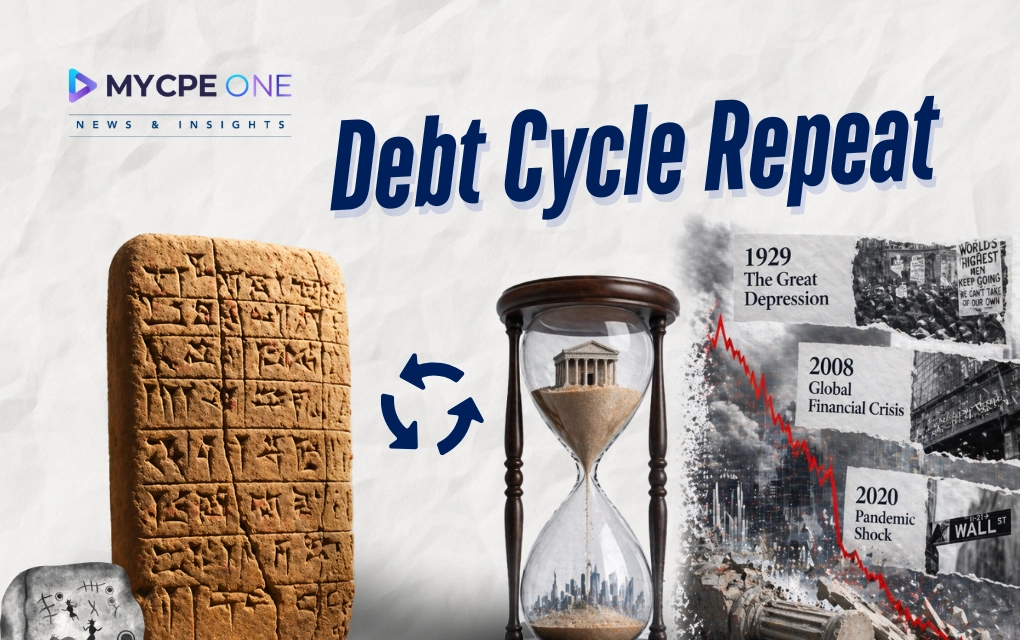
I was halfway through a routine portfolio review last week when a colleague said, “Feels like everything is stable… until it isn’t.” That line stuck. Because if you zoom out, today’s global financial system looks calm on the surface, but underneath, the pressure is building in ways that feel oddly familiar. History does not repeat perfectly, but it sure likes to rhyme. And right now, the rhythm is getting louder.

Are we sitting on too much debt?

Let’s start with the numbers, because they are doing a lot of the talking. Global debt is sitting just above 235% of GDP, roughly $251 trillion. Public debt alone is pushing toward 94% of GDP and is expected to hit 100% by 2029. That timeline just got pulled forward. That matters. What’s interesting is the split. Private debt has actually cooled, dropping below 143% of GDP, while governments have picked up the slack. In the U.S., public debt is already around 121% of GDP. China is climbing too, sitting near 88%.

Source: IMF

So, what’s going on here? Simple answer: governments are still carrying the bill from the pandemic, energy shocks, and now geopolitical tensions. Fiscal deficits are hovering around 5% of GDP globally. Interest costs alone have jumped from about 2% to nearly 3% of GDP in just a few years. That is not a rounding error. That is real money walking out the door. Now layer in reality. Defense spending is up. Social spending is sticky. Energy transition is not cheap. And politicians are not exactly lining up to cut benefits ahead of elections. You do not need a crystal ball to see the pressure building. The bigger question is this: how long can markets stay comfortable funding all of this?

Source: IMF

When did “safe” start feeling a little risky?

For decades, U.S. Treasuries have been the bedrock of the global financial system. The risk-free anchor. The thing that everything else is priced against. That assumption is starting to get quietly questioned. Not loudly, not in headlines, but in structure. The buyer base is shifting. Central banks are stepping back. Private investors and leveraged nonbank players are stepping in. The system is leaning more on hedge funds, repo markets, and fast-moving capital.


Source: Financial Times

The U.S. repo market alone is now close to $13 trillion. Europe is not far behind at around €14 trillion. This is plumbing most people never think about, until it freezes. And when it freezes, things break fast. Just ask anyone who lived through 2008. Add to that a subtle but important point: the “safety premium” on Treasuries is not what it used to be. Rising debt issuance means more supply. More supply means higher yields, unless demand keeps up. That is the tension. If the world ever starts doubting the safety of the safest asset, even a little, that is when things can get messy. Not overnight, but gradually, then suddenly.

Are we accidentally building the next crisis?

Every major financial crisis leaves behind reforms. And those reforms usually push risk somewhere else. After 2008, banks got safer. Capital requirements went up. Oversight tightened. On paper, the system looks stronger. And to be fair, it held up well during COVID. But risk did not disappear. It moved. Today, a growing share of financial activity sits outside traditional banks. Shadow banking, private credit, synthetic risk transfers, structured products. The alphabet soup is back, just wearing a different outfit.

Even products designed to reduce risk can create new ones. Credit default swaps were meant to hedge exposure. They ended up amplifying it. Now we are seeing similar patterns with newer instruments that shift risk to investors who may not fully understand it. Then there is the AI boom. Massive capital is flowing into data centers, chips, and infrastructure. Estimates suggest up to $5 trillion in investment by 2030.

Source: Financial Times

If that sounds big, it is. But history has seen bigger relative bets. The U.S. railroad boom in the 1800s consumed a third of GDP at the time and ended in a brutal crash. Yet it also built the backbone of the modern economy. So here is the uncomfortable thought: bubbles can build something valuable and still burn investors along the way. Sound familiar?

When geopolitics crashes the financial party

Now add the wildcard that finance people love to underestimate until it hits the P&L: geopolitics. The Middle East conflict is not happening in a vacuum. It is landing at a time when fiscal positions are already stretched. Oil prices, inflation pressures, and market volatility all feed directly into debt dynamics. Under a severe scenario, global debt at risk could exceed 120% of GDP within a few years. Emerging markets would take the biggest hit, but advanced economies are not immune. Here is the tricky part. Governments feel pressure to step in with support. Subsidies, relief programs, stimulus. It is politically unavoidable. But every dollar spent adds to debt. Every untargeted subsidy distorts prices. Every delay in fiscal adjustment narrows future options.


Source: IMF

It is a bit like trying to put out a fire with gasoline because water is expensive. And there is a deeper layer. Geopolitical tensions are no longer isolated events. They are interconnected. Trade conflicts, technology restrictions, capital flows, military alliances. It is all part of a broader shift in global order. Markets often assume things will return to “normal.” History suggests that once these shifts start, normal changes.

Where does this leave the average CPA or finance leader?

If you are running a mid-sized firm or advising clients, this is not abstract macro chatter. It shows up in very practical ways. Clients are already feeling higher borrowing costs. Corporate treasurers are rethinking debt structures. Businesses are holding more cash and borrowing less. That explains part of the drop in private debt. At the same time, government borrowing can crowd out private investment. When Treasuries offer higher yields, why take risk elsewhere? That dynamic can quietly slow growth.

Think about a typical client scenario. A manufacturing business planning expansion might delay capital investment because financing costs are higher and demand looks uncertain. That decision, multiplied across thousands of firms, becomes a macro trend. Then there is compliance and planning. Tax policy is likely to tighten over time. Governments need revenue. That means fewer loopholes, broader tax bases, and more scrutiny. If you are advising clients, the conversation is shifting from growth to resilience.

The Takeaway

Debt cycles, political cycles, and geopolitical cycles are all lining up at the same time. That does not guarantee a crisis, but it raises the odds of instability. History shows a pattern. Rising debt, shifting power dynamics, technological disruption, and geopolitical tension often show up together before major turning points. Does that mean we are heading into a crisis? Not necessarily. But it does mean the margin for error is getting thinner.

If there is one thing professionals should take from all of this, it is this: the real risks rarely come from the obvious headlines. They build slowly in the background. Debt levels. Market structure. Funding assumptions. Policy trade-offs. Right now, global debt is high, fiscal space is limited, and the system is leaning more on private markets to absorb risk. At the same time, geopolitical tensions and structural spending pressures are not going away. That combination deserves attention. You do not need to predict the next crisis. But you do need to recognize when the foundation is under strain. Because when things finally move, they tend to move fast.

Until next time…

Don’t forget to share this story on LinkedIn, X and Facebook

Subscribe now for $199 and get unlimited access to MYCPE ONE, from CPE credits to insights Magazine

📢MYCPE ONE Insights has a newsletter on LinkedIn as well! If you want the sharpest analysis of all accounting and finance news without the jargon, Insights is the place to be! Click Here to Join

Unlock Annual Access to News & CPE Subscription

You’ve reached the 3 free-content piece limit. Unlock unlimited access to all News & CPE resources.
Subscribe Today.

News & Updates

  • Exclusive News & Insights
  • Latest Regulatory Updates
  • Accounting Industry Trends
  • Expert Insights
  • AI-Driven Audio & Summaries
  • Infographics & Videos
  • CPE-Approved Articles
  • Digital Magazine
  • Benchmarking Blogs

Unlimited CPE Access for 1 Year

  • 15,000+ Hours of Content
  • 500+ Subject Areas
  • Mandatory Ethics Courses
  • 250+ Compliance Packages
  • 50+ Virtual Conferences and Events Access
  • Format: Live, Audio, Video, E-Books
  • Audio Based Courses & Podcasts
  • Add External Certificates with AI
  • AI Compliance Tracking and Report
  • Instant Certification and Fast Reporting
  • Mobile App Access (iOS and Android)
  • Dedicated Support System
  • Practical Training Programs
  • AI Academy Access
  • Tax Academy Access
  • Audit Academy Access
  • Leadership Academy Access