Join 250,000+
professionals today
Add Insights to your inbox - get the latest
professional news for free.
Join our 250K+ subscribers
Subscribe28 AUG 2025 / ECONOMY
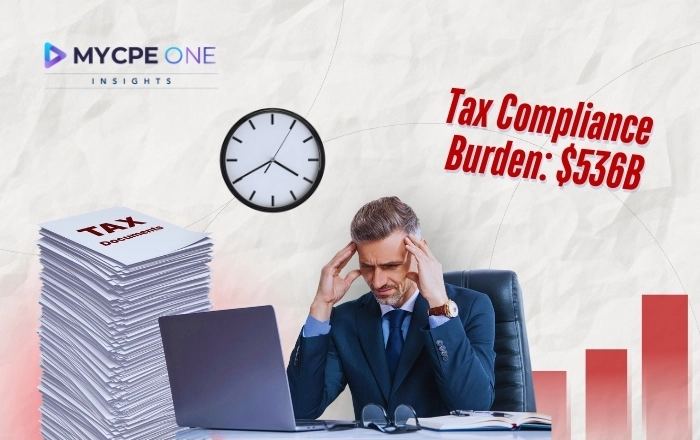
The One Big Beautiful Bill Act (OBBBA) has not significantly simplified the US tax system as promised, with compliance anticipated to cost the economy $536 billion in 2025. Despite technological advances and rising use of e-file tax systems, the tax code continues to become more complex due to evolving rules and exceptions, ultimately causing difficulties and expensive compliance burdens for individuals, businesses and the Internal Revenue Service.
Tax season. That time of year when even the best of us would rather be on a beach somewhere than sifting through receipts and forms. And while the "One Big Beautiful Bill Act" (OBBBA) promised sweeping changes to simplify our tax code, the reality is more like a makeover that leaves some audit and tax professionals looking even more confused. With Trump’s tariffs increasing consumer prices, slowing GDP growth, raising unemployment, and reducing household incomes, it feels like we're all paying the price. Meanwhile, the IRS is maintaining interest rates at the same level for the fourth quarter of 2025, ensuring that tax season remains a challenging experience. So, grab your coffee, because we’re about to dive into how tax complexity is still wreaking havoc on taxpayers, businesses, and even the IRS itself.
Despite the fanfare around the OBBBA’s passage, the reality is that it did little to streamline the U.S. tax system. In fact, it’s estimated that compliance with the tax code will cost the economy a whopping $536 billion this year. That’s about 1.8% of the GDP; bigger than the total revenue the corporate income tax is expected to rake in for 2025. What does $536 billion look like? Well, it’s a lot more than what we’re coughing up to the IRS directly. It’s the result of 7.1 billion hours Americans will spend complying with tax filing requirements in 2025. That's roughly 3.4 million full-time workers, more than the entire population of Los Angeles, doing nothing but paperwork. And no, they’re not getting paid for that time.
While individuals may groan about tax season, businesses are the true unsung heroes of the compliance world. They shoulder much of the burden, and when it comes to tax filing, it’s like they’re running a marathon with ankle weights on. Corporate income tax returns alone incur $126.2 billion in compliance costs, with quarterly tax filings adding another $47.3 billion. Let’s not forget the depreciation schedules, those seemingly innocent sheets of paper that cost another $26.2 billion to manage. This is all on top of the regular headaches small businesses face, from payroll taxes to the constantly changing deduction rules. Certainly, some businesses, particularly larger ones, may have the resources to handle these complexities, but what about small business owners? The red tape is a real pain.
Here’s where things get even wilder: cryptocurrency. No, not the cute digital coin you hear about in TikTok videos, but the actual regulatory nightmare behind it. Thanks to the Infrastructure Investment and Jobs Act (IIJA), reporting requirements for digital assets, such as Bitcoin, have expanded. While the IIJA was designed to raise tax revenue (approximately $28 billion over ten years), the compliance costs have skyrocketed. In 2022, Form 1099-B (used for reporting cryptocurrency transactions) took a staggering 674 million hours to complete. Fast forward to 2025, and that number has jumped to nearly 2.2 billion hours. Yes, billion with a b. This increase in time? Well, it’s expected to cost taxpayers $127.6 billion, far more than the anticipated revenue the government will collect from these rules. The IRS is working overtime just to keep up with the paperwork.
Here’s a fun fact: despite all the technological advances over the years, the efficiency gains in filing taxes have barely made a dent in the overall compliance burden. Indeed, 94% of individual returns are filed electronically, and 90% of filers use tax software. But technology isn’t a magic wand that can untangle years of complex legislation. The truth is, while computing power is increasing and IRS e-filing is booming, the tax code continues to evolve into a complex web of new rules and exceptions. The latest? Provisions in the OBBBA that could, ironically, add more complexity, like new deductions for tipped income and overtime pay. And while some tax breaks, such as those for green energy, were repealed under the new law, they were replaced by even more complex rules for foreign entities.
For lower-income individuals, things are looking a little worse under the OBBBA. While the law promised tax relief, it also added time burdens, especially with the “No Tax On” provisions aimed at helping lower-income groups. Sounds good on paper, but those provisions have made filing more complicated, especially for the folks in the lowest income brackets. Take a look at the numbers: the first income quintile (the lowest earners) is expected to spend an extra 2 hours on filing their taxes. The second quintile isn’t far behind with an increase of about 36 minutes. And for those higher up the income ladder, it’s not all smooth sailing either, thanks to the higher SALT caps. More itemizers? More time.
Despite all the hoopla about the OBBBA, the reality is that true simplicity in the tax code remains an elusive goal. Could we ever move to pre-filled returns for everyone? Maybe. A program like Direct File, currently being tested in select states, would make life easier for taxpayers with simple filings. But under the OBBBA, even that’s in jeopardy. The Trump administration recently halted the IRS Direct File program, citing it as a step toward reducing “government waste.”
So, here’s the big question: How can we truly simplify the tax code without adding new layers of complexity? That’s a question for Congress, but given the ongoing changes and the sheer number of tax forms (have you heard of Form 1099-B? Yeah, it’s fun), it’s safe to say we’re a long way from the simplicity we were promised.
The OBBBA did a lot, but when it comes to making taxes easier? It’s still a mixed bag. While it removed a few barriers and gave us some new breaks, it also added new hurdles. At the end of the day, Americans will continue to spend billions of dollars and hours filing taxes, and businesses will bear the brunt of the burden. So, while you’re filing your taxes this year, just remember: you’re not alone. You’re part of a $536 billion system of tax compliance that’s about as simple as a Rubik’s Cube in a tornado. Now, if only we could find a way to make tax season feel a little less like a trip to the dentist, right? Weekly tax intelligence for smart professionals. Join thousands who never miss critical industry updates.
Until next time…
Don’t forget to share this story on LinkedIn, X and Facebook
Subscribe now for $199 and get unlimited access to MYCPE ONE, from CPE credits to insights Magazine
📢MYCPE ONE Insights has a newsletter on LinkedIn as well! If you want the sharpest analysis of all accounting and finance news without the jargon, Insights is the place to be! Click Here to Join
The Only All-in-One CPE & Learning Platform for CPA & Accounting Firms
Get everything you need for team learning and CPE compliance—starting at just $199 per user/year!
You’ve reached the 3 free-content piece limit. Unlock unlimited access to all News & CPE resources.
Subscribe Today.
Already have an account?
Sign In