Join 250,000+
professionals today
Add Insights to your inbox - get the latest
professional news for free.
Join our 250K+ subscribers
Subscribe25 AUG 2025 / ECONOMY
CPE Approved
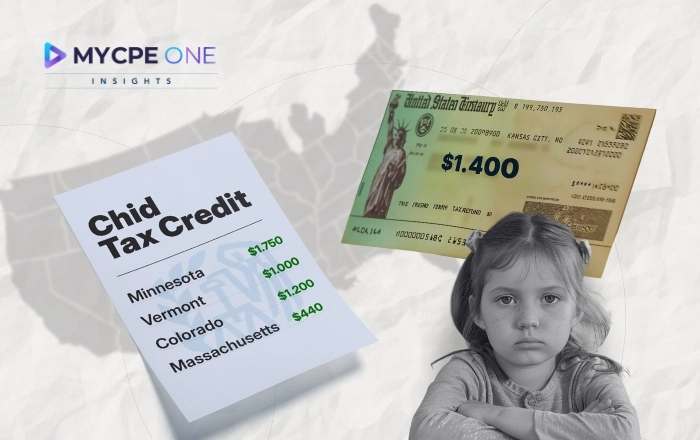
After the expanded federal Child Tax Credit (CTC) ended in 2021, twelve U.S. states and the District of Columbia implemented their own refundable credits to help families in financial distress. The credits, though varied in size and eligibility requirements, helped families pay bills, afford essentials, and reduce anxiety, but gaps remain with many families lacking access to these benefits, underscoring the need for a universally accessible federal CTC.
Sometimes Congress freezes, and states have to grab the wheel. That’s exactly what happened after the expanded federal Child Tax Credit (CTC) ended in 2021. While D.C. bickered, a dozen states (plus the District of Columbia) rolled out their own refundable credits to soften the blow. They weren’t as generous as the federal $3,000–$3,600 per child benefit under the American Rescue Plan, but they were enough to keep families from going under. And according to Columbia University’s Center on Poverty and Social Policy (CPSP), the strategy worked.
The state programs vary widely in size, age eligibility, and design. Some offered just a few hundred dollars, while others came closer to the federal benefit’s punch.
Source: Bloomberg
Other states joining the refundable club include Maryland, Maine, New Mexico, New Jersey, New York, Oregon, plus the District of Columbia.
The numbers tell one side of the story. The lived experiences tell another. A Boston University and Drexel University study, published in JAMA Network Open, found that families who received the expanded CTC in 2021 weren’t just paying bills; they were paying rent on time, avoiding food insecurity, and reporting lower levels of anxiety. One Massachusetts mom called the monthly payments during the pandemic a “lifesaver,” giving her family breathing room for basics and even letting her kids join sports programs. These improvements, food on the table, stable housing, and less stress directly feed into children’s development and long-term health.
Source: Bloomberg
But here’s the catch: millions missed out. Families without bank accounts, prior tax filings, or Social Security numbers often couldn’t access the benefit. That gap looms again today, as Congress has set a new $2,200 CTC beginning in 2025 that is not fully refundable, meaning the lowest-income households will again be left out.
Here’s where the rubber meets the road. A refundable credit gives families the full benefit even if they owe no taxes. A nonrefundable credit only offsets taxes owed, leaving out low-income households.
Under current rules:
States tried to patch that hole. Minnesota and Colorado showed it could be done. But inconsistency is the name of the game; some states capped credits by age, others phased out benefits quickly, and a few only offered small amounts. That uneven patchwork leaves too many kids behind.
The federal expansion in 2021 drove hardship among children to record lows. But once it expired, levels shot back up:
State credits didn’t erase the climb, but they blunted the spike. Without them, families in states like Minnesota, Colorado, and Vermont would have faced an even steeper slide.
Today, 12 states and D.C. offer refundable CTCs. Another five have nonrefundable versions. But most were born out of federal retreat, and few are permanent fixtures. Worse, many eligible families don’t even know these programs exist.
The fix is straightforward:
Refundable credits do more than shrink tax bills. They stabilize housing, fill fridges, ease mental strain, and give kids a shot at steady development. States have shown the blueprint. Now, Washington has to decide whether to follow through or leave millions of children hanging.
State-level refundable credits proved one thing loud and clear: when designed right, they don’t just trim tax bills, they keep kids fed, housed, and healthier. Minnesota, Colorado, and Vermont showed what’s possible, but a patchwork isn’t enough. To truly move the needle, Washington needs to lock in a fully refundable federal Child Tax Credit that reaches every family, every year, no matter their income or ZIP code. Don’t miss the next big shift in tax and policy. Subscribe to the MYCPE ONE Insights newsletter and stay ahead with expert analysis delivered weekly.
Get your CPE Credit From Here
Until next time…
Don’t forget to share this story on LinkedIn, X and Facebook
Subscribe now for $199 and get unlimited access to MYCPE ONE, from CPE credits to insights Magazine
📢MYCPE ONE Insights has a newsletter on LinkedIn as well! If you want the sharpest analysis of all accounting and finance news without the jargon, Insights is the place to be! Click Here to Join
Scale Your Accounting Firm the Smart Way with MYCPE ONE!
Your Trusted Offshore Partner for CPAs and Accounting Firms.
Struggling to scale? Let MYCPE ONE’s offshore accounting team help you grow faster and more efficiently.
With 500,000+ vetted professionals across 40 offices in 2 countries, we provide you access to top talent and advanced technology, all while handling the hiring process for you.
Trusted by 3,000+ firms, including 45+ BDO Alliance Firms and 40+ of the Top 200 Accounting Firms!
Start building your offshore dream team today with MYCPE ONE!
Scale smarter. Save bigger. Stay ahead.
You’ve reached the 3 free-content piece limit. Unlock unlimited access to all News & CPE resources.
Subscribe Today.
Already have an account?
Sign In