MYCPE ONE
MYCPE ONE LOGO

Join 250,000+
professionals today

Add Insights to your inbox - get the latest
professional news for free.

MYCPE ONE insights

Why America’s Economy Is Living Two Different Realities

Join our 250K+ subscribers

Join our 250K+ subscribers

Subscribe

12 NOV 2025 / ECONOMY

Why America’s Economy Is Living Two Different Realities

Why America’s Economy Is Living Two Different Realities

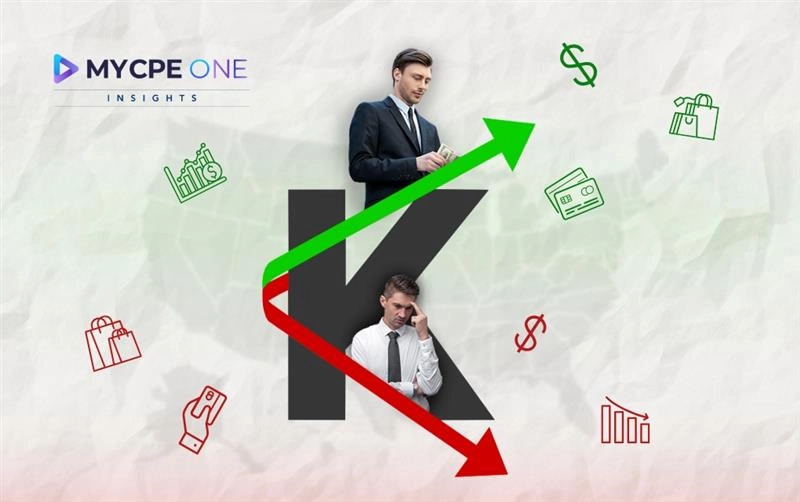
If the U.S. economy were a movie, it’d be called Rich People Keep Winning: The Sequel. While CEOs cheer record profits and the stock market pops champagne, millions of working Americans are eyeing their grocery bills like a bad plot twist. Economists call it a K-shaped economy, a polite way of saying the top’s flying first class while the rest are stuck in the middle seat with no legroom. The letter K says it all: one line shooting upward, the other falling fast. And 2025 is making that divide clearer than ever. McDonald’s, Chipotle, and Coca-Cola aren’t just selling food; they’re serving data points. Their earnings calls have become confessionals about inequality. McDonald’s CEO Chris Kempczinski recently said low-income consumers are cutting back “double digits,” while higher-income customers are still “ordering extra fries.” Translation: the economy’s doing great, if you already have money.

One Economy, Two Wallets

Let’s be honest, America’s been unequal for a while. But lately, the split isn’t just about wealth; it’s about confidence. Peter Atwater, the economist who first coined “K-shaped recovery,” says it’s all about how people feel about their future. During COVID, white-collar workers got to work from home and save cash. Blue-collar workers? They got risk, layoffs, and now, rising debt. Fast-forward to 2025, and that confidence gap is back, and wider. Bloomberg reports that the top 10% of earners now account for nearly half of all consumer spending. In the early 1990s, it was just 35%. That means the U.S. economy is increasingly powered by a small crowd of well-heeled spenders while everyone else scrambles to make rent.

Source: FT

The Federal Reserve’s own data backs that up: while the wealth share of the bottom half of U.S. households rose between 2011 and 2022, it’s flatlined since. Wages for the bottom rung have stalled, too. The result? A “stable but no longer hopeful” working class, as The Financial Times put it. Think of it like a game of musical chairs where the music stopped years ago, and the people still standing are now paying 7% mortgage rates.

The Paycheck-to-Paycheck Problem

If you’re wondering who’s feeling the squeeze, Bank of America (BofA) just dropped the receipts. Nearly one-third of lower-income households are living paycheck to paycheck, up from 27% in 2023. For millennials and Gen Xers, often juggling rent, childcare, and student loans, the math just doesn’t add up. Meanwhile, higher-income millennials are pulling ahead fast. Their wages grew about five percentage points faster this year than their lower-income peers. It’s the generational version of “Sorry, we’re out of budget.”

BofA analysts blame “slowing wage growth” for this paycheck-to-paycheck surge. In plain English: paychecks aren’t stretching, and prices aren’t budging. Gas, groceries, and housing remain pricey. So, while the top 10% debate which AI stock to buy next, the rest are debating whether to skip the avocado. Even fast food is feeling the divide. McDonald’s and Chipotle report fewer visits from lower-income diners, while the high earners keep their dining habits intact. Cava’s CFO even admitted their customers in the $100k-plus bracket are still splurging, but those in their twenties and thirties are “less ebullient.” That’s corporate for “broke.”

When Even the Dollar Menu Feels Pricey

Here’s a curious truth: when economists can’t get clean job data, they look at fast food. Why? Because burger sales never lie. McDonald’s, Chipotle, and Cava earnings this fall told a story you won’t find in an FOMC statement: middle- and lower-income consumers are quietly retreating. Chipotle says 40% of its sales come from households under $100,000, but that group “dines out less often.” Cava admits it’s surviving because it “underpriced inflation by 10%” since 2019. Basically, it didn’t hike prices as aggressively as competitors.

Source: FT

Meanwhile, the Federal Reserve Chair Jerome Powell is watching the same split unfold across industries. “There’s a bifurcated economy,” he told reporters in October. “Consumers at the lower end are struggling and buying less.” You don’t need an economics degree to see it, just a grocery receipt. And the split isn’t limited to restaurants. Airlines, housing, and retail all show the same story: premium customers keep spending; everyone else keeps scaling back. The fancy seats are sold out. The budget flights are canceled.

Debt’s the New American Pastime

While the wealthy debate interest rates, the rest of America is drowning in them. U.S. consumer debt just hit an all-time high, and defaults on credit cards, car loans, and mortgages are creeping back toward post-pandemic peaks. According to The Economic Times, the share of Americans falling behind on payments is climbing fastest among younger and lower-income borrowers, the same groups that benefited most from pandemic stimulus checks. Those safety nets are gone, inflation is still sticky, and “buy now, pay later” has turned into “buy now, panic later.”

Source: FT

Economist Anthony Chan, a former Fed adviser, put it bluntly: “The top 10% aren’t using buy now, pay later. They just buy it.” That difference matters. When debt piles up at the bottom, it doesn’t just hurt individuals; it drags down overall growth. Moody’s economist Cristian deRitis warns that the top-heavy economy is “fragile.” If the rich stop spending, say, after a market drop or an AI stock correction, the whole system could wobble like a Jenga tower missing too many blocks.

Source: FT

Can the Bottom Half Catch a Break?

Here’s the trillion-dollar question: can an economy running hot for some and cold for others stay balanced? Right now, the answer looks shaky. The job market is softening, wage growth is slowing, and consumer sentiment among lower-income Americans remains near pandemic lows. Even as the U.S. posts strong GDP numbers, 3.8% and 4% growth in back-to-back quarters, the optimism isn’t trickling down. It’s more like evaporating before it reaches the ground.

Policy options? Economists keep circling back to tax reform. Raising capital gains, tweaking payroll taxes, or expanding tax credits could ease the imbalance. But as Bloomberg noted, “the political appetite for redistributive reform is running on fumes.” Washington seems busier playing budget chicken than rebalancing the K. Meanwhile, the Fed’s rate cuts might offer short-term relief, but as Jerome Powell said, “A further reduction is far from a forgone conclusion.” Translation: don’t count on cheap credit to save the day.

So, Where Does That Leave Us?

In a word: divided. America’s economy isn’t collapsing, but it’s contorting. It’s less about who has money and more about who believes they’ll have any left next year. As confidence fades among the working class, they’re cutting back on extras, defaulting more, and saving less. At the top, luxury spending and investment portfolios are holding up, at least for now. But as economist Peter Atwater warns, “Invincible markets are incredibly fragile.” One bad shock to Wall Street or AI valuations could turn that letter K into a capital F. So, maybe the better metaphor isn’t a letter at all. Maybe it’s that Jenga tower Atwater mentioned glittering at the top, hollow underneath. Pull a few more blocks from the bottom, and the sound you’ll hear won’t be applause.

Takeaway

The U.S. economy isn’t “booming” or “busting.” It’s bifurcating. The top keeps rising, the bottom keeps juggling bills, and the middle keeps wondering which direction to lean. As one McDonald’s exec said, “We’re not losing customers to competitors. We’re losing them to groceries.” That about sums it up: America’s most reliable growth engine, its consumers, is now split between the ones who can splurge and the ones who can’t even supersize. The letter K has never looked so sharp.

Until next time…

Don’t forget to share this story on LinkedIn, X and Facebook

Subscribe now for $199 and get unlimited access to MYCPE ONE, from CPE credits to insights Magazine

📢MYCPE ONE Insights has a newsletter on LinkedIn as well! If you want the sharpest analysis of all accounting and finance news without the jargon, Insights is the place to be! Click Here to Join

Unlimited CPE for Just $199/Year!

Get CPE credits by reading or listening to approved content. Enjoy unlimited CPE for CPA (US), EA, CMA, CIA, CFE, SHRM, HRCI, and 100+ other designations—all for just $199 per year! (Learn More)

  • 15,000+ Hrs of Content
  • Live, Audio, Video, E-Books
  • 500+ Subject Areas
  • Insights - CPE Approved News Articles
  • 700+ Content Creators
  • Audio Based Courses
  • Mandatory Ethics Courses
  • Monthly and Quarterly Updates
  • Compliance Packages
  • Add External Certificates
  • 250+ Compliance Packages
  • Compliance Tracking and Report
  • 100+ Advanced Certification Programs
  • Instant Certification and Fast Reporting
  • 50+ Conferences and Events Access
  • Mobile App Access (iOS and Android)
  • Podcasts with Industry Leaders
  • Communities

Team Subscriptions Available – Starting at Just $199/Year!

Schedule a no-obligation call

Unlock Annual Access to News & CPE Subscription

You’ve reached the 3 free-content piece limit. Unlock unlimited access to all News & CPE resources.
Subscribe Today.

News & Updates

  • Exclusive News & Insights
  • Latest Regulatory Updates
  • Accounting Industry Trends
  • Expert Insights
  • AI-Driven Audio & Summaries
  • Infographics & Videos
  • CPE-Approved Articles
  • Digital Magazine
  • Benchmarking Blogs

Unlimited CPE Access for 1 Year

  • 15,000+ Hours of Content
  • 500+ Subject Areas
  • Mandatory Ethics Courses
  • 250+ Compliance Packages
  • 50+ Virtual Conferences and Events Access
  • Format: Live, Audio, Video, E-Books
  • Audio Based Courses & Podcasts
  • Add External Certificates with AI
  • AI Compliance Tracking and Report
  • Instant Certification and Fast Reporting
  • Mobile App Access (iOS and Android)
  • Dedicated Support System
  • Practical Training Programs
  • AI Academy Access
  • Tax Academy Access
  • Audit Academy Access
  • Leadership Academy Access