MYCPE ONE
MYCPE ONE LOGO

Join 250,000+
professionals today

Add Insights to your inbox - get the latest
professional news for free.

MYCPE ONE insights

Why the Supreme Court Hit Pause on Trump’s Tariffs

Join our 250K+ subscribers

Join our 250K+ subscribers

Subscribe

24 FEB 2026 / ECONOMY

Why the Supreme Court Hit Pause on Trump’s Tariffs

Why the Supreme Court Hit Pause on Trump’s Tariffs

The other night I rewatched a scene from A Few Good Men. The courtroom is quiet, almost polite. Then it isn’t. Someone insists on an answer. Someone else says, “You can’t handle the truth.” It’s less about the law than about who gets to speak with authority. I kept thinking about that line this week. Not because of drama, but because of tone. When institutions start correcting each other in public, the temperature changes. It becomes less about policy preferences and more about boundaries. There is something almost old-fashioned about a branch of government saying, calmly, “No, that power belongs over here.” No fireworks. Just a line drawn. Most of us who work in that arena do not live there. We live in spreadsheets, close calendars, and cash flow models. Still, when the rules around taxes shift overnight, we feel it in our bones. It is hard to keep the lights on when the meter keeps changing. And lately, the meter has been doing backflips.

When did the Supreme Court strike down the Tariffs?

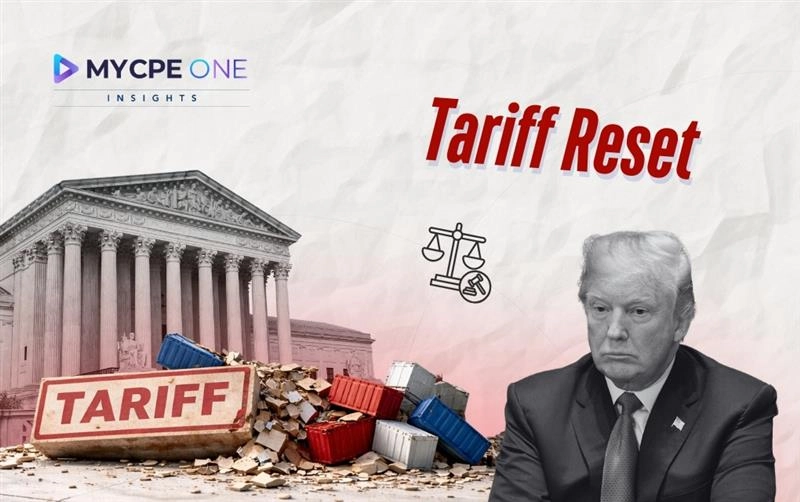
Here is the narrow question that keeps circling in my head: What does it mean when the Supreme Court says the president cannot impose tariffs under the International Emergency Economic Powers Act, yet tariffs remain in place? On February 20, 2026, in a 6 to 3 decision, the Court ruled that IEEPA, a 1977 law meant for national emergencies, does not authorize tariffs. The Constitution gives Congress the power to tax. If Congress wants the executive to levy duties, it must explicitly say so. According to the majority opinion, IEEPA never did.

Within hours, a new 10% global tariff was announced under Section 122 of the Trade Act of 1974. That authority allows tariffs up to 15% for 150 days. Some reports suggest 15% may follow. Either way, the clock runs to mid-July unless Congress extends it. So, the legal basis shifted. The effective tariff rate fell from roughly 16.9% to about 9.1% after the ruling, according to Yale Budget Lab, though the new Section 122 rate pushes it back into the low teens. If you are an importer, you might be forgiven for asking: Did anything really change? 

Are we watching incentives collide?

The lens that helps me think about this is incentives versus authority. Charlie Munger used to say, “Show me the incentive, and I will show you the outcome.” It is a blunt instrument, but useful. Incentives shape behavior more reliably than mission statements. The Constitution assigns tariff power to Congress. That is authority. The executive branch has incentives to act quickly, especially in a polarized environment where legislative consensus is scarce. Markets move fast. Voters respond to decisive action. Congress deliberates. So, the executive looks for statutory hooks. IEEPA was one. Section 122 is another. Section 232 and Section 301 remain on the table. The Court just said, in effect, that one hook was not designed to hold that weight. It did not say the executive has no tariff tools. It said that this particular shortcut exceeded the delegation Congress provided. The tension, then, is structural. The incentive to act quickly collides with a constitutional design that favors friction. And friction, for those of us who like clean models, is uncomfortable.

What does this look like in dollars and dates?

Under the IEEPA framework, tariffs targeted Canada, Mexico, China, and later expanded globally under what was branded “Liberation Day” in April 2025. Estimates vary, but between $130 billion and $175 billion in duties were collected before the Court’s ruling. Some models peg the refund exposure at around $175 billion, or roughly $1,300 per U.S. household. Customs and Border Protection stopped collecting the IEEPA tariffs as of February 24, 2026. The administration’s executive order terminated them going forward. But what about past collections? Legally, importers of record appear entitled to refunds plus interest. Practically, the process is messy. Entries can remain unliquidated for up to 314 days. Some will require protests within 180 days of liquidation. Multiply that by thousands of entries across industries, and you start to see the operational drag.

Meanwhile, the Section 122 tariff, set at 10% and potentially 15%, expires after 150 days unless Congress extends it. Certain goods are exempt, including some agricultural products, pharmaceuticals, and USMCA-compliant trade with Canada and Mexico. Other tariffs under Section 232 and Section 301 remain untouched. Globally, the shift rebalances relative winners and losers. Morgan Stanley estimates average tariffs on Chinese goods fall from 32%to 24%. Asia’s weighted average drops from 20%to 17%. Countries that previously negotiated 10%rates now face the flat global rate, which erases their relative edge. If you step back, the average effective tariff rate may still hover around levels not seen since the mid-20th century. That is not trivial. Yet the macro forecasts suggest limited near-term impact. Inflation relief might be measured in tenths of a percent. GDP adjustments appear incremental. Which leaves me wondering if the real story is not macro at all.

Where does this become fragile?

Each tool has prerequisites. Each invites litigation. The Supreme Court’s 2024 Loper Bright decision eliminated Chevron deference, telling courts to exercise independent judgment rather than defer to agency interpretations. That changes the litigation risk profile. So, here is the uncomfortable question: Are we drifting into a cycle where tariffs are imposed quickly, challenged quickly, replaced quickly, and refunded slowly? If Congress does not reassert itself with clearer statutory direction, does trade policy become a rotating door of executive experiments?

Refunds alone could take months or years. Democrats have proposed legislation to mandate refunds within 180 days with interest, prioritizing small businesses. The administration says the courts should sort it out. That tension is both political and procedural. For those of us advising companies, the compliance creep is real. Pricing models shift. Contracts get rewritten. Incoterms are scrutinized. Transfer pricing assumptions wobble. No one panics. But everyone squints at the horizon.

So, what is this really about?

I keep returning to that courtroom scene. Authority asserted. Authority checked. Not with fireworks, but with a citation to Article I. Maybe this is less about tariffs and more about institutional muscle memory. The Court reminded the executive that taxation requires explicit delegation. The executive immediately searched for another statute. In some ways, that is the system working as designed. Friction. Contest. Adjustment. But friction has a cost. Not always in GDP points. Sometimes in trust. We build models under the assumption of baseline stability. Even when policy shifts, we assume the mechanism is legible. When the mechanism itself becomes the subject of dispute, the air feels thinner. There is a line from Milton Friedman about floating exchange rates eliminating balance-of-payments crises. Markets adjust. Maybe this is similar. Perhaps the system absorbs the shock and moves on. Or maybe we are watching the quiet renegotiation of who gets to say what a tax is. Either way, mid-July will arrive quickly. And somewhere, in a courtroom or a committee room, someone will insist on an answer.

Until next time…

Don’t forget to share this story on LinkedIn, X and Facebook

Subscribe now for $199 and get unlimited access to MYCPE ONE, from CPE credits to insights Magazine

📢MYCPE ONE Insights has a newsletter on LinkedIn as well! If you want the sharpest analysis of all accounting and finance news without the jargon, Insights is the place to be! Click Here to Join

Unlock Annual Access to News & CPE Subscription

You’ve reached the 3 free-content piece limit. Unlock unlimited access to all News & CPE resources.
Subscribe Today.

News & Updates

  • Exclusive News & Insights
  • Latest Regulatory Updates
  • Accounting Industry Trends
  • Expert Insights
  • AI-Driven Audio & Summaries
  • Infographics & Videos
  • CPE-Approved Articles
  • Digital Magazine
  • Benchmarking Blogs

Unlimited CPE Access for 1 Year

  • 15,000+ Hours of Content
  • 500+ Subject Areas
  • Mandatory Ethics Courses
  • 250+ Compliance Packages
  • 50+ Virtual Conferences and Events Access
  • Format: Live, Audio, Video, E-Books
  • Audio Based Courses & Podcasts
  • Add External Certificates with AI
  • AI Compliance Tracking and Report
  • Instant Certification and Fast Reporting
  • Mobile App Access (iOS and Android)
  • Dedicated Support System
  • Practical Training Programs
  • AI Academy Access
  • Tax Academy Access
  • Audit Academy Access
  • Leadership Academy Access