Join 250,000+
professionals today
Add Insights to your inbox - get the latest
professional news for free.
Join our 250K+ subscribers
Subscribe27 NOV 2025 / ECONOMY
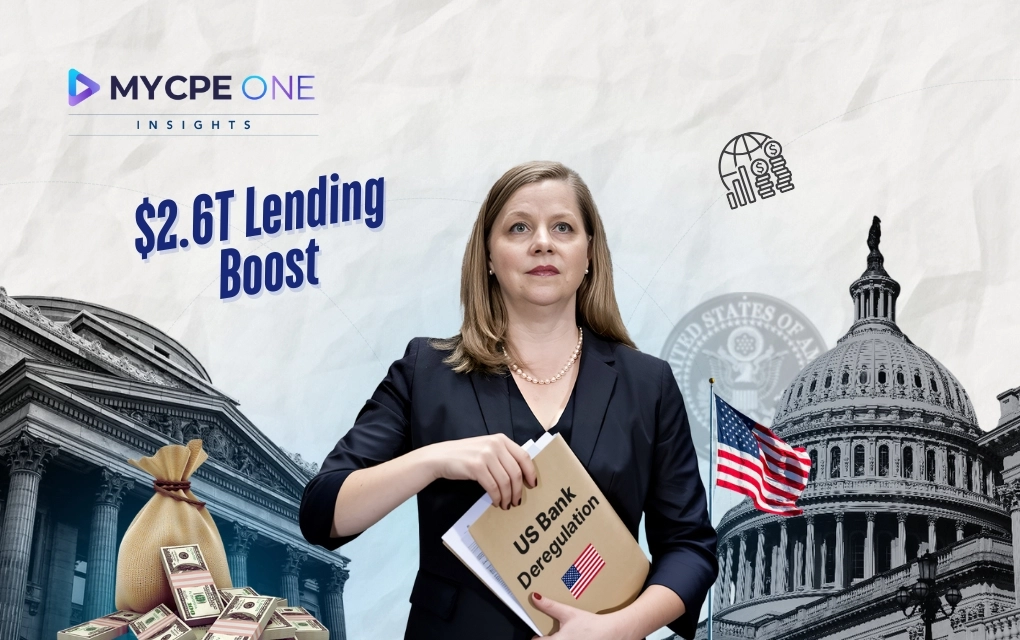
Fed Vice Chair for Supervision, Michelle Bowman, is leading a new deregulatory wave that could unlock up to $2.6 trillion in lending capacity for US banks. Alongside a push for lighter rules aimed to boost lending and maintain Wall Street's lead, global regulators are considering whether to match these steps, a shift that may either stimulate a banking boom or set the stage for future financial instability.
US bank regulators are loosening the screws, and the rest of the world is watching like auditors in the back row of an earnings call. Under Fed vice chair for supervision Michelle Bowman, a new deregulatory wave could unlock up to 2.6 trillion dollars in lending capacity for big U.S. banks. It all sounds efficient and growth-friendly, but deregulation has a way of shifting gears fast. The U.S. is betting that lighter rules will boost lending and keep Wall Street in front. Maybe it works. Or maybe it’s the first page of a financial story we’ve seen before.
Meanwhile, the rest of the world is pacing the hallway, wondering whether to match the U.S. move or hold their ground and risk losing competitiveness. Either way, the global playing field is shifting fast. If you work in accounting, banking, tax or risk, this is the moment to keep your radar sharp and your models flexible. The real question now is simple but thrilling: Does this wave of deregulation spark a banking boom, or are we quietly setting the stage for the next global surprise? Stick around, because the answer is going to reshape the next decade of finance.
Before we talk about deregulation, we have to go back to the last time everyone said “what could go wrong?”
In the 1990s and early 2000s, U.S. and global regulators relaxed rules on leverage, trading and securitisation. By 2008, many banks were running with thin equity cushions and complex risks parked in opaque vehicles. When U.S. housing turned, they simply did not have the capital to absorb losses.
The fix was brutal but clear. After the crisis, Basel III rules and national reforms forced banks to hold far more common equity tier 1 capital. Major U.S. banks more than doubled their CET1 stacks compared with 2011, to well over 1 trillion dollars, backed by tough stress tests and extra buffers for systemically important institutions.
The logic was simple: thicker capital plus stronger supervision equals fewer taxpayer bailouts. Those safeguards are exactly what critics fear will be eroded if Washington now swings too far in the other direction.
Michelle Bowman is not a random technocrat who wandered into this debate. Her great-great-grandfather founded a small Kansas bank, and she worked there herself before joining the Fed. In 2025 she was confirmed as the Fed’s vice chair for supervision and quickly laid out a “fresh look” agenda that centers on recalibrating capital rules, leverage ratios and stress tests.
A few highlights of what she is pushing:
Bowman insists she is “modernising” rather than deregulating, focusing on material financial risks instead of box-ticking. Her critics hear something different: a systematic effort to roll back the post-2008 guardrails just as memories of the last crisis are starting to fade.
So why is the U.S. suddenly happy to let banks run lighter? A few drivers stand out.
First, there is a political story. The current administration has made no secret of its desire to shrink regulation, lean on private credit and “re-privatise” growth by shifting more funding back onto bank balance sheets. Treasury officials have explicitly linked deregulation to boosting non-government lending and reducing the fiscal burden.
Second, there is the capital overhang. The top 13 U.S. banks are sitting on roughly 200 billion dollars of capital above current minimums. Jefferies estimates that a friendlier rule set could translate into 2.6 trillion dollars of extra lending capacity, with consultants projecting mid-double-digit gains to earnings per share and a meaningful lift in return on equity.
Third, regulators are worried about market plumbing. Current leverage rules treat low-risk assets like U.S. Treasuries the same as riskier exposures. Bowman and her allies argue that this discourages banks from making markets in government debt, which is not ideal when you are trying to finance a 29 trillion dollar Treasury market smoothly.
Seen from Washington, loosening capital and leverage requirements is not just about helping banks. It is about getting more credit flowing, keeping the Treasury market liquid and, yes, giving U.S. lenders a competitive edge over their European peers.
Outside the U.S., reactions range from “maybe we should keep up” to “absolutely not.”
Source: Alvarez & Marsal
The tension is obvious. If U.S. banks can lend more, buy back more stock and pay higher dividends without carrying as much capital, international investors will keep rewarding them with higher valuations. That puts pressure on other jurisdictions to ease up, even if their supervisors quietly think the U.S. is taking things a bit too far.
For accountants, CFOs, controllers, analysts and risk professionals, this is not just regulatory news. It is an operational shift that affects client advice, financial modelling and risk assessments.
Here’s what matters next:
You will need to help clients understand not only the numbers, but how the rules behind the numbers are shifting.
A softer, capital-neutral Basel III Endgame, a looser stress testing regime and lower leverage constraints could reshape U.S. financial markets for years. Whether that story ends in a growth surge or another round of instability depends on how far the pendulum swings. Even abroad, regulators are feeling the pressure. No one wants to be the jurisdiction whose banks earn less, lend less or lose global market share simply because someone else loosened the rules first. The next two years will reveal whether global Banking 2.0 is happening on U.S. terms or whether other regulators push back. For more sharp analysis that helps you stay ahead of regulatory shifts, explore MYCPE ONE Insights.
Until next time…
Don’t forget to share this story on LinkedIn, X and Facebook
Subscribe now for $199 and get unlimited access to MYCPE ONE, from CPE credits to insights Magazine
📢MYCPE ONE Insights has a newsletter on LinkedIn as well! If you want the sharpest analysis of all accounting and finance news without the jargon, Insights is the place to be! Click Here to Join
Unlimited CPE for Just $199/Year!
Get CPE credits by reading or listening to approved content. Enjoy unlimited CPE for CPA (US), EA, CMA, CIA, CFE, SHRM, HRCI, and 100+ other designations—all for just $199 per year! (Learn More)
Team Subscriptions Available – Starting at Just $199/Year!
Schedule a no-obligation callYou’ve reached the 3 free-content piece limit. Unlock unlimited access to all News & CPE resources.
Subscribe Today.
Already have an account?
Sign In