Join 250,000+
professionals today
Add Insights to your inbox - get the latest
professional news for free.
Join our 250K+ subscribers
Subscribe15 DEC 2025 / FINANCE
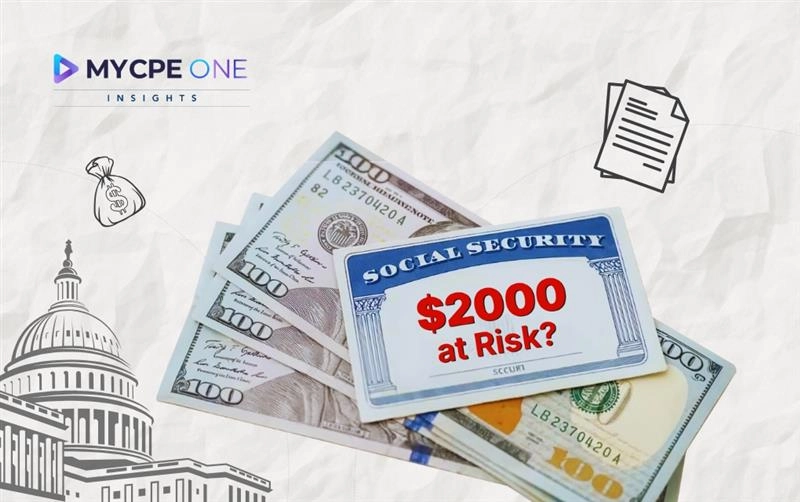
The stringent clauses, or "guardrails," built into the Social Security system in the United States can effectively nullify benefits if retirees continue working without understanding income limits, prompting critics to liken it to a "gotcha" game. These regulations mean that if Social Security is claimed before Full Retirement Age (FRA) and the individual earns above set thresholds, benefits can be unjustifiably clawed back, resulting in significant economic stress for seniors who often rely on those payments cover essential living costs.
Picture this: you’ve waited decades for that Social Security check to hit your account. You’ve watched the estimated benefit climb on your statements. You’ve built retirement budgets around it. You’ve treated that ~$2,000 a month like a rock-solid safety net. Then one tiny, nothing-burger, paperwork-level mistake comes along… and poof, the entire thing disappears. No recession. No scammer pretending to be your “grandson in jail. No market meltdown. Just… a rule. A boring rule you didn’t know to watch. Welcome to America’s fine print retirement system, where Social Security acts less like a pension and more like a game of “gotcha,” written by someone who really, really loves conditions. This is the past, present, and future of the Social Security slip-up that can quietly nuke your benefits at a time when inflation, COLAs, and rising costs make every dollar feel like it has premium value.
There’s a soft-focus myth that Social Security is a parting gift from the government for surviving adulthood. It’s not. It never was. It’s a contract with clauses, lots of them. Back in the 1930s, when the program was designed, policymakers assumed:
Fast-forward to 2025 and… yeah, that whole blueprint didn’t age well. To keep the system solvent, Congress layered the program with:
These weren’t glitches, they were intentional “guardrails.” And they birthed today’s most expensive mistake: working while collecting benefits without understanding the limits.
Here’s the part that hits like a plot twist: If you collect Social Security before your Full Retirement Age (FRA) and earn above the allowed limit, the SSA will claw back your benefits. Not partially. Not politely. Systematically. The Numbers You Cannot Ignore:
So, let’s say you go $8,920 over the limit. SSA will reduce your benefits by $4,460. Not a typo. Not negotiable. This is exactly how retirees lose entire months of benefits without realising they crossed a line until the dreaded SSA letter arrives.
If you reach FRA partway through the year:
Miss that fine print? Say goodbye to more benefits. These rules were highlighted in the major media coverage, because they’re the kind of “blink and you miss it” details that can vaporize your check.
The No. 1 reason people slip up? Social Security is a maze of acronyms pretending not to be a maze.
Cross that SGA line? SSA may decide you’re “not disabled enough” anymore. Different programs. Same vibe: earn too much → lose benefits.
On paper, COLAs (cost-of-living adjustments) sound great.
But when you zoom out? Between 2010 and 2024:
That’s not a gap; that’s a canyon. Surveys show:
So, when does SSA reduce your benefits due to an earnings slip-up? There’s no cushion. No, “my budget can absorb that.” Just straight into survival mode.
Let’s be real: losing your Social Security benefit in 2025 hurts more than it did in 2005. Why?
Most retirees aren’t working because they want to. They’re working because math demands it. And that’s the cruel irony: You work because benefits aren’t enough… then you lose benefits because you worked too much. This is the retirement version of an ouroboros, the snake that eats itself.
Another landmine retirees are stepping on? The belief that Social Security is suddenly tax-free because of political headlines like “No Tax on Social Security.”
The reality (from Forbes & SSA breakdowns):
Translation: It's not a revolution. It’s marketing dressed as policy.
If you misinterpret this? You can accidentally under-withhold or under-report and owe taxes you didn’t plan for. Another slip-up. Another bill.
This earnings-test problem isn’t going away; it's growing. Why does this get worse?
Every dollar of that $2,000 check will matter more. Every mistake will cost more. Every misunderstanding will hurt more. Future retirees won’t just ask: “Can I work?” They’ll ask: “Exactly how close to the earnings limit can I get without getting smoked?”
The biggest Social Security risk of 2025 isn’t running out of money; it’s misunderstanding the rules. A single slip, a few extra hours of work, an overlooked earnings limit, or even a misunderstood political promise can quietly erase a $2,000 benefit that took you decades to earn. In an economy where seniors are already choosing between groceries and prescriptions, that kind of mistake isn’t a technicality; it’s the difference between stability and stress. Social Security still matters, but how you navigate it matters even more. And in 2025 and beyond, the most expensive mistake isn’t spending your benefits, it’s losing them.
Until next time…
Don’t forget to share this story on LinkedIn, X and Facebook
Subscribe now for $199 and get unlimited access to MYCPE ONE, from CPE credits to insights Magazine
📢MYCPE ONE Insights has a newsletter on LinkedIn as well! If you want the sharpest analysis of all accounting and finance news without the jargon, Insights is the place to be! Click Here to Join
Transforming Finance & Accounting Operations for Enterprises!
We help 100+ clients streamline F&A operations with our full-suite outsourcing services-eliminating the need for in-house teams. Partner with us for Top-tier finance & accounting talent, Cutting-edge technology, and World-class infrastructure.
Our Full-Suite F&A Services Include:
We collaborate with CPA and accounting firms to drive real business value.
Schedule a no-obligation discovery callYou’ve reached the 3 free-content piece limit. Unlock unlimited access to all News & CPE resources.
Subscribe Today.
Already have an account?
Sign In