Join 250,000+
professionals today
Add Insights to your inbox - get the latest
professional news for free.
Join our 250K+ subscribers
Subscribe05 FEB 2026 / FINANCE
CPE Approved
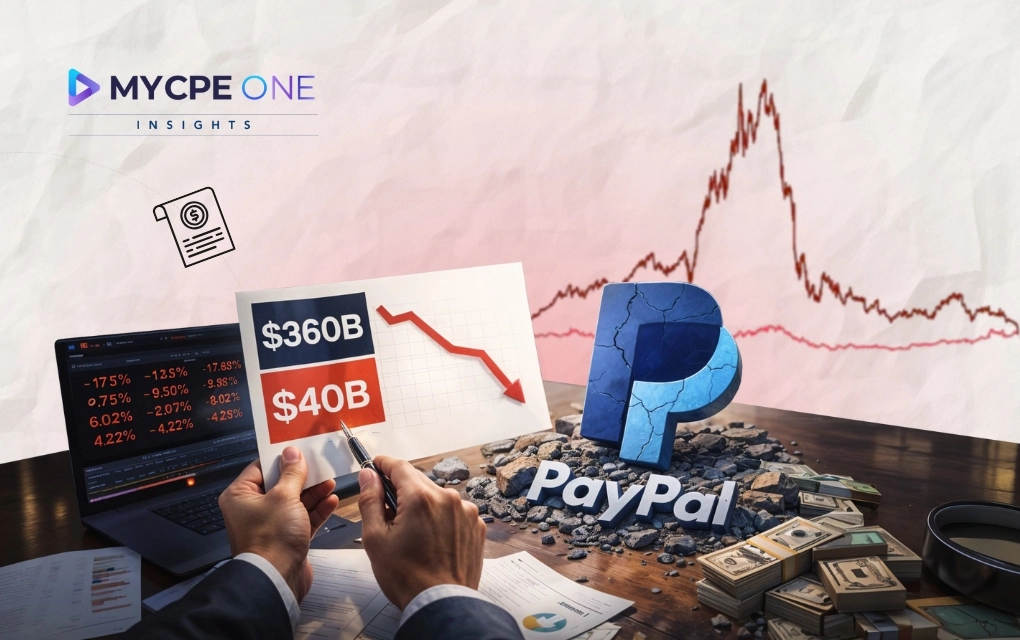
PayPal's market cap fell significantly, from $360 billion in 2021 to $40 billion in 2026, amid underperforming earnings reports, increasing competition and a slowdown in growth post-pandemic. PayPal's leadership is hoping to pivot toward artificial intelligence and agentic commerce to improve profitability and stay ahead of competitors like Apple Pay and Google Pay.
Remember when PayPal was the shining star of the fintech world? In 2021, it was riding high, with a market cap of around $360 billion, outpacing its former parent eBay. Fast forward to February 2026, and PayPal’s market cap has plummeted to just $40 billion, trailing eBay's $42 billion. Ouch. So, what went wrong for this fintech giant, and what’s next for PayPal?
If you were holding PayPal shares, the past year was likely a rough ride. The company’s recent fourth-quarter earnings report missed Wall Street’s expectations; revenue hit $8.68 billion, falling short of the projected $8.8 billion. Earnings per share came in at $1.23, while analysts were expecting $1.28. The stock responded accordingly, dropping a painful 17% in a single day. For investors, this isn’t just a blip; it’s a sign that PayPal is facing serious struggles after its post-pandemic peak. The decline from the $360 billion market value in 2021 to today’s $40 billion isn't just about a poor quarter or two. It’s a mix of underwhelming growth, fierce competition, and leadership changes that have left PayPal’s future uncertain. For comparison, PayPal’s stock has dropped 85% over the past five years, marking a stark contrast to its pandemic-driven surge.
Source: Forbes
At its peak, PayPal was the undisputed leader in the digital payments space, benefiting massively from the pandemic-driven e-commerce boom. But as the world returned to normal, PayPal’s growth slowed dramatically. Its total payment volume (TPV) growth, a key metric, dropped from double digits to low single digits. The company’s core payment services, including its iconic branded checkout button, saw only a 1% increase in TPV; hardly impressive when the overall e-commerce market grew at a steady clip. This slowdown in growth has been exacerbated by some tough competition.
Apple Pay, Stripe, Zelle, and others have chipped away at PayPal’s dominance in peer-to-peer (P2P) payments, with Zelle even surpassing Venmo in volume. PayPal’s market share in the P2P space has slipped significantly, as users increasingly choose alternatives like Apple Pay and Shop Pay, which offer faster, more seamless checkout experiences.
The shake-up at the top hasn’t helped matters. CEO Alex Chriss, who took the reins in late 2023, didn’t manage to turn things around, and now PayPal is searching for a new direction. His departure, after only two years, was followed by a sharp drop in stock price. Enter Enrique Lores, the new CEO and former HP leader. His experience turning HP into an AI-forward company might help PayPal pivot to new growth areas like artificial intelligence and agentic commerce. But there’s no guarantee that these new strategies will be enough to turn the tide in the short term. PayPal’s leadership has long been plagued by uncertainty and mixed signals. Under former CEO Dan Schulman, the company made a series of acquisitions (Honey, iZettle, Hyperwallet) that promised growth but haven't fully paid off. And while Lores might have a fresh perspective, PayPal's track record in execution makes investors nervous.
Competition is arguably PayPal’s biggest challenge right now. With tech giants like Apple and Alphabet pushing deeper into the payment space, PayPal’s competitive advantage in the checkout process has eroded. Apple Pay’s easy integration with iPhones and Google Pay’s global presence are formidable rivals that PayPal has struggled to match. In fact, Stripe, a competitor that focuses more on the developer market, has outpaced PayPal in terms of growth, with a 38% increase in TPV compared to PayPal’s 10%. Despite these challenges, PayPal does have a strong brand and large scale, which keeps it in the game. But even with a loyal customer base, PayPal's branded checkout service is becoming less of a must-have for merchants and consumers, especially when alternatives are offering better features and simpler integration.
Looking forward, PayPal is banking heavily on its push into artificial intelligence and agentic commerce, essentially, using AI to guide shoppers through the entire buying journey from search to payment. The idea is that with AI, PayPal can create a more seamless and personalized shopping experience. But this strategy is far from a sure thing. The market for AI-driven commerce is still nascent, and PayPal’s success in this space is by no means guaranteed. PayPal’s leadership team is pinning its hopes on these innovations to regain relevance. But the real question remains: Can AI and other futuristic initiatives be enough to counterbalance the erosion of its core business?
PayPal’s dramatic fall from grace is a tough pill to swallow, but does it mean the company is done for? Not necessarily. With its strong customer base and ongoing efforts to innovate, PayPal still holds value, especially if its AI and agentic commerce plans pay off. However, the road to recovery is likely to be long, and investors need to be cautious before betting on a quick turnaround. For now, PayPal is in a bit of a holding pattern. It’s a company caught between its past dominance in digital payments and the rapidly evolving future of AI-powered commerce. While its stock may be trading at a significantly depressed value, there are better opportunities for investors in the fintech space if you’re looking for quicker growth. It’s hard to see PayPal as the juggernaut it once was, but for those willing to wait for its pivot into AI and other new ventures, there could be a payoff down the line. Just don’t expect it to happen overnight.
Click here to get your CPE Credit.
Until next time…
Don’t forget to share this story on LinkedIn, X and Facebook
Subscribe now for $199 and get unlimited access to MYCPE ONE, from CPE credits to insights Magazine
📢MYCPE ONE Insights has a newsletter on LinkedIn as well! If you want the sharpest analysis of all accounting and finance news without the jargon, Insights is the place to be! Click Here to Join
You’ve reached the 3 free-content piece limit. Unlock unlimited access to all News & CPE resources.
Subscribe Today.
Already have an account?
Sign In